D3 · Publication Volume 19
Grade-Control Sampling
blast holes, face and channel samples, support and bias
Learning objectives
By the end of this lesson, the learner should be able to define the decision and support represented by a grade-control sample; compare blast-hole, face, channel and dedicated control-drilling evidence; identify contamination, segregation, recovery and delimitation risks; design field and laboratory quality controls; and decide whether turnaround speed is compatible with data validity.
Grade-control sampling estimates properties of material at a scale and time relevant to an operational decision. It does not simply produce more assays. The sampling target may be an in-situ interval, a face channel, cuttings from a drilled volume, broken material on a belt or a stockpile increment. Each has a different relationship to the parcel eventually mined or processed.
Define the lot, increment, sample and decision
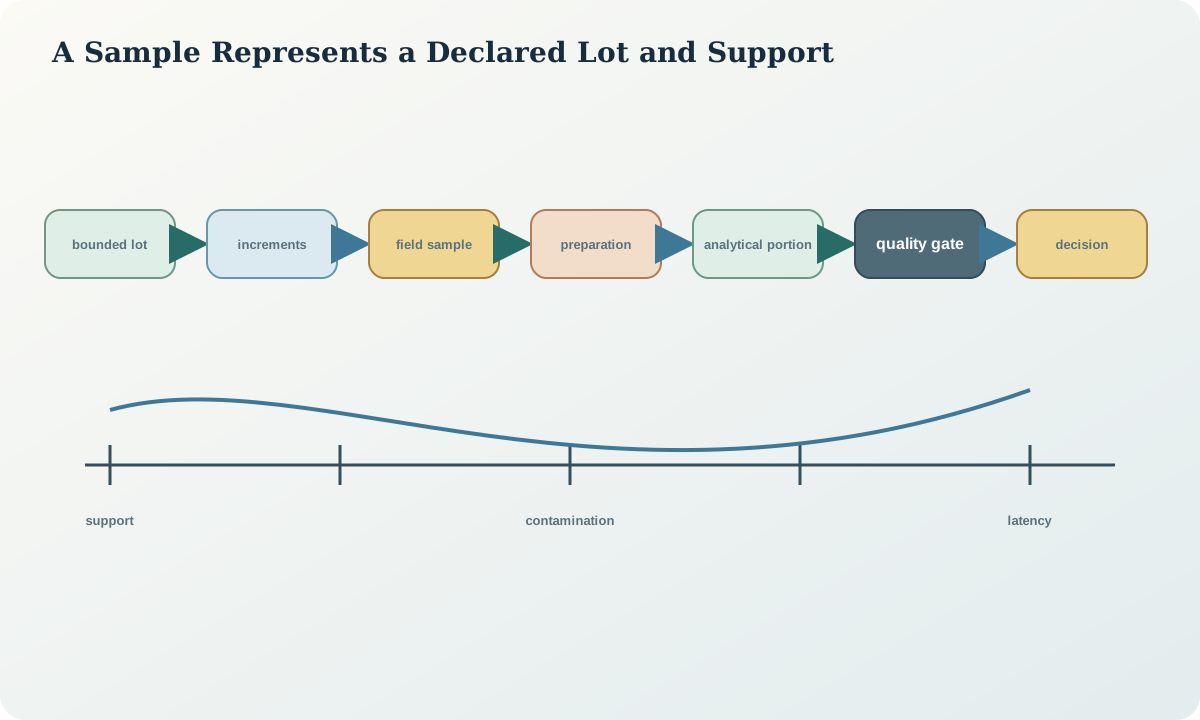
Start with the lot: the bounded material about which a decision is required. An increment is one physical extraction from that lot. The field sample combines one or more increments. Preparation reduces it through drying, crushing, splitting or pulverising, and the analytical portion is a small final mass. Trace every reduction step.
State whether the decision is boundary placement, destination assignment, blend control, domain update or model validation. A sample adequate for recognising a contact may not estimate parcel mean grade. A composite adequate for feed control may erase the local contrast needed for an ore–waste boundary.
Blast-hole evidence
Blast holes provide dense, timely information but are drilled primarily for fragmentation geometry rather than sampling. Their diameter, inclination, depth, subdrill, water condition and cuttings return affect support. Cuttings may mix vertically, segregate by size or density, lose fines, receive contamination from the collar pad or neighbouring holes, or be incompletely recovered.
The sampling protocol should define collection interval, capture device, mass, splitting, wet-hole treatment, cleaning, recovery observation and the relationship between hole trace and blast parcel. Do not place an assay at a nominal collar or midpoint without preserving the interval and trajectory it represents. Separate unsampled, no-return and pending states from analytical values below detection.
Face and channel evidence
A channel sample is intended to approximate a continuous strip of declared width, depth and orientation across exposed material. Its support depends on whether the channel is perpendicular to geological variation, whether hard and soft minerals are removed proportionally, whether contact material is included consistently, and whether weathered or contaminated surface material was removed.
Record the start and end coordinates, face plane, channel dimensions, recovery, lithological contacts and sample boundaries. A sketch or oriented image should connect sample intervals to observed geology. Selective chipping of visually interesting material is not a channel sample. If access or safety prevents the planned geometry, record the deviation and reassess the inference.
Dedicated control drilling and mixed data
Dedicated control drilling can be oriented and spaced for geological and grade decisions, but it may have different diameter, recovery, analytical method or support from exploration drilling. Do not merge data merely because analyte names and units match. Use a provenance field for campaign, method, support and status, then compare overlapping populations.
Mixed datasets require bias and precision tests by source type and domain. Paired or nearby samples are useful only when separation and support allow a meaningful comparison. A mean difference can arise from method bias, local heterogeneity or both. Interpret the test with geometry, duplicates and geological context.
Representativity, support and delimitation
Representativity requires correct delimitation, extraction and mass reduction. The sample boundary should be physically or procedurally defined so every part of the target has an appropriate chance of selection. Material outside the target must not enter, and target material must not be systematically lost. The analytical result inherits every earlier error.
Support includes size, shape, orientation and averaging volume. Short-range variability at sample support is normally greater than variability at selective-mining-unit support. Therefore a sample above cut-off is not proof that its surrounding mining unit is ore. Estimation or classification must bridge the supports and quantify uncertainty near the decision boundary.
Quality control across the chain
Field controls test collection and handling; preparation controls test reduction and contamination; analytical controls test accuracy, precision and carry-over. Use blanks, reference materials, field duplicates, coarse duplicates, pulp duplicates, umpire checks or other controls only when each has a defined failure question. A control chart without action thresholds and disposition rules is decoration.
Track custody, identifiers and status transitions. A result should not become available for operational classification until mandatory checks pass. If conditional release is permitted, mark it and define what happens when later validation fails. Preserve original results, re-assays and the rule selecting the reported value.
Turnaround, latency and decision risk
Faster data are valuable only if they arrive before the decision and remain fit for purpose. Decompose turnaround into collection, transport, receipt, preparation, analysis, validation, import, interpretation and release. A timestamp at each transition reveals the actual constraint.
Design a fallback for missing or late results: conservative boundary, alternate destination, isolation stockpile, delayed extraction or explicit uncertainty class. The appropriate response depends on consequence and reversibility. Never convert a pending assay to zero or a historical average solely to complete a colour map.
Synthetic worked example
A synthetic 12 m bench contains six 2 m cuttings intervals per control hole. One wet hole returns only four recognisable increments and its splitter overflow is not recovered. The protocol marks two intervals invalid rather than assigning their neighbouring results. A nearby dry hole and an oriented face channel constrain the contact, while the uncertain sector is assigned to a temporary isolation class.
Duplicate results show acceptable pulp precision but poor field precision in wet holes. The investigation therefore focuses on collection and splitting rather than the analytical instrument. A revised wet-hole capture test is evaluated on the next synthetic blast before its results are eligible to alter the short-term model.
Practice and decision record
For blast-hole, face-channel and dedicated control-drilling methods, define the lot, increment, support, dominant error mechanisms, quality controls and release latency. Draw the reduction chain from several tonnes or cubic metres of target material to the final analytical portion. At every step, ask what can be excluded, added, segregated or mislabeled.
The decision record should include the sampling purpose, spatial and material boundaries, method and deviations, collection status, preparation and analytical methods, quality-control disposition, release time and eligible downstream uses. Explain why one valid assay may still be unfit for parcel classification.
Sources
- Best-practice sampling methods, assay techniques and quality control, documents channel and blast-hole sampling risks and quality-control considerations.
- Poor sampling, grade distribution and financial outcomes, demonstrates how support, error and bias affect ore–waste decisions.
- Mine-waste sampling protocol, provides a public example of lot definition, field sampling, documentation and quality controls.
- Mineral-resource and mineral-reserve estimation best-practice guidelines, connects sample collection, preparation, analysis and reconciliation evidence.