D3 · Publication Volume 19
Stockpiles and Material Tracking
source, destination, blending and inventory
Learning objectives
By the end of this lesson, the learner should be able to model material as state-changing parcels and events; define source, destination and custody identifiers; close a stockpile mass balance; calculate a mass-weighted blend with compatible bases; distinguish book inventory from surveyed inventory; quantify unallocated movement and measurement uncertainty; and design a traceable correction process.
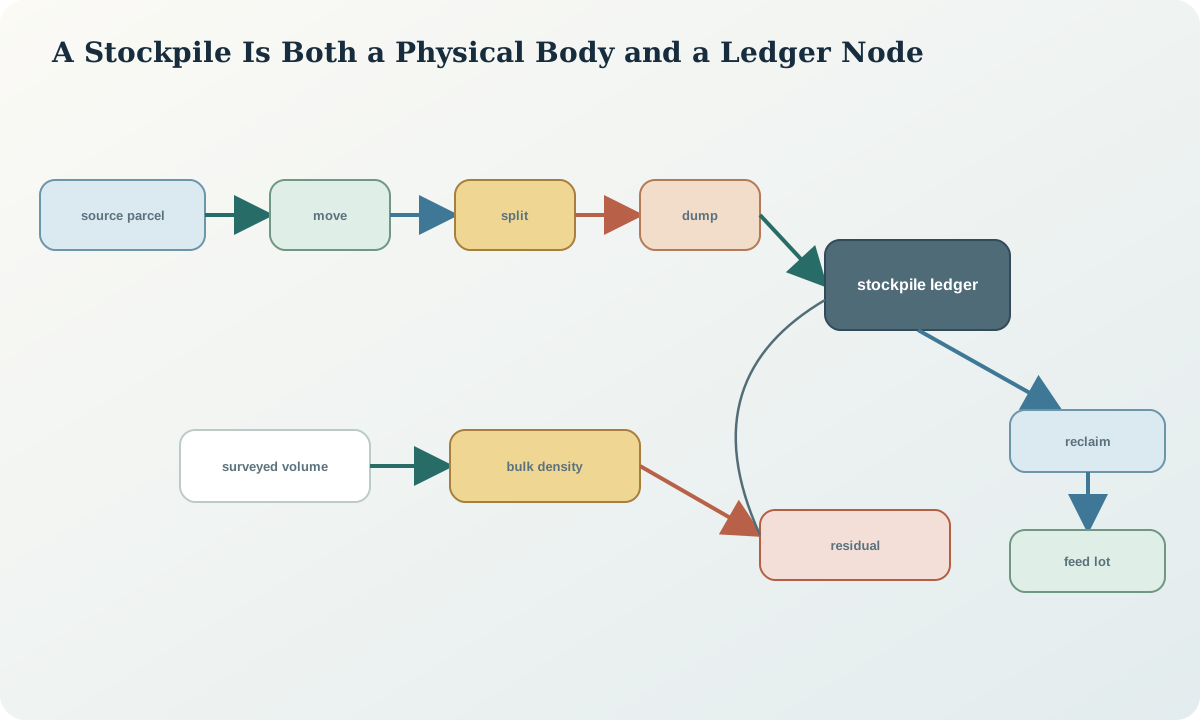
A stockpile is both a physical body and a time-dependent accounting node. Its shape, mass, moisture, grade distribution and recoverability change as material is dumped, spread, compacted, weathered, sampled and reclaimed. A single name and average grade cannot preserve that history. Material tracking must connect what was predicted, moved, measured and later consumed.
Material states and events
Represent the chain as states joined by events. States may include in situ, designed, blasted, available, loaded, hauled, dumped, stockpiled, reclaimed and fed. Events include split, merge, move, reclassify, measure, sample, correct and invalidate. Each event needs a unique identifier, event time, recorded time, source, destination, quantity basis and quality reference.
Avoid changing a parcel's location field in place. A movement should create a new state connected to the former state. This preserves route, residence time and the possibility of partial movement. If one load contains two source classes, record a split or mixed-source allocation rather than choosing the dominant class without disclosure.
Identity, lineage and spatial control
Use stable identifiers for source polygons or solids, blasts or extraction units, loads or batches, stockpile zones, surveys and feed lots. Human-readable labels may change; stable identifiers should not. Parent–child relations describe splits and blends. A correction references the record it replaces and states why.
Location must include a coordinate reference or controlled destination code. A stockpile name is insufficient when several pads, lifts or reclaim zones exist. Record dump position or zone when spatial grade segregation matters. Preserve the operational instruction and model version active at the source event.
Mass ledger and period balance
For a stockpile over a bounded period,
M_{\mathrm{close}}=M_{\mathrm{open}}+\sum M_{\mathrm{dump}}-\sum M_{\mathrm{reclaim}}-M_{\mathrm{known\ loss}}+R.
Every term must use the same dry or wet basis. If a load is measured wet, convert with declared moisture w using M_{\mathrm{dry}}=M_{\mathrm{wet}}(1-w) when w is a wet-basis mass fraction. Do not apply a period-average moisture to all loads without testing whether source and weather conditions differ.
The residual R contains unrecorded movement, measurement differences, timing mismatch and model error. Track unallocated events separately from measured residuals. An identifier error should be corrected at event level, not absorbed into a stockpile adjustment.
Quality ledger and blending
Contained quantity entering a pile is Q_{\mathrm{in}}=\sum M_i g_i on compatible bases. A simple book grade at close is
g_{\mathrm{book,close}}=\frac{Q_{\mathrm{open}}+Q_{\mathrm{in}}-Q_{\mathrm{out}}}{M_{\mathrm{book,close}}}.
This assumes reclaimed quality is known and mixing is represented appropriately. First-in-first-out, last-in-first-out or perfect mixing are allocation models, not observations. Real piles may segregate by particle size, density, mineralogy, moisture or dump sequence. State the reclaim model and test it against samples or spatial records.
Blend targets should include mass, quality range, harmful or beneficial properties and uncertainty. A target mean alone can conceal local excursions or incompatible material. Preserve component contributions so a later feed anomaly can be traced back through the blend.
Surveyed inventory
Surveyed volume requires a base surface, current surface, boundary and treatment of inaccessible faces, voids and overlap. The same top surface can yield different volumes under different bases. Record survey time, coverage, resolution, coordinate reference, processing method and uncertainty. A volume becomes mass only through a density model appropriate to the pile state.
Broken bulk density may vary with fragmentation, compaction, moisture and lift. Do not reuse in-situ density automatically. Use measurements or bounded scenarios, and distinguish bulk volume from solid volume. Compare surveyed and book inventory only after aligning the exact timestamp and all movements before and after survey capture.
Stockpile sampling and grade uncertainty
Surface grabs rarely represent a heterogeneous three-dimensional pile. A sampling plan should define the lot, increment geometry, access, particle-size distribution, segregation risk and reclaim mechanism. Belt or stream sampling during construction or reclaim may better represent flow, while drilling or trenches may be needed for an existing pile; each method has limits and safety constraints.
Keep book grade, sampled grade and reconciled grade as separate estimates. If a new campaign updates pile quality, do not overwrite historical inputs. Record the estimation method, support and effective time. Where spatial segregation matters, maintain zones or layers rather than one average.
Controls, exceptions and visual ledger
Automated controls should reject duplicate event identifiers, impossible source–destination pairs, negative mass, moves after parcel closure, incompatible units and timestamps outside an open period. Alerts should identify missing source, missing destination, unvalidated quality, late entry and stockpile capacity conflicts. Manual corrections need reason, evidence and supersession links.
Visualise the ledger as a directed network with node balances. Line thickness can represent mass, colour can represent material class, and uncertainty can be shown separately. A Sankey-style diagram is useful for completeness but must not imply measurement precision that the records lack.
Reconciliation and corrective action
Reconcile event-derived inventory, survey-derived inventory and sampled or allocated quality as separate estimates. First align their cut-off times and bases; then show pairwise differences with uncertainty. A closing adjustment may be justified by a controlled stocktake, but it should be posted as a measured correction with provenance, not distributed backwards across source loads to make every period agree.
Investigate residuals through event completeness, timing, survey surfaces, bulk density, moisture, reclaim allocation and sampling support. Correct the earliest demonstrably wrong record and allow dependent balances to recalculate. If no branch is supported, retain an unresolved residual and define the observation needed to test it.
Synthetic worked example and practice
Synthetic stockpile SP-03 opens with 4,800 dry tonnes. Movement records add 3,100 tonnes and reclaim 2,600 tonnes. A survey aligned to the cut-off estimates 5,500 dry tonnes under the central bulk-density case, matching the book balance at 5,300 tonnes only within a broad density interval. Two duplicate truck identifiers account for 90 tonnes of apparent inflow; one late 120-tonne dump belongs after the survey cut-off.
After event correction and time alignment, the book balance becomes 5,090 tonnes and the survey range remains 5,050–5,950 tonnes. The review reports no proved physical gain or loss. Construct the event graph, calculate book mass and grade, test two reclaim-allocation rules, and identify which additional observation would most reduce the closing contained-quantity uncertainty.
Sources
- Reconciliation along the mining value chain, identifies stockpiles, inventories, movement paths and measuring points as essential reconciliation controls.
- Guidelines for compliance at non-coal mines, provides a public example of stockpile survey and production-record expectations.
- Provenance data model, supplies technology-independent concepts for entities, activities, derivations and invalidations.
- Guidelines for evaluating and expressing measurement uncertainty, supports explicit component uncertainty and reporting for derived inventories.