C2 · Publication Volume 12
Target Concepts and Target Models
target criteria, scale, and necessary versus supporting evidence
Learning goals
After this lesson, you should be able to distinguish a deposit model from a target concept and a target model, translate mineral-system processes into scale-aware criteria, separate necessary from supporting evidence, and show how dependence or an adequately tested missing condition changes a target assessment.
A target is not an anomaly selected for its visual prominence. It is a spatially and temporally bounded hypothesis that a specified geological object or process can be tested by an available observation. A target concept explains why a sought system could exist and what evidence should survive. A target model applies that concept to a particular interpreted geometry, depth range, footprint and uncertainty envelope.
From deposit model to target concept
A deposit model organises recurring geological attributes and genetic interpretations. It may describe host rocks, age, tectonic setting, alteration, mineralogy, geometry and grade-tonnage characteristics. Used properly, it is a compact comparison set. Used mechanically, it encourages learners to count similarities while ignoring scale, timing and contradictions.
A target concept begins with processes rather than labels. It states a source of material, an energy or transport driver, pathways, focusing mechanisms, traps, preservation and expected footprints. It also names alternatives that could produce similar observations. The concept is portable across a region only where its process requirements remain geologically plausible.
A target model localises the concept. It specifies the interpreted object, coordinates, depth or elevation interval, dimensions, orientation, cover, predicted physical and chemical contrasts, uncertainty envelope and the next observation. Multiple target models may implement the same concept with different geometry. Conversely, one anomaly may be tested under several competing concepts.
Necessary, supporting, ambiguous and refuting criteria
A necessary criterion must be present for the stated hypothesis, though it may not be directly observable. Absence can refute the hypothesis only when detection adequacy is established. A supporting criterion is expected more often under the hypothesis than under alternatives but can be absent or produced by other causes. An ambiguous criterion has similar likelihood under several hypotheses. A refuting criterion is an observation whose likelihood is very low under the hypothesis and appreciably higher under an alternative.
Do not convert “commonly associated” into “necessary.” A regional fault may support a pathway model without being the local conduit. An alteration mineral may support fluid–rock interaction without identifying the fluid source. A geophysical anomaly may reveal physical contrast without establishing mineralisation. Criteria should be propositions with a scale and test, not thematic-layer names.
Logical gates and weighted evidence serve different purposes. A gate protects a necessary condition from being compensated by unrelated favourable scores. Weighted evidence compares degrees of support after the gates are satisfied. Every gate needs an indeterminate state, because missing or inadequate observations are not equivalent to absence.
Scale, footprint and observation model
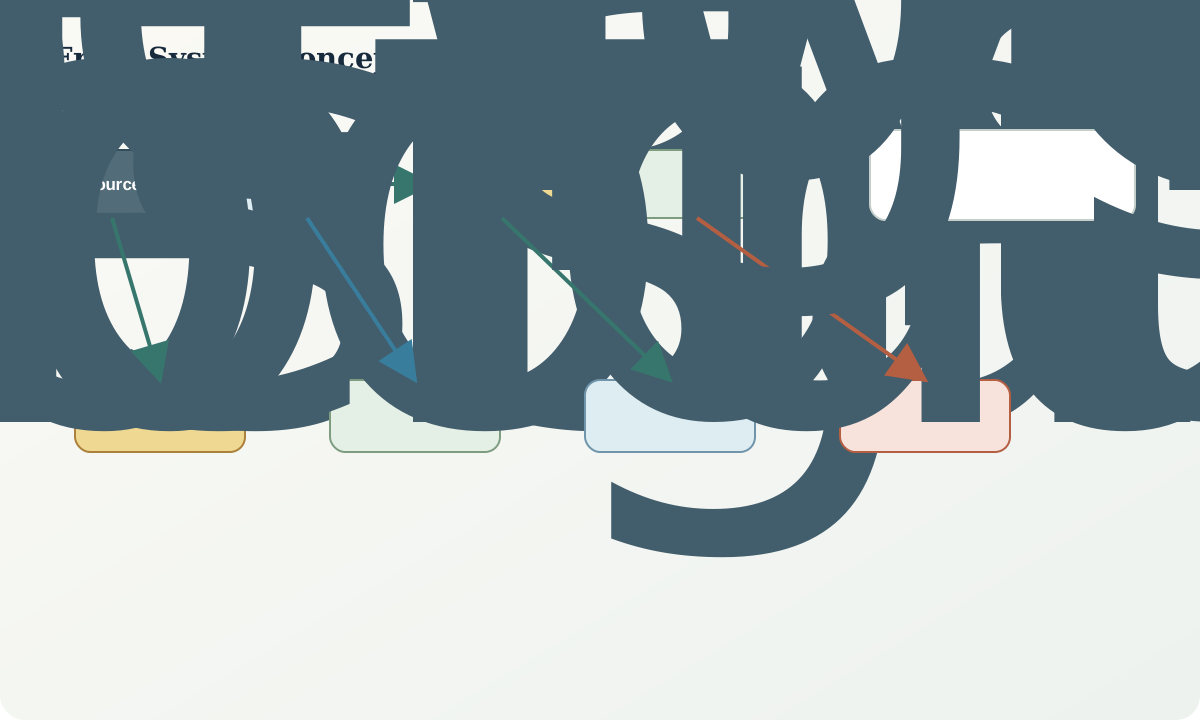
The causal process, geological footprint and measured response may occupy different scales. A deep source can be regionally extensive, a focusing structure narrow, an alteration halo broad and the sought mineralised body discontinuous. A sample records only its support; an interpolated raster adds a model of space rather than new observations.
For each criterion, state the observation model: what physical object is measured, by which method, over what support, with what resolution and detection limit, and how the result is transformed. The same buried conductor could arise from sulfides, graphite, saline groundwater, clay or infrastructure. Discrimination requires independent geological observations, not simply a second transformation of the same signal.
Scale incompatibility is a common failure. A regional lineament derived from coarse data may not predict a metre-scale conduit. A narrow geochemical sample may not represent a broad transported catchment. A high-resolution image cannot recover information removed by deep cover. Every criterion should include the range of footprint sizes it can realistically detect.
Criteria matrix and target-model record
A criteria matrix places hypotheses in columns and observations in rows. Cells contain the predicted state, direction, scale, detection requirement and likelihood or qualitative discrimination. Add columns for actual result, quality status, dependence group and interpretation. This reveals criteria that appear numerous but are all derived from one underlying source.
The target-model record should include: immutable target identifier; concept version; geometry and uncertainty envelope; geological domain; predicted depth and footprint; necessary gates; evidence table; alternatives; data gaps; planned test; stop or revise rule; and links to every source object. Keep the target name neutral and stable when its interpretation changes.
Version criteria before applying them. If distance thresholds, anomaly cut-offs or weights are tuned after viewing known occurrences, record the tuning and evaluate performance on spatially independent evidence. Otherwise the model describes hindsight rather than prospective discrimination.
Worked synthetic example
A fictional target compares a coherent-system hypothesis H_1 with a non-system alternative H_0. Prior probability for H_1 is 0.25, so prior odds are 0.25/0.75=0.333. Three observations have teaching likelihood ratios in favour of H_1: compatible source domain, 2.0; interpreted conduit, 3.0; and alteration footprint, 1.5.
Naively treating all three as independent gives posterior odds 0.333(2)(3)(1.5)=3.0, or probability 0.75. The conduit and alteration maps, however, were derived partly from the same physical survey and are dependent. An audited joint likelihood ratio of 3.5 replaces their product of 4.5. Posterior odds become 0.333(2)(3.5)=2.333, or probability 0.70. The difference is not huge here, but duplicated evidence can dominate larger models.
The concept also requires a reactive trap. A suitable method had 90% probability of detecting that trap if present. The observed result is absence; teaching likelihoods are P(E^-\mid H_1)=0.10 and P(E^-\mid H_0)=0.80, giving a ratio of 0.125. Updated odds become 2.333(0.125)=0.292, or probability about 0.226. Strong supporting evidence cannot compensate for an adequately tested missing necessary condition. The correct action is to revise or reject this target model, while another concept not requiring that trap may remain viable.
Interpretation workflow
- Define the geological system and the decision scale.
- Express source, driver, pathway, focusing, trap and preservation as propositions.
- Generate at least one non-mineralising explanation for each predicted footprint.
- Classify criteria as necessary, supporting, ambiguous or refuting.
- Specify scale, support, resolution, detection limit and uncertainty for every criterion.
- Group criteria that share source data or causal processes.
- Apply necessary gates with present, absent and indeterminate states.
- Combine remaining evidence transparently and test dependence sensitivity.
- Build alternative target geometries where location or depth is uncertain.
- Predeclare the next test and the conditions for revision or retirement.
Practice and review
- Convert a generic “near a fault” criterion into a process proposition with scale and detection requirements.
- Give three non-mineralising causes of a conductive anomaly and one observation that discriminates each.
- Recalculate the synthetic posterior if the joint conduit–alteration likelihood ratio is 2.0.
- Explain why a necessary geological process may lack one specific observable footprint.
- Draft a target record that contains two geometries for the same process concept.
Sources and further reading
- Translating the mineral systems approach into an effective exploration targeting system, distinguishes processes, targeting elements and scale.
- Australian Proterozoic mineral systems: essential ingredients and mappable criteria, develops source, transport, trap and preservation reasoning.
- Mineral Deposit Models, Bulletin 1693, illustrates descriptive and genetic model structure.
- Applying spatial prospectivity mapping to exploration targeting, discusses practical limitations of model inputs and target outputs.