D5 · Publication Volume 21
From Ore to Product
mineralogy, liberation, concentration and product specifications
Learning objectives
By the end of this lesson, the learner should be able to describe ore as a mineralogical and textural feed rather than an assay alone; distinguish liberation, exposure, concentration and extraction; build a defensible ore-to-product hypothesis; identify product and residue streams; calculate simple mass pull, grade and recovery; recognise where product specifications constrain a flowsheet; and state what evidence is needed before a pathway can advance.
Frame the transformation question
Begin with a decision contract: what material, what potential products, what decision stage and what confidence are in scope? A reconnaissance question may ask whether valuable minerals can plausibly be separated. A later question may ask whether a specified product can be made across the expected feed range. These are not interchangeable. Record the spatial and temporal support of the feed, potential mining dilution, moisture basis, expected throughput range, downstream boundary and residues that must be characterised.
An ore-to-product hypothesis is a chain of conditional statements. If the valuable component occurs mainly in mineral A, if grains of A can be sufficiently exposed at a practicable size, and if A has a property contrast from the gangue, then a separation route may enrich it. If the component is finely locked or substituted in a lattice, direct concentration may be weak and chemical extraction may be investigated. Each “if” becomes a test; none is filled by commodity tradition alone.
Mineral identity, deportment and association
Bulk elemental grade says how much of an element is present, but not which phases contain it. Deportment allocates the element among minerals or chemical hosts. Modal mineralogy estimates proportions of phases. Texture describes grain size, shape, intergrowth, replacement, rims, fractures and spatial associations. Together these determine whether a component can be exposed, whether gangue follows it, and which impurities may enter product or solution.
Distinguish a valuable mineral from a payable component. One mineral may contain several potentially payable components; the same element may occur in recoverable and unrecoverable hosts. An impurity may reside in the valuable mineral lattice, as an attached inclusion, in a separate gangue phase or on a weathered surface. Those occurrences respond differently to grinding, separation and leaching. The mineralogical method, detection limits, stereological assumptions and unclassified fraction must accompany every conclusion.
Liberation, exposure and accessibility
Liberation is not a single property of “the ore.” It is a distribution over particles, size classes, phases and association types. A liberated particle may consist predominantly of one mineral, while an exposed valuable grain may still share a composite particle but contact the particle surface. Surface exposure can be enough for some reactions or surface-based separations even when volumetric liberation is incomplete. Chemical accessibility also depends on connected pores, fractures, coatings and reaction products.
Reducing size may increase liberation and surface area, but it can also create slimes, change surface chemistry, increase energy demand and make solid–liquid separation harder. The target is not maximum liberation at any cost. It is an adequate distribution for the next operation and final product, with acceptable losses, energy, water, reagents and residue behaviour. Report liberation by size and mineral, not as an unexplained average.
Concentration, extraction and product pathways
Concentration separates particles or phases using contrasts such as density, magnetic response, electrical or optical response, surface wettability or size. Extraction transfers a component from a solid into another phase, often a solution or molten phase, followed by purification and recovery. A flowsheet may combine both: preconcentration rejects barren material, grinding exposes minerals, flotation makes a concentrate, and downstream metallurgy recovers a refined product.
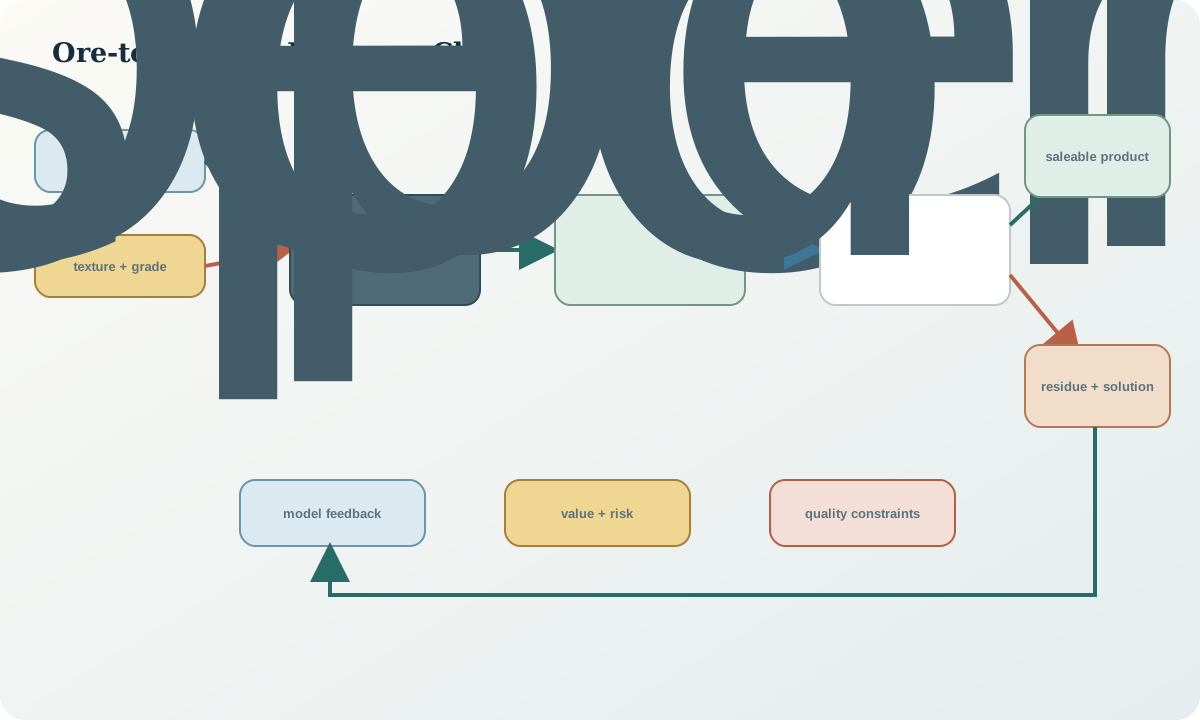
Draw the complete boundary. Include feed preparation, recycles, intermediate inventories, concentrate or product, tailings, residues, solution bleed, water and reagent additions. A stream excluded from the drawing cannot be accounted for. Identify which outputs are saleable, internally recycled, stored, treated or discharged. Product names should describe measurable properties and contractual state, not imply that material is accepted before specifications are checked.
Quantitative measures of separation
For a feed mass F with grade f, a concentrate C with grade c, and tailings T with grade t, dry-mass and component balances are
$F=C+T$
$Ff=Cc+Tt.$
Mass pull to concentrate is Y=C/F. Component recovery is R=Cc/(Ff). Enrichment ratio is c/f. These metrics answer different questions. High recovery can occur with excessive mass pull and low concentrate grade; high enrichment can occur while most component is lost. Quote them together with uncertainty and the product-quality requirements.
For a two-product balance, the calculated mass pull from assays is Y=(f-t)/(c-t) when all grades use the same component and basis. This relation is diagnostically useful, not a replacement for measured mass. If the calculated value lies outside [0,1], or strongly contradicts measured mass pull, investigate sampling, moisture, assay, stream timing, inventory and model assumptions before reporting recovery.
Product specifications and downstream acceptance
A product specification can include target grade, maximum impurities, moisture, particle-size distribution, mineral form, physical handling properties and variability limits. Downstream recovery may depend on mineralogy even when elemental grade passes. Some components earn credit only above a payable threshold; others attract treatment charges, penalties or rejection. These terms are time-dependent external inputs and must be dated, sourced and scenario-tested.
Do not optimise one element independently. Raising valuable-mineral recovery can also raise an impurity or reduce product grade. Fine grinding may improve liberation but worsen filtration and moisture. Blending may meet an average limit while short-period excursions remain unacceptable. The decision object is therefore a distribution of product and residue properties through time, not one composite assay.
Build an evidence-led flowsheet hypothesis
Start with feed mineralogy and likely variability. List candidate property contrasts, required size or exposure, plausible unit operations, expected intermediate streams and failure mechanisms. For each operation, state its input requirement, response metric, product requirement and test. Arrange low-cost discriminating tests before expensive integrated work. Preserve rejected pathways and reasons so later mineralogical evidence can reopen them if appropriate.
At each gate ask whether the sample represents the decision population, whether response is reproducible, whether the pathway handles adverse domains, whether products have a credible destination, and whether wastes and solutions have been characterised. A flowsheet remains a hypothesis until integrated and variability evidence supports its operating window. Analogy can identify questions; it cannot supply project recovery.
Uncertainty and common failure modes
Common failures include treating head assay as mineralogy, analysing only average-grade composites, ignoring the unclassified mineral fraction, quoting liberation without size basis, assuming laboratory product is commercially acceptable, omitting recycles or moisture, and selecting a route before identifying impurity hosts. Another failure is “recovery borrowing”: copying a recovery from unrelated material and presenting it as measured or expected performance.
Separate natural variability from knowledge uncertainty. Spatial changes in texture are variability; sparse mineralogical sampling creates uncertainty about that variability. Method bias, preparation alteration and two-dimensional section effects add measurement uncertainty. Record alternative hypotheses—for example lattice-bound impurity versus removable inclusion—and design observations that discriminate between them.
Interfaces and transferable data
Geology should pass material identity, coordinates, interval support, lithology, alteration, oxidation, structure, assays, density, mineralogy, texture and confidence. Processing should return tested mass, preparation history, size distribution, response variables, product quality, residues, method conditions and uncertainty. The interface should not write a scalar recovery into every block without a model, applicability domain and version.
Use persistent sample and parent-child identifiers so a test aliquot traces back through compositing and preparation to source intervals. Store raw stream measurements separately from balanced values. A domain code without definition, effective date and evidence is only a label. A product assumption must identify the specification version and whether acceptance is observed, quoted, inferred or hypothetical.
Integration checkpoint
Before advancing, verify that mineral hosts, particle-scale exposure, stream balances, product requirements and residue destinations form one consistent chain. If any link depends on an analogy or an untested assumption, mark it conditional and assign a discriminating test. The checkpoint passes only when another reader can trace every claimed outcome back to material and method.
Synthetic worked example
A synthetic 1,000 kg dry composite contains 1.20% component X. Mineral observations suggest that 85% of X occurs in target mineral A, 10% in fine inclusions within gangue and 5% in an uncertain host. A preliminary separation makes 80 kg concentrate grading 10.5% X. The contained X in feed is 12.0 kg and in concentrate is 8.4 kg, so mass pull is 8.0%, recovery is 70.0% and enrichment ratio is 8.75.
The result does not mean that the remaining 30% is simply “unliberated A.” Tailings mineralogy must distinguish liberated losses, composite losses and other hosts. The concentrate also contains a synthetic impurity near a provisional acceptance limit. The decision is to retain the route for variability testing, add size-by-mineral deportment and impurity-host analysis, and avoid assigning 70% recovery to the block model. Every number in this example is invented for instruction.
Conceptual figure
Practice and decision record
For a synthetic feed, list three minerals that host one valuable component and one deleterious component. Propose two contrasting pathways, calculate mass pull and recovery for one two-product test, and identify a measurement that could overturn the preferred route. Then write a decision record stating scope, material support, evidence, alternative hypotheses, product assumptions, residues, unresolved risks, next test and approval boundary.
The record fails if it uses a real operation without authorised evidence, treats an assay as a mineral phase, omits tailings or solution streams, reports a product without specifications, or turns a preliminary composite result into a universal recovery factor.
Sources
- Practice Guidelines for Mineral Processing, 2022, sample, process, product and variability guidance.
- Global critical mineral production and the boundaries of mining and processing, public overview of extraction and processing boundaries.
- Geometallurgy as a route to resilient mine operations, peer-reviewed synthesis of mineralogical variability, process response and value.