D5 · Publication Volume 21
Flotation
surface chemistry, reagents, recovery and selectivity
Learning objectives
By the end of this lesson, the learner should be able to explain flotation as coupled surface chemistry, particle–bubble interaction and froth transport; distinguish true flotation from entrainment; relate size, liberation and oxidation to response; interpret grade–recovery and kinetic curves; calculate first-order response cautiously; design reagent and condition tests; and identify why a high single-test recovery is not sufficient flowsheet evidence.
Define the separation mechanism
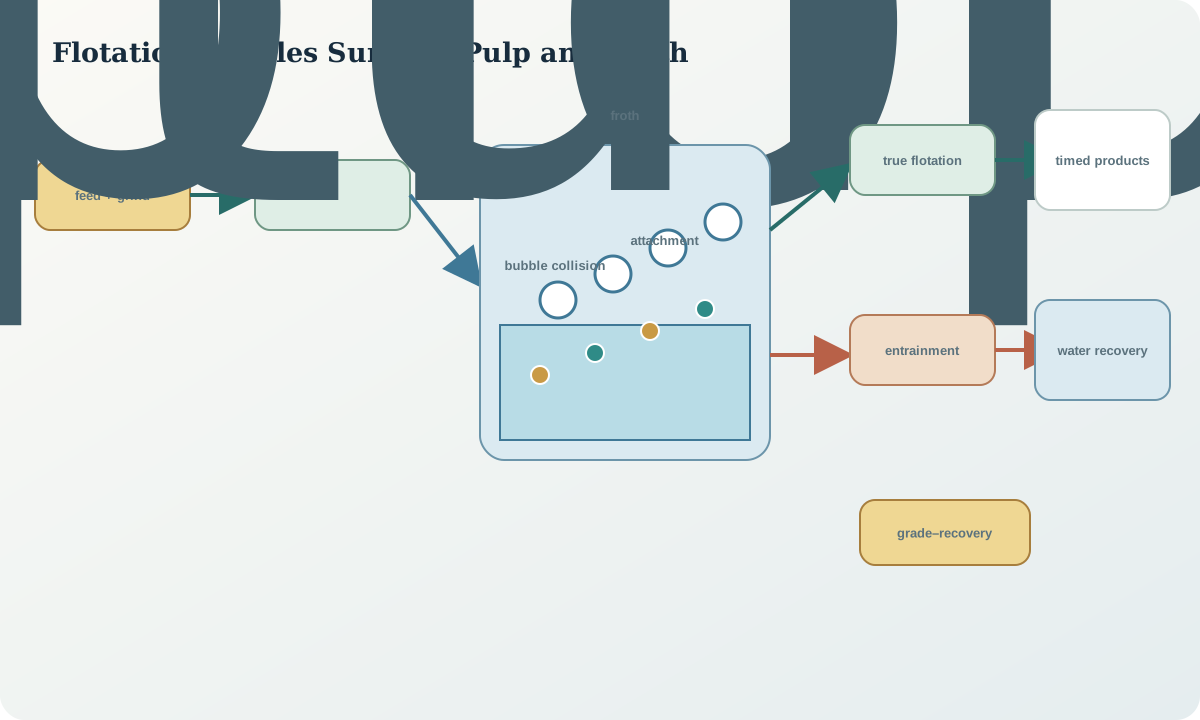
Flotation separates particles by differences in surface wettability. Hydrophobic particles can collide and attach to bubbles, rise into a froth and survive transport to a product. Hydrophilic particles tend to remain in pulp, but fine gangue can still enter froth with water. The observed product therefore combines collision, attachment, detachment, entrainment, froth recovery and drainage. Each mechanism responds to different variables.
Write the objective in mineral terms: recover a target mineral or component while limiting specified gangue and impurities, at an acceptable mass pull, product grade, time and operating range. Elemental recovery alone may hide recovery of the wrong mineral host. Define feed size, liberation, water chemistry, pulp density, temperature, gas and mixing conditions, reagent sequence and froth collection method.
Surface condition and reagent roles
Mineral surfaces acquire charge and chemical species through dissolution, adsorption, oxidation and interaction with water. pH and ionic composition influence these processes. Collectors increase hydrophobic response selectively when conditions permit. Frothers influence bubble size and froth stability. Modifiers may activate, depress, disperse or control chemistry. These functional labels do not guarantee one mechanism or effect across all minerals.
Reagent response depends on dose per appropriate basis, addition point, conditioning time, concentration, order and water composition. More collector can raise target recovery while also floating gangue. Excessively persistent froth can increase entrainment or make product handling difficult. Treat reagent schemes as controlled hypotheses and record actual additions and conditions, not only nominal recipes.
Particle size, liberation and association
Coarse particles may collide with bubbles but detach because weight and turbulence exceed attachment strength. Very fine particles may follow fluid streamlines, collide less efficiently, consume reagent through large surface area and enter froth by entrainment. Intermediate sizes often respond best, but the range is mineral- and condition-specific. Report size-by-size recovery and water recovery rather than assuming one universal optimum.
Liberated target particles, target-rich composites and gangue-rich composites have different floatability and product effects. Regrinding an intermediate can expose target surfaces, but it can also create fines and fresh reactive surfaces. Surface coatings, oxidation and clays can suppress or nonselectively alter response. Mineralogy before and after each stage is needed to distinguish liberation opportunity from chemistry or hydrodynamic limitation.
Collision, attachment and froth transport
Successful true flotation requires a particle to encounter a bubble, drain the intervening liquid film, form a stable attachment and reach the froth. Turbulence can improve collision but also cause detachment. Bubble size, gas rate and mixing change collision area and carrying capacity. In the froth, drainage and coalescence affect selectivity, while excessive solids loading or unstable froth changes recovery.
Entrainment is transport of particles with water into the froth. It often affects fine gangue and can be diagnosed through size, water recovery and mineral behaviour. Washing or froth-depth changes may improve selectivity, but must be tested. Calling all recovered material “floatable” confuses fundamentally different mechanisms and makes model transfer unreliable.
Kinetics and grade–recovery trade-off
A simple first-order model is
$R(t)=R_\infty\left(1-e^{-kt}\right),$
where R_\infty is an asymptotic recovery and k is an apparent rate constant. The model summarises a test under stated conditions; heterogeneous particles often contain multiple rate classes and do not obey one constant. Fit with residuals and uncertainty, and do not extrapolate far beyond collection time.
Collecting longer usually increases cumulative recovery and mass pull while product grade may fall. A grade–recovery curve is more informative than a selected point. Compare curves at consistent feed, conditions and component basis. For multi-stage circuits, roughing, scavenging, cleaning and regrinding redistribute recovery and grade; stage recovery cannot be multiplied blindly when recycles and changing feed compositions exist.
Experimental design and test control
Use representative feed and controlled grinding, aging and water. Establish baseline repeats before testing factors. Vary pH, reagent doses, conditioning, air, mixing, solids and time within safe and relevant ranges. Randomise or block tests where drift matters. Include blanks or reagent-free response when useful, and retain products for mass balance, size and mineralogical analysis.
Factor interactions are common: reagent effect changes with pH, grind or water. One-factor-at-a-time tests can miss them. A structured design can map a response surface, but model form and experimental region must be explicit. Screen fatal flaws before fine optimisation, and validate a selected region with independent repeats and variability samples.
Mass balance and diagnostic products
Measure dry masses or suitable slurry flows, moisture, assays and water. Close total mass and relevant component balances. Collect timed concentrates separately during kinetics tests. Calculate cumulative and incremental grade, recovery and mass pull. Analyse final tailings and selected intermediate products. If closure is poor, do not conceal it by normalising without reporting raw data and the adjustment method.
Use size-by-size and mineral-by-mineral balances to locate losses. A low tailings grade can coexist with material component loss if tailings mass is large. A high concentrate assay can coexist with poor recovery. Report impurity recovery and water recovery alongside target response. Reconciled values should preserve raw measurements and uncertainties.
Uncertainty and common failure modes
Failure modes include stale or oxidised samples, uncontrolled water chemistry, inconsistent grinding, unrecorded reagent concentration, selective froth scraping, incomplete product collection, assay below reporting capability, and tests without mass closure. Another is optimising on target recovery while product grade, impurity, water or residue behaviour fails.
Separate test repeatability, sample variability, method bias and scale-up uncertainty. Laboratory cells differ from continuous circuits in mixing, residence-time distribution, froth transport, recycle and control. A fitted kinetic constant belongs to its apparatus and conditions. Preserve alternative explanations when changes in response could arise from mineralogy, surface state or hydrodynamics.
Interfaces and transferable data
The upstream interface supplies size-by-mineral liberation, surface alteration, water and preparation history. Flotation returns response by mineral, size and stage; reagent and water conditions; kinetics; products and residues; closure and uncertainty. Geological models need response functions or domain evidence, not the name of a reagent regime. Environmental and downstream interfaces need water, reagent and residue composition.
Link every test product to its feed and timed collection. Record method and reagent identities generically by chemical function in teaching data, with actual controlled identifiers in real work. Model attributes distinguish intrinsic mineralogy from test-dependent floatability. Historical plant response must be time-aligned through stockpiles and residence before it trains a geological prediction.
Integration checkpoint
Check mineral and size deportment, true-flotation and entrainment evidence, mass closure, product quality and water response together. A condition is retained only within its tested operating region and only when the apparent improvement survives repeat and variability evidence.
Synthetic worked example
A synthetic test feed contains 1.00% component X. Four timed concentrates give cumulative recoveries of 48%, 67%, 76% and 80% at 1, 3, 7 and 12 time units. Product grade falls from 18% in the first increment to 4% in the last, while water recovery rises. Mineral analysis shows that late target recovery is mostly fine liberated mineral, but late impurity recovery is dominated by entrained fine gangue.
The decision is to test a cleaner and altered froth condition rather than simply extend time. A first-order curve is fitted only as a descriptive comparison, with residuals showing a fast and slow population. Domain South remains separate because oxidation changes surface response. No recovery is assigned beyond the tested material and conditions; all numbers are synthetic.
Conceptual figure
Practice and decision record
Given four synthetic timed products, calculate cumulative mass pull, grade and recovery. Plot or tabulate the grade–recovery path, identify where entrainment could dominate, and propose one test that separates a liberation explanation from a surface-chemistry explanation. Write a decision record with feed state, conditions, closures, response region, uncertainty, product limits and next gate.
The record fails if it quotes recovery without product quality, fits kinetics without time-resolved data, transfers a reagent recipe to another domain without evidence, or hides water and fine-gangue recovery.
Sources
- An overview of optimising strategies for flotation banks, peer-reviewed treatment of kinetics and bank response.
- Size-by-liberation characterisation of a flotation bank, peer-reviewed evidence on liberation, recovery and circuit role.
- Multi-parametric investigation of collector adsorption and mineral flotation, primary research illustrating surface charge, adsorption and conditional selectivity.