D5 · Publication Volume 21
Leaching and Hydrometallurgy
solubility, kinetics, recovery and impurities
Learning objectives
By the end of this lesson, the learner should be able to separate thermodynamic feasibility from kinetic attainability; frame dissolution through mineral hosts, solution chemistry and transport; calculate extraction from solid and solution measurements; distinguish leaching, solution purification and product recovery; interpret apparent kinetic curves cautiously; identify reagent, impurity and residue balances; and define evidence needed before transferring a bottle or column result to a process prediction.
Define the extraction pathway
Leaching transfers selected components from a solid to a solution. Hydrometallurgy then includes solution conditioning, separation, purification, concentration and recovery of products, together with reagent recycle, bleed and residue management. The pathway is not complete at high dissolution. A useful solution must be recoverable and manageable, impurities controlled, reagents supplied, and residues and effluents characterised.
Begin with mineral hosts and desired chemical species. State feed preparation, target extraction, lixiviant function, oxidising or reducing environment, pH or acidity range, temperature, pressure if relevant, solids concentration, contact method, time, solution recycle and downstream product. Keep method selection conditional on mineralogy and safe, site-specific engineering.
Thermodynamic feasibility and speciation
Thermodynamics asks whether a reaction or phase assemblage is favourable at equilibrium under stated conditions. Solution speciation determines which dissolved complexes and solids are stable or predominant. pH, redox potential, ligand concentration, ionic strength, temperature and gas contact can change feasibility. Diagrams and equilibrium calculations are models based on species and data selected by the analyst.
Favourable equilibrium does not establish a useful rate or selectivity. A mineral can be thermodynamically soluble yet protected by slow transport or a passivating layer. An unwanted mineral can consume reagent rapidly. Precipitation downstream can remove the target or impurity unexpectedly. Verify models with solution and solid observations, and document database, activities, excluded species and uncertainty.
Reaction and transport controls
Observed leaching can involve surface reaction, diffusion through fluid films, diffusion through pores or product layers, fracture access, reagent transport and removal of products. Particle size changes area and path length, but mineral texture and connected porosity determine accessible area. Agitation and temperature affect multiple mechanisms. A fitted rate law alone does not prove which mechanism controls.
Use diagnostic experiments that vary particle size, temperature, reagent concentration, agitation and time while preserving comparable material. Analyse residual solids for unreacted hosts, secondary phases and passivation. If a shrinking-particle or empirical model is used, state geometry and assumptions. Report an apparent response region rather than claiming a unique mechanism from a straight line.
Extraction and solution balance
Solid-based extraction of component j can be written
$X_j=1-\frac{M_r g_{r,j}}{M_f g_{f,j}},$
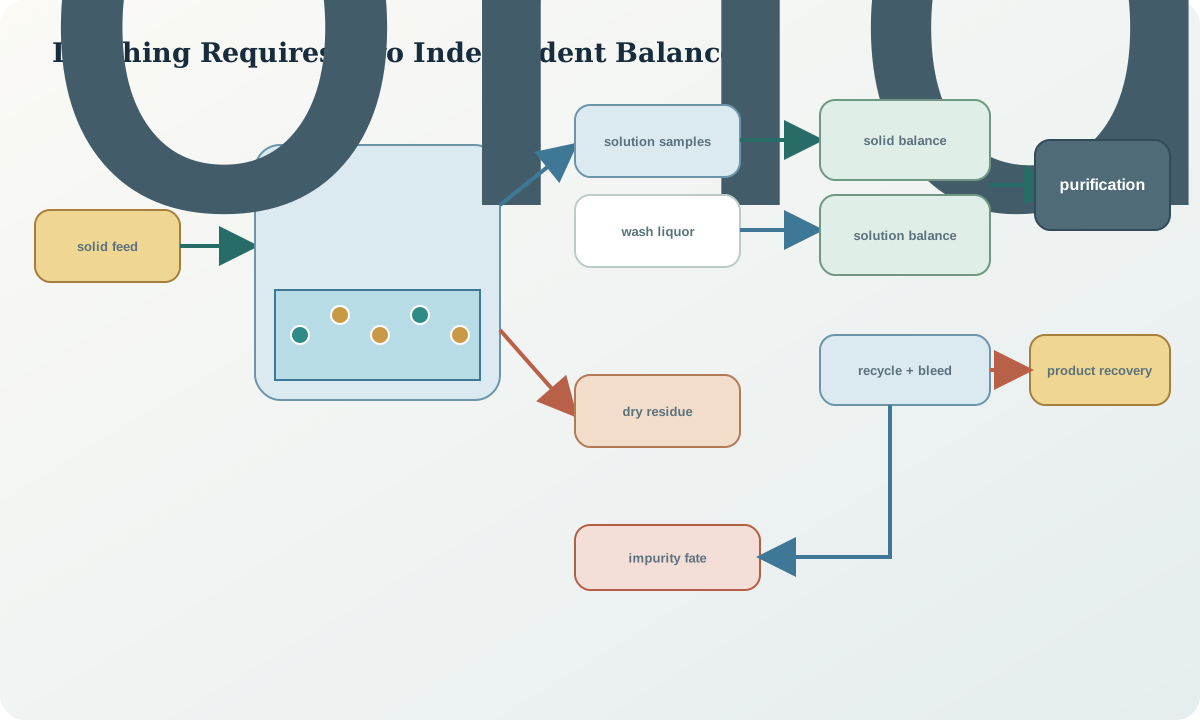
where M_f,g_{f,j} describe dry feed and M_r,g_{r,j} dry residue. Solution-based extraction uses solution volume or mass and concentration, including samples and wash liquors. Agreement between independently measured solid and solution balances is a powerful diagnostic, but both require representative sampling and moisture or entrained-solution corrections.
Track total mass, water, target component, key impurities, acid or base equivalents, oxidant or reductant and inventory. Samples removed over time change the system. Evaporation, entrained liquor and wash water alter concentration. State whether extraction means dissolution from feed, presence in pregnant solution, recovery after purification or final product yield; these quantities are not synonymous.
Selectivity, impurities and consumption
Selectivity is the desired extraction relative to unwanted dissolution and downstream burden. Gangue minerals can consume reagent, neutralise acidity, release impurities, create gels or fines, and change permeability. Minor phases may dominate impurity chemistry. A high target extraction with excessive reagent consumption or an unmanageable impurity can be inferior to a lower, more selective response.
Record reagent consumption on a declared feed or extracted-component basis, and distinguish chemical consumption from solution inventory and losses. Map impurities through leach, purification, bleed and residue. Recycling solution can accumulate species that a single-pass laboratory test never reveals. Integrated tests must examine steady or cyclic solution composition, not just fresh reagent response.
Reactor and contact modes
Agitated tanks provide mixing and controlled residence but require fine preparation and solid–liquid separation. Columns or heaps rely on percolation through coarser material and introduce wetting, channeling, permeability, solution distribution and long residence. Pressure or elevated-temperature systems alter reaction and equipment boundaries. In-situ concepts add subsurface flow, containment and recovery requirements.
These descriptions are families, not recommendations. The appropriate mode depends on mineralogy, kinetics, permeability, scale, water, energy, safety, residue and economics. Laboratory bottles can screen chemistry but cannot reproduce a large porous bed. Columns can explore percolation but remain scale- and preparation-dependent. State what phenomenon each test represents and what it omits.
Experimental design and sample integrity
Use samples that cover mineral hosts, oxidation, alteration, grade, gangue and spatial variability. Preserve moisture and oxidation state where they matter. Establish feed mineralogy, size, porosity and solution composition. Include repeat tests, blanks and analytical checks. Sample both liquid and solid phases at appropriate times and maintain chain of mass through subsampling and washing.
Test conditions should answer a decision, not create the highest possible extraction. Map response over plausible ranges, include adverse domains and examine reagent consumption and impurities. Scale progression may move from diagnostic extraction to bottle, column, continuous pilot and integrated purification work. Each stage has an applicability boundary and should update, not erase, earlier uncertainty.
Uncertainty and common failure modes
Failure modes include calculating extraction from solution concentration without volume; ignoring entrained solution in residues; using unrepresentative fine material; allowing sample weathering to change mineralogy; confusing equilibrium with rate; fitting a mechanism from one curve; omitting wash liquors; and reporting dissolved target as recovered product. Unmeasured impurity, solution recycle and precipitation can invalidate a route.
Separate analytical uncertainty, balance closure, test repeatability, material variability, model form and scale-up. Test sensitivity to particle-size distribution, temperature and solution composition. Preserve negative results and residue observations. If hazardous chemistry or pressure is involved, tutorial calculations never replace approved facilities, procedures and specialist oversight.
Interfaces and transferable data
Geology supplies mineral hosts, associations, oxidation, alteration, permeability-related texture and domain confidence. Leach testing returns extraction curves, consumption, solution and residue chemistry, mineral transformations, conditions and uncertainty. Water and environmental interfaces need inventories, bleed and residue leachability. Economic models need complete reagent, energy, residence, recovery and product assumptions.
Data records link each solution and residue to feed, vessel, time, condition and sampling event. Concentrations preserve units and density basis. Balanced and raw data remain distinct. A block-model recovery attribute must identify the test population, prediction model, particle preparation and process scenario; “leachable” without these is not a transferable property.
Integration checkpoint
Reconcile feed, solutions, residues, washes and sampled inventory before interpreting extraction. Confirm that dissolved target can pass the proposed purification and recovery boundary and that impurity, reagent and residue consequences remain inside the assessment.
Synthetic worked example
A synthetic 500 g dry sample contains 1.50% component X. After a controlled test, 470 g dry residue contains 0.48% X. Solid-based extraction is 1-(470\times0.0048)/(500\times0.0150)=0.699, or 69.9%. The measured combined solution and wash inventory accounts for 5.10 g X, equivalent to 68.0% of feed X. The 1.9 percentage-point difference exceeds the predeclared balance tolerance.
The result is held for investigation. Possible causes include residue subsampling, retained liquor, solution-volume error and assay uncertainty. An impurity also increases late in the test, so extending contact time may not improve downstream value. The next work repeats the balance, analyses residues mineralogically and tests purification. All materials, values and tolerances are synthetic teaching choices.
Conceptual figure
Practice and decision record
Create a synthetic feed, residue and solution dataset. Calculate extraction independently by solids and solution, reconcile sample withdrawals and identify a plausible balance gap. Propose a diagnostic test that distinguishes reaction limitation from transport or passivation. Write a record with mineral host, conditions, species boundary, consumption, impurities, residues, uncertainty, safety boundary and next gate.
The record fails if solution concentration is treated as recovery, residue moisture is ignored, equilibrium predicts operating rate, or a short agitated test is presented as a full-scale percolation forecast.
Sources
- Practice Guidelines for Mineral Processing, 2022, extraction-route, testwork, product, effluent and risk guidance.
- Hydrometallurgy and electrowinning process overview, public technical explanation of a leach, solution-extraction and recovery chain.
- Hydrogeochemical controls on element occurrence, transport and fate, peer-reviewed synthesis of mineral occurrence, reaction, sorption, precipitation and flow controls.