D5 · Publication Volume 21
Metallurgical Testwork
samples, variability, representativity and scale-up
Learning objectives
By the end of this lesson, the learner should be able to connect each metallurgical test to a decision; distinguish composite, variability, diagnostic and pilot samples; assess representativity in spatial, geological, grade and process terms; design sample and test matrices; separate repeatability from variability; manage preparation and chain of custody; evaluate scale-up boundaries; and issue a testwork interpretation that states support, uncertainty and unresolved risk.
Begin with decisions and hypotheses
Testwork is evidence generation, not a ritual list of standard tests. Write the decision first: screen a route, identify a fatal flaw, quantify variability, provide design parameters, predict product quality, evaluate residue behaviour or validate a model. Then state competing hypotheses and the result that would discriminate among them. A test that cannot change a decision may be lower priority than one that resolves a load-bearing uncertainty.
Define stage and confidence. Early work can eliminate implausible pathways and reveal data needs. Later work must cover feed variability, integrated operations, recycles, products, residues, operating windows and scale effects. Do not label evidence by study stage alone; describe what material and phenomena it actually supports.
Define the decision population
The population is the material expected to be processed over a stated spatial and temporal range, including mining dilution, stockpile or blending effects where relevant. Describe lithology, alteration, mineralisation, oxidation, weathering, grade, mineralogy, texture, hardness, clay, impurities and schedule. Identify portions with no available material and explain the consequence.
Representativity is multidimensional. A sample can match average grade while missing fine texture, an adverse impurity or a hard domain. Spatial coverage cannot be repaired by making one composite larger if it blends away important response. Build a coverage table that compares available test material with the decision population by domain, grade range, location, mass and required test size.
Sample types and their roles
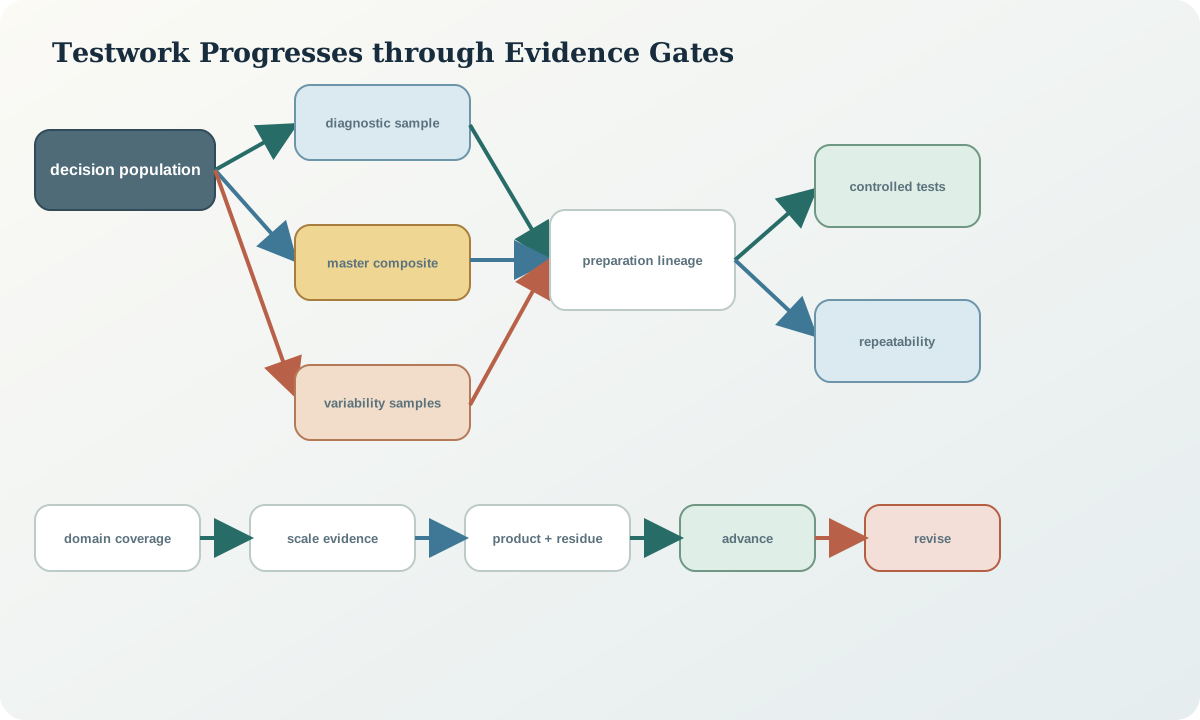
A diagnostic sample isolates a question such as mineral host, liberation mechanism or leach residue. A master composite approximates a selected blend and supports flowsheet development, but it conceals variability. Variability samples preserve contrasts and support response distributions or predictive models. Special samples target extremes, impurities, transition material or expected dilution. Pilot feed supplies integrated work and must have a documented relationship to future feed.
No sample type is inherently representative. State selection logic, parent intervals, mass weighting and exclusions. Purposefully selected adverse samples are valuable but should not be described as random. Composites require rules for dry-mass proportions, residual material, minimum increments and retained archives. Preserve individual-source data so a composite can be reconstructed.
Sample mass, support and preparation
Required mass depends on particle size, heterogeneity, mineral rarity, test apparatus, replicate needs and retained material. Coarse tests may require intact pieces or large mass; fine analytical aliquots cannot replace them. Fundamental sampling considerations mean rare or coarse valuable particles can create large variance at small mass. Record how the mass requirement was determined and what compromise was made.
Preparation can change the property being tested. Crushing changes particle size and may preferentially break weak material. Drying alters clays, oxidation or moisture-sensitive phases. Storage changes surfaces. Splitting and subsampling can segregate size or density. Define preparation sequence, equipment cleanliness, mass after each step, size, moisture, atmosphere if needed, dates and retained fractions.
Test matrix and staged progression
Construct a matrix with samples as rows and decisions or tests as columns. Include characterisation, baseline repeats, route screening, parameter ranges, variability, confirmation and integrated work. Not every sample needs every expensive test; use inexpensive proxies only after calibration to direct measurements. Ensure the matrix can estimate both central response and adverse tails relevant to the decision.
Progress through gates. Characterisation confirms material identity and hypotheses. Scoping tests compare pathways. Optimisation defines a response region, not one lucky condition. Variability tests assess domain and grade effects. Locked-cycle, column, continuous or pilot work explores recycles and scale. Product and residue studies close the boundary. At each gate, update risk and decide whether more detail is justified.
Quality control and repeatability
Use written methods, trained execution, calibrated measurements, blanks where relevant, references where available, duplicates or repeats, mass checks and controlled calculations. Repeatability measures variation under closely similar conditions; reproducibility includes changed operators, apparatus or laboratories. Neither establishes that the sample represents the orebody. Plot control data through time and investigate drift before pooling results.
Predeclare acceptance criteria for mass closure, analytical checks and repeat response. Preserve failures and reruns with reasons. If a result is excluded, retain the raw record and decision. Blindly averaging a failed and a valid test is not conservative. Conversely, deleting an inconvenient but valid adverse result creates bias.
Variability, prediction and nonlinear response
Processing responses are often nonlinear and constrained. Recovery can depend jointly on mineralogy, size, grade and conditions; throughput may be controlled by the hardest or most abundant blend component; impurity may cross a rejection threshold. An arithmetic average of sample recoveries may not equal blend recovery. Use models appropriate to the response and validate on independent or withheld samples.
Report distributions, residuals and applicability. Separate measured primary attributes from test-dependent response variables. A proxy model such as \hat y=f(\mathbf{x}) must state predictors, transformations, calibration population, cross-validation, prediction interval and extrapolation checks. High fit on reused data is not proof of predictive performance.
Scale-up and integrated behaviour
Scale-up asks which physical and chemical phenomena change with equipment size, continuity and time. Residence-time distribution, mixing, energy transfer, particle transport, froth depth, bed permeability, heat transfer, recycle accumulation, process control and operator response can differ. Pilot work reduces selected uncertainties; it does not make uncertainty vanish.
Define scale ratios and invariants used for interpretation. Distinguish apparatus capacity from ore response. Record start-up, shutdown and steady periods. Integrated tests must track inventories and recycles so apparent recovery is not inflated by stored component. Where no scale evidence exists, describe the prediction as conditional and maintain contingency.
Uncertainty and common failure modes
Failure modes include choosing remnants for convenience, using only average-grade composites, losing parent-child identity, insufficient coarse mass, drying or aging without assessment, changing method mid-program without bridging tests, optimising and validating on the same samples, and converting a precise laboratory mean into a spatial prediction. Another is “test abundance”: many similar tests create a false sense of coverage while key domains remain absent.
Build an uncertainty register with sample selection, preparation, method, analytical, repeatability, spatial variability, model form and scale-up components. Identify which can be reduced and which must be managed. Use stop rules when material is unrepresentative or balances fail. State missing evidence openly rather than filling it with borrowed performance.
Interfaces and transferable data
The testwork register connects source intervals, composites, preparation batches, test runs, products, assays, calculations, reports and model attributes. Each entity needs a stable identifier, version, status and parent links. Coordinates and geological domains belong to source material; conditions and responses belong to tests. Do not overwrite raw observations with reconciled results.
Geology receives coverage gaps and response relationships. Process design receives operating regions and variability, not selected maxima. Economics receives distributions and confidence appropriate to the stage. Environmental work receives all solid and liquid outputs. A decision record identifies the role accountable for accepting each data package without naming an organisation or individual.
Synthetic worked example
A synthetic population has three domains representing 45%, 35% and 20% of planned dry feed. Available variability samples cover 40, 30 and only 4 spatial locations respectively. The smallest domain contains the penalty-bearing mineral and highest clay. A master composite weighted 45:35:20 gives acceptable recovery and product quality, but two of four separate South samples exceed the provisional impurity limit.
The programme does not report the composite as representative performance. It adds spatially distributed South material, preserves it as individual samples, repeats the impurity and water-sensitivity tests, and constructs a blend threshold scenario. The composite remains useful for flowsheet continuity, while variability evidence controls prediction. Counts, weights and results are synthetic.
Conceptual figure
Practice and decision record
Design a synthetic test matrix for three domains, including one poorly sampled adverse domain. Assign each sample a purpose, required preparation, test family, retained mass and decision gate. Show which evidence estimates repeatability and which estimates spatial variability. Write a testwork decision record with population, coverage, exclusions, quality criteria, scale boundary, model use and next material need.
The record fails if a composite erases variability, precision is described as representativity, altered preparation is unrecorded, failed balances disappear, or pilot work is claimed to certify a commercial design.
Sources
- Practice Guidelines for Mineral Processing, 2022, detailed guidance on sample selection, testing, variability, design support and risk.
- Mineral processing practice-guideline portal, source and version context for current published guidance.
- Geometallurgical sampling and testwork: general considerations, peer-reviewed treatment of spatial samples, representativity, integrity, quality control and predictive use.