D5 · Publication Volume 21
Geometallurgy
domains, mineralogy, hardness and recovery prediction
Learning objectives
By the end of this lesson, the learner should be able to define geometallurgy as an integrated predictive framework rather than a renamed assay table; distinguish primary rock attributes from process-response variables; design domains and variability sampling; build and validate response models; handle non-additive variables and change of support; express uncertainty and applicability; and feed observed performance back into geological and planning models without circular validation.
Define the programme and decision
Geometallurgy connects spatial knowledge of material to mining, processing, product, residue and value responses. A programme begins with decisions: throughput forecasting, route selection, blending, product-quality control, energy planning, residue prediction or economic risk. It then identifies the rock attributes and tests needed to predict those responses at appropriate supports. Adding recovery columns to a block model without this chain is not a geometallurgical programme.
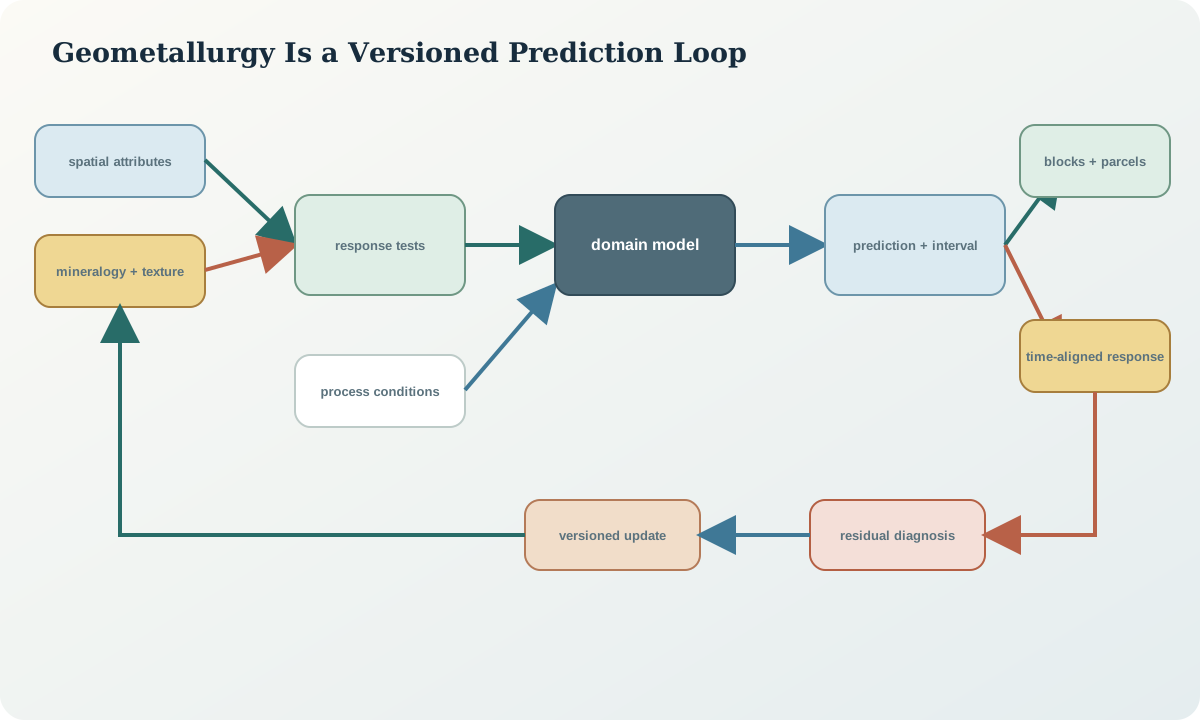
Write a conceptual causal graph before fitting models. Geological history influences mineralogy, texture, alteration and structure; these influence hardness, liberation, surface response, permeability and impurity deportment; process conditions interact with those properties; streams and value result. The graph helps distinguish predictors from consequences and reveals measurements that would create leakage.
Primary attributes and response variables
Primary attributes describe material independent of the particular process test, such as mineral proportions, grain size, texture, density and chemistry, subject to their measurement definitions. Response variables arise when material is subjected to a procedure: work index, throughput, flotation recovery, reagent consumption or leach extraction. A response belongs to its method, conditions and scale.
Some attributes are additive under the correct mass or volume weighting; many responses are not. Mean grade of a blend can be mass-weighted, but mean recovery may fail because feed grade, mineralogy and circuit conditions interact. Store enough information to recompute contained-component flows. Never average ratios without checking their numerator, denominator and support.
Sampling spatial and process variability
Sampling must span geological domains, grade, depth, alteration, oxidation, mineralogy, texture and schedule while targeting adverse or rare states. Spatial distribution matters because clustered tests can appear numerous but leave large volumes unsupported. Sample mass and preparation must suit the response test. Record unavailable areas and whether drill or core selection excludes weak or coarse material.
Use both composites for integrated flowsheet questions and numerous smaller variability samples or calibrated proxies for spatial modelling. Design the programme iteratively: early observations define provisional domains; tests reveal which contrasts matter; new sampling targets uncertainty; model residuals identify missing controls. Avoid defining domains solely from the response being predicted and then reporting in-sample separation as validation.
Domain concepts and boundaries
A geometallurgical domain is a volume or material class within which selected predictive relationships are sufficiently stable for a stated purpose. It is not necessarily identical to lithology or resource-estimation domain. Boundaries may be categorical, transitional or probabilistic. Different responses may require different domains: hardness can follow one pattern while impurity or flotation follows another.
Define domain criteria using observable attributes and document hierarchy, precedence, minimum support and boundary uncertainty. Test within-domain variance and between-domain distinction on held-out data. If domains overlap strongly, a continuous predictor may be more appropriate. Do not force every block into a confident label; “unknown” and probability vectors can be honest states.
Prediction models and applicability
A response model can be mechanistic, empirical or hybrid. A generic form is
$\hat y(\mathbf{x},\mathbf{u})=f(\mathbf{x},\mathbf{u})+\varepsilon,$
where \mathbf{x} contains rock attributes, \mathbf{u} contains process conditions and \varepsilon represents residual variation and model inadequacy. Separating rock from operating conditions prevents the model from calling a control setting an inherent ore property.
Report training population, feature definitions, missing-data treatment, transformations, validation split, residuals, prediction intervals and extrapolation distance. Cross-validation must respect spatial clustering and parent samples. If nearby aliquots occur in both training and testing, performance is optimistic. A model can predict poorly in a small but high-value domain despite good global metrics.
Change of support and blending
Tests act on grams to tonnes; blocks represent much larger volumes; plant feed is a time-dependent blend after mining, stockpiling and transport. Support change smooths some attributes and mixes domains, but nonlinear response and bottlenecks remain. Define how block predictions aggregate to parcels and how parcels blend through inventories. Preserve mass and contained components before calculating ratios.
Use blending experiments or validated process models where interactions matter. A throughput constraint may respond to the fraction of hard material rather than mean hardness. Product impurity can be linear in contained mass but acceptance is a nonlinear threshold. Uncertainty may reduce through aggregation for independent fine-scale variation, but systematic bias and domain uncertainty do not average away.
Uncertainty and scenario propagation
Separate natural variability, measurement error, spatial estimation uncertainty, response-model uncertainty, process-condition uncertainty and future scenario uncertainty. A single standard deviation cannot represent all of them. Provide prediction intervals at the support of the decision and maintain correlations among recovery, throughput, product quality and cost when they share mineralogical controls.
Use alternative domain interpretations, conditional simulations or scenario ensembles where decisions are sensitive. Ask which uncertainty changes sequence, blend, capacity or value. Model uncertainty should trigger sampling or operational controls, not merely a colourful map. Report where the prediction is extrapolated or unsupported.
Operational learning without leakage
Observed plant response can update models only after material identity, timing and operating conditions are reconciled. Stockpiles mix sources; residence and recycle delay outputs; sensor and laboratory methods drift; control actions respond to feed. A naive correlation between current block labels and current recovery can therefore be confounded.
Build a time-aligned genealogy from mined parcel to stockpile, feed and products. Separate data used to estimate production performance from data used for independent validation. Record model version and predeclare comparison metrics. When the model changes, reproduce historical predictions under the old version before attributing improvement.
Governance and transferable artefacts
The core artefacts are a programme objective, sampling coverage map, attribute dictionary, test registry, domain specification, model card, validation report, block or parcel schema, uncertainty layer and change log. Each states purpose, owner by role, effective time, inputs, units, methods, limitations and supersession. The model card names no company or person; it describes responsibilities generically.
Geology, processing, planning, environment and economics consume different outputs but must share identifiers and version lineage. A process response cannot silently overwrite a geological observation. Derived predictions identify source models. Decisions retain the scenario and product assumptions used so a later specification change can be propagated.
Integration checkpoint
Test the programme end to end on a held-out spatial and temporal slice. Confirm that source identity survives support changes, rock attributes remain distinct from operating conditions, prediction intervals cover adverse domains and downstream decisions can be reproduced from versioned inputs.
Synthetic worked example
In the synthetic system, target recovery correlates with exposed target-mineral surface, while throughput responds to a hardness proxy and product impurity responds to the penalty-mineral proportion. A model trained on North and Central samples predicts recovery well there but underpredicts uncertainty in South. Spatially blocked validation gives wider errors than random row splitting because neighbouring aliquots had shared texture.
The programme stores three separate predictions with a covariance description rather than one value score. South blocks remain low-confidence, and a planned sampling campaign targets oxidation transitions. A blend scenario reveals that average recovery is acceptable but a short impurity excursion breaches the provisional limit. All data and domains are invented.
Conceptual figure
Practice and decision record
Draw a causal graph for hardness, liberation, recovery and impurity. Classify each variable as primary, response, operating or economic. Propose a spatial validation split and a change-of-support rule for a synthetic block model. Write a model record with objective, training population, domains, conditions, performance by domain, uncertainty, extrapolation, update rule and prohibited uses.
The record fails if response variables are treated as additive, random aliquot splitting leaks parent information, operating controls are stored as rock properties, unsupported blocks receive confident predictions, or model updates erase prior versions.
Sources
- Geometallurgy as a route to resilient mine operations, peer-reviewed framework for variability, uncertainty, primary attributes and response variables.
- Development of a geometallurgical framework for process prediction, primary research linking mineral texture, liberation and predictive models.
- Geometallurgical sampling and testwork: general considerations, peer-reviewed guidance on spatially referenced variability samples and predictive programmes.