D5 · Publication Volume 21
Mass Balance and Recovery
feed, concentrate, tailings and metal accounting
Learning objectives
By the end of this lesson, the learner should be able to draw a balance boundary; distinguish flow, inventory and transfer; close total mass, water and component balances; calculate recovery and two-product assay estimates; identify timing and moisture inconsistencies; understand data reconciliation as uncertainty-weighted adjustment rather than truth creation; diagnose residuals and bias; and produce an auditable metal-accounting record that preserves raw data.
Define boundary, period and state
A balance begins with a physical boundary and time period. List every stream crossing it, every inventory inside it and every relevant component. State whether masses are wet or dry, whether flow is instantaneous or integrated, which timezone and cut-off apply, and how start and end inventories are measured. A flowsheet icon is not a balance until these definitions exist.
At steady state with negligible inventory change, inputs equal outputs. During start-up, shutdown, campaigns, batch tests or normal storage variation, inventory matters. The general total-mass relation is
$\sum M_{\mathrm{in}}-\sum M_{\mathrm{out}}=\Delta I_M.$
For component j, replace mass with M g_j and include component inventory. The sign convention must remain consistent.
Wet mass, dry mass and water
If wet mass is M_w and moisture mass fraction is w, dry mass is M_d=M_w(1-w) under the declared convention. Slurry measurements may use density, solids fraction and volumetric flow. Each conversion needs temperature, calibration and sampling compatibility. Mixing wet feed tonnes with dry product tonnes creates an apparent loss even if the process is perfect.
Balance water separately when it affects flow, sampling or product moisture. Reagent solutions and wash water cross the boundary. Entrained solution carries dissolved components. Evaporation or unmeasured addition can matter. A dry solids balance can close while the solution component balance fails, so choose balances that represent the process and decision.
Component balance and recovery
For feed f and product p, component recovery is
$R_{p,j}=\frac{M_p g_{p,j}}{M_f g_{f,j}}.$
Use unrounded values, consistent grade units and the same component definition. Recovery is a ratio of contained quantities over a period; it is not product grade or mass yield. If multiple feeds, products or recycles cross the chosen boundary, include them. Internal recycle cancels only when entirely inside the boundary and inventory is handled.
For a two-product system, assay-based concentrate mass fraction is Y=(f-t)/(c-t). This formula becomes unstable when product grades are close and assumes unbiased, representative, synchronous assays with no additional stream or inventory. Compare it with measured mass, propagate uncertainty and use contradictions as diagnostic evidence.
Measurement architecture
Mass and component accounting combines scales, flowmeters, density measurements, moisture samples, samplers, laboratories and inventory surveys. For each input, document measurement principle, location, frequency, calibration, bias checks, precision, missing-data rule and responsible role. The mass measurement and assay sample must represent the same material and period.
Continuous streams require increment selection and composite construction that capture process variation. Stockpiles need geometry, density, moisture and grade support with correlated uncertainty. In-process inventory in mills, tanks, thickeners, heaps or pipelines can be difficult to observe. Declare estimates and do not force unexplained inventory into a balancing adjustment.
Raw closure and residuals
Calculate raw residual before reconciliation. A relative mass residual can be stated as
$r_M=\frac{\sum M_{\mathrm{in}}-\sum M_{\mathrm{out}}-\Delta I_M}{\sum M_{\mathrm{in}}},$
with the exact convention documented. Component residuals use contained mass. Review residuals through time and by material state. Random scatter around zero suggests a different issue from a persistent directional bias.
Closure tolerance is decision- and measurement-specific; this tutorial supplies no universal percentage. A balance within a numerical threshold can still contain compensating biases. Examine independent checks, trends, cross-component consistency and measurement uncertainty. A large residual is not “fixed” by dividing all outputs by a closure factor without explanation.
Data reconciliation
Reconciliation adjusts measured values within an explicit statistical model so conservation constraints are satisfied while respecting uncertainty. A common objective minimises weighted adjustments,
$J=\sum_i\left(\frac{x_i^*-x_i}{\sigma_i}\right)^2,$
subject to mass and component balances, where x_i are measurements, x_i^* reconciled values and \sigma_i uncertainty parameters. Correlation, bias and constraints require careful treatment.
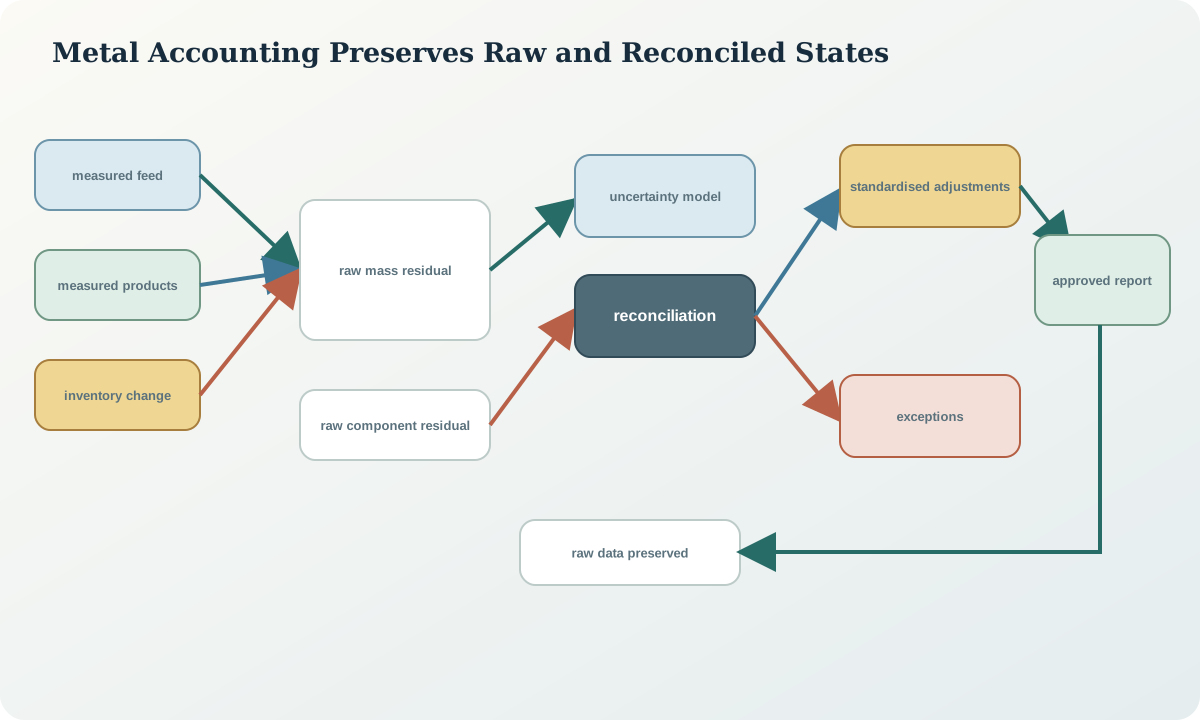
Reconciled values are estimates, not replacement raw measurements. Inspect standardised adjustments and goodness-of-fit. Large repeated adjustment to one stream may reveal a biased instrument, sampler or inventory model. Unrealistically small uncertainty forces the optimiser to move other values. Reconciliation cannot rescue missing streams or a wrong flowsheet boundary.
Recovery uncertainty and bias
Recovery uncertainty depends on mass and grade uncertainties and their covariance. Low feed grade or small differences between product assays can amplify relative uncertainty. Use analytical propagation, simulation or another documented method appropriate to distributions. Report intervals and calculation basis, especially when comparing small changes.
Bias does not disappear with more samples. Calibration, sampler design, moisture mismatch and selective loss can cause persistent error. Establish bias tests and independent checks. Separate short-term process variation from accounting uncertainty. A recovery trend should not be interpreted until measurement-system changes and inventory timing are reviewed.
Governance, audit and versioning
An accounting period closes through defined data cut-off, validation, exception review, inventory estimate, raw balance, reconciliation, approval and lock. Later corrections create a new version with reasons; they do not silently alter history. Roles for measurement, calculation, review and approval should be separated where practical.
The audit package includes boundary diagrams, tag and sample registers, calibration evidence, raw data, exclusions, uncertainty models, residuals, adjustments, exceptions and final reports. Access controls protect integrity without obscuring methods. A tutorial example demonstrates structure only and does not establish corporate or financial reporting requirements.
Interfaces and transferable data
Mine tracking provides material transfers and inventories; processing provides stream states; laboratories provide results and uncertainty; survey can support stockpile volumes; finance consumes approved quantities; geometallurgy uses reconciled performance with lineage. Identifiers, time periods, units and material states must match across systems.
Keep operational performance data separate from model predictions so reconciliation can test rather than confirm a model. When returning recovery to geological domains, account for blends, process conditions and measurement uncertainty. A balanced monthly recovery is not automatically a block-scale observation.
Integration checkpoint
Close raw mass, water and component balances before reconciliation, examine standardised adjustments afterward, and verify that inventory and time support match. Approve a reported recovery only when measurement, sampling, uncertainty and exception records remain auditable.
Synthetic worked example
Over a synthetic period, dry feed is measured as 1,000 mass units at 1.00% X. Concentrate is 55 units at 15.0% X and tailings are 938 units at 0.18% X. Output dry mass is 993, giving a raw mass residual of 0.7%. Contained X is 10.00 in feed and 9.9384 in outputs, giving a smaller component deficit of 0.0616. Unmeasured inventory and stated measurement uncertainties are reviewed.
Raw concentrate recovery is 82.5%. Reconciliation is not performed until the seven-unit mass gap is investigated because a transfer bin changed inventory during the period. After an independently supported inventory change is added, residuals are recomputed. The original data remain preserved. Values and acceptance decisions are synthetic.
Conceptual figure
Practice and decision record
Create a synthetic three-stream balance with wet mass, moisture and two component assays. Convert to dry basis, calculate mass and component residuals and recovery, then introduce an inventory change. Identify the measurement most likely to create a directional bias. Write an accounting record with boundary, period, tags, uncertainty, raw closure, adjustments, exceptions, version and approval role.
The record fails if wet and dry bases mix, internal inventory is ignored, adjusted values overwrite observations, tolerance substitutes for diagnosis, or a monthly balance is assigned directly to blocks without material lineage.
Sources
- Sampling, metallurgical accounting and reduction of balance-estimation variance, technical paper on sampling uncertainty, balance constraints and recovery intervals.
- Leveraging accuracy and precision through mass balancing and reconciliation, technical paper on redundant measurements and reconciled data.
- Practice Guidelines for Mineral Processing, 2022, guidance on sampling, testing, process evidence and transparent reporting.