D5 · Publication Volume 21
Data Interfaces with Geological Models
attributes, testwork lineage and domain updates
Learning objectives
By the end of this lesson, the learner should be able to design a data contract linking geological observations, samples, testwork, models, blocks, parcels and process streams; distinguish intrinsic attributes, responses and predictions; preserve lineage through compositing and preparation; define units, support, conditions, versions and uncertainty; update domains without erasing history; validate model-to-plant feedback; and construct an institution-neutral interface register.
Define entities before fields
Start with real conceptual entities: source interval or specimen, sample, preparation batch, aliquot, test run, test product, analytical result, geological domain, model block, mined parcel, stockpile movement, process feed, stream sample and accounting period. Give each a stable identifier and define parent-child relationships. A wide spreadsheet that repeats sample names without entity rules is not a data model.
Separate identity from description. A sample remains the same entity when an interpretation changes. A domain version is a model object, not a physical property stamped on the sample forever. A test product is derived from a feed under conditions. A block prediction derives from a model version and inputs. These distinctions allow corrections without rewriting history.
Attribute classes and semantic definitions
Classify fields as observed, measured, interpreted, derived, predicted, assumed or decided. Intrinsic rock attributes such as mineral proportion remain method-defined observations or estimates. Response variables such as recovery belong to test conditions. Economic attributes belong to scenarios. Store status explicitly so a predicted recovery cannot be mistaken for a measured result.
Every field definition includes quantity, component or phase, unit, dry or wet basis, support, method, condition, valid range, missing-value meaning, uncertainty representation and aggregation rule. Avoid overloaded names such as grade, recovery or hardness. A data dictionary should make two independent implementers produce compatible values.
Sample and preparation lineage
Lineage begins at source location and records collection, mass, date, orientation or interval, storage and condition. Splitting creates child samples with mass accounting. Compositing creates a new sample linked to all parents and dry-mass weights. Crushing, grinding, drying and chemical preparation are events with input, output, equipment or method, size, contamination controls and retained material.
Tests consume aliquots and create products; analyses consume or subsample products. Preserve chain of mass where practical and flag exhausted material. Do not attach composite response to each parent interval as if individually measured. If a test record loses its parent or conditions, it is not suitable for spatial prediction.
Model-ready response tables
A response table has one defined observation unit, often a test run or sample-condition pair. Predictors derive only from information available for prediction. Include response, conditions, method version, quality flags, censoring, uncertainty and parent grouping. Long-form result tables are preferable when components and methods vary; curated model views can be generated with traceable code.
Prevent leakage. Products of the test being predicted cannot become predictors. Replicates, aliquots and nearby intervals from one parent should be grouped in validation. Define train, validation and test populations before model selection. Store excluded records and reasons. A model-ready table is a versioned derivative, never the sole repository of observations.
Block, parcel and time interfaces
Blocks need geometry, coordinate reference, volume, density, dry mass, domain probabilities, estimated primary attributes, prediction distributions, model versions and effective date. Parcels need source-block proportions, mining state, dilution, time, destination and uncertainty. Stockpiles add mixing and inventory. Process streams add residence, recycle, water and sampling periods.
The interface must state change-of-support and aggregation. Add contained component masses, not grades; recompute ratios afterward. Non-additive response predictions require a blending or process model. Time-align feed and output before comparison. If genealogy is uncertain, represent source proportions probabilistically instead of inventing exact traceability.
Domain update and version control
A domain update is a controlled model change triggered by evidence. Record trigger, new data, hypothesis, algorithm or rules, validation, affected volumes and decision impact. Assign a new version and preserve the previous geometry, codes and predictions. Never reuse a code for a materially different definition.
Provide mappings where old and new domains overlap, including transition and uncertainty. Recompute downstream predictions under the new version and identify decisions that require review. A better global metric is not sufficient if an adverse domain degrades. Approvals are by accountable roles, without tying the curriculum to a named organisation or person.
Quality rules and validation
Validate identifiers, parent existence, mass conservation, units, ranges, coordinate systems, interval overlap, timestamps, method applicability and version compatibility. Cross-field rules catch impossible combinations: recovery outside its defined interval, product mass exceeding feed without additions, dry mass greater than wet mass, or a test date before sample creation.
Data validation is not scientific validation. A syntactically valid recovery can still come from an unrepresentative sample. Keep quality dimensions separate: structural validity, measurement quality, representativity, model fitness and decision approval. Automated checks should generate exceptions and lineage, not silently coerce values.
Feedback from process observations
Observed performance returns through a reconciled chain: material movement, stockpile, feed, process conditions, streams, inventories and accounting. Compare observed and predicted response at a common support and version. Diagnose residuals against material attributes, process conditions, measurement changes and timing. Avoid updating geology merely to absorb an operational problem.
Use monitoring and holdout periods. A model revised on a period cannot claim independent validation on that same period. Record calibration and evaluation windows. Feedback can update response relationships, domain probabilities or data needs, but raw geological observations remain unchanged unless new geological evidence justifies revision.
Interoperability and controlled exchange
An exchange package includes manifest, schemas, data tables, units, coordinate and time references, code lists, method definitions, lineage, quality results, model cards and change log. Use open serialisations where practical, but syntax alone does not guarantee shared meaning. Validate round trips and identifiers. Protect sensitive or restricted records while keeping derivation transparent to authorised reviewers.
The package should not embed a company, person, product or website as the scientific owner. The host can deliver files without becoming publisher or authority. Source organisations belong only in source metadata. Roles and responsibilities are expressed functionally so the tutorial transfers to different institutions.
Uncertainty and common failure modes
Failure modes include duplicate sample identifiers, overwritten raw data, unitless fields, mixed dry and wet basis, response copied to parent intervals, domain codes without versions, random validation leakage, exact parcel lineage invented from blended stockpiles, and process feedback joined by calendar day without residence. Another is a single “confidence” flag that conflates measurement, model and approval.
Design uncertainty as data: distributions, intervals, covariance, category probabilities, quality flags and applicability distances. Missing is not zero. Unknown is not below detection. Preserve source precision without implying accuracy. Test migrations and schema changes on copies, reconcile record counts and hashes, and retain rollback paths.
Synthetic worked example
A synthetic composite CMP-017 has six source intervals with recorded dry-mass weights. It produces three variability aliquots and one flotation test. The test creates timed concentrates and tailings; assays and a reconciled balance are linked but stored separately. A response model predicts recovery for version 3 blocks using mineral exposure and oxidation, with process condition fixed to scenario S2.
Later mineralogy splits one provisional domain into two. Version 4 is created; old blocks and predictions remain queryable. A mapping table identifies overlaps, and only unsupported transition blocks are flagged for new sampling. Observed plant-like data are not used because the teaching system has no real operation. Every identifier and value is synthetic.
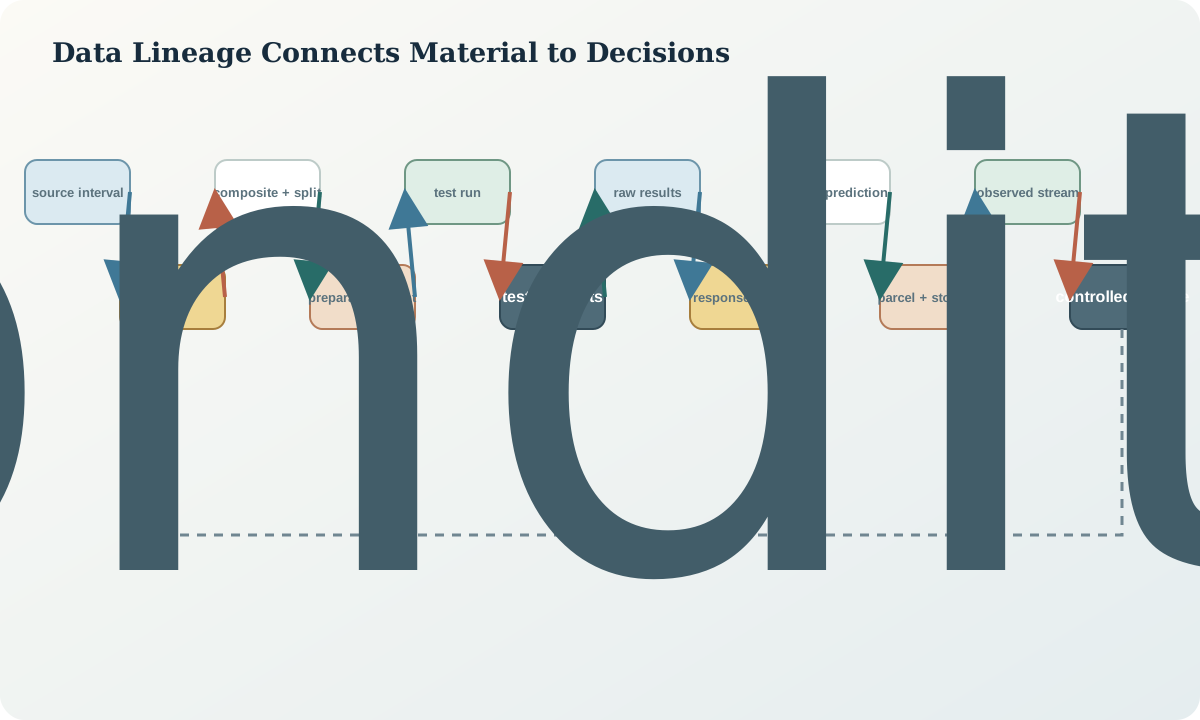
Conceptual figure
Practice and decision record
Design tables for samples, composite members, preparation events, tests, products, results, models, predictions and domain versions. Define keys, units and quality rules. Trace one result back to source and one prediction forward to a parcel. Write an interface contract with purpose, entities, schemas, lineage, uncertainty, validation, access boundary and change process.
The record fails if model predictions overwrite observations, a composite response is assigned to every parent, domain definitions change without versions, missing values become zero, or the hosting website is represented as scientific owner, publisher or curriculum subject.
Sources
- Practice Guidelines for Mineral Processing, 2022, guidance on sampling lineage, test information, process support, transparency and risk.
- Geometallurgy as a route to resilient mine operations, peer-reviewed framework connecting primary variables, response variables, block models and uncertainty.
- PROV-O: the provenance ontology, public recommendation for representing entities, activities, agents and derivation; source metadata does not imply curriculum affiliation.