A3 · Publication Volume 4
Crystals, Lattices and Symmetry
crystal structures, unit cells, symmetry, defects and amorphous materials
Learning objectives
After this lesson, you should be able to distinguish a lattice from a crystal structure, explain what a unit cell represents, relate symmetry to repeated atomic arrangements, recognise that real crystals contain defects, and state what diffraction can and cannot establish.
Long-range order is the central idea
The International Union of Crystallography defines a crystal in terms of long-range order. Many crystals are periodic in three dimensions, but ordered aperiodic crystals also exist. Therefore “crystal” should not be reduced to “a solid with flat shiny faces” or even to “a perfectly repeating stack of atoms.” External faces may express internal order, yet growth conditions, breakage and space competition can obscure the ideal form.
An amorphous solid lacks the long-range order that produces a crystal's discrete diffraction pattern. Glass is the familiar geological example. Poorly crystalline material lies between simple end-member descriptions: it may contain nanometre-scale ordered domains, stacking disorder or mixed crystalline and amorphous components. Those distinctions require a method sensitive to order; appearance alone is insufficient.
Lattice, motif and structure
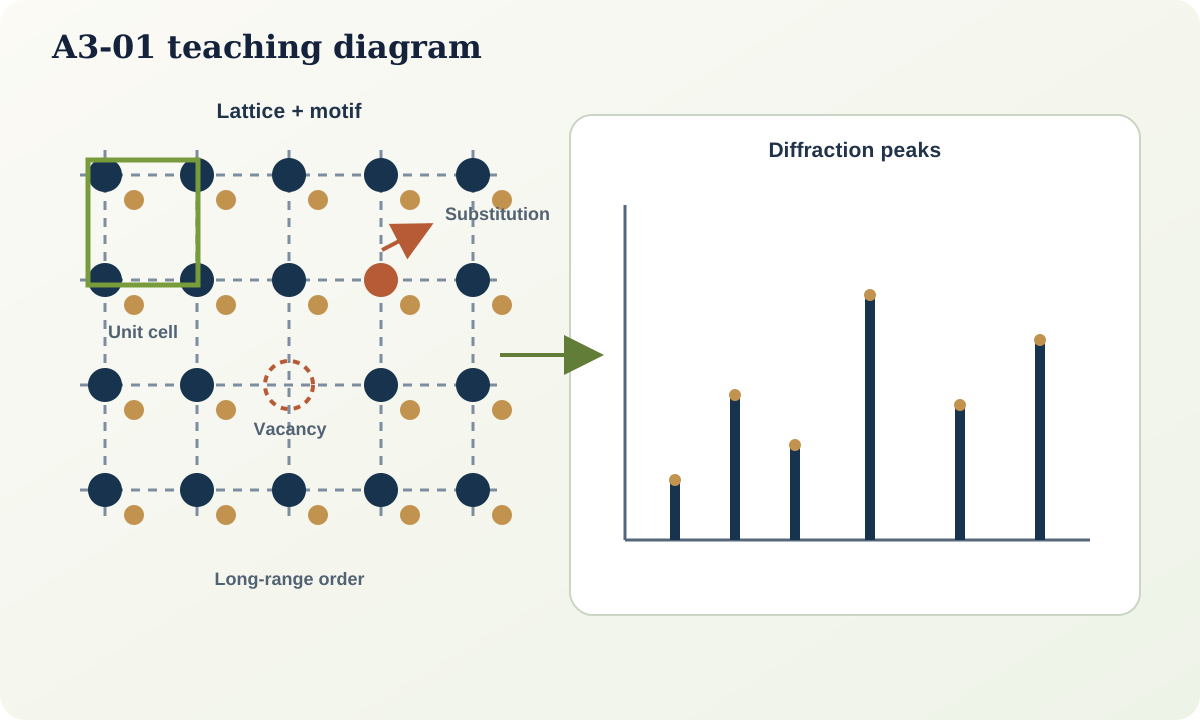
A lattice is an abstract periodic set of equivalent points generated by integer combinations of basis vectors. It contains no atoms by itself. A motif or basis is the atom, ion or group attached to every equivalent lattice point. Combining lattice and motif produces a crystal structure.
This separation matters. Two minerals can share a broad structural topology while differing in site occupants, or share chemistry while arranging atoms differently. Polymorphs illustrate the second case: the same composition can form different structures with different properties and stability fields. A ball-and-stick drawing is thus a model of selected atoms and bonds, not the lattice itself.
The unit cell is a repeating description
A unit cell is a parallelepiped defined by three basis vectors \mathbf{a}, \mathbf{b} and \mathbf{c}. Its dimensions are a, b, c and the interaxial angles \alpha, \beta, \gamma. Repeating the cell by lattice translations can generate the periodic structure. The cell volume is the scalar triple product
V = \mathbf{a}\cdot(\mathbf{b}\times\mathbf{c})
A primitive cell contains one lattice point after shared boundary points are counted correctly. A conventional cell may contain more than one lattice point because its axes are chosen to display symmetry clearly. “Smallest box” and “most useful conventional box” are therefore not always the same.
The conventional crystal systems—triclinic, monoclinic, orthorhombic, tetragonal, trigonal, hexagonal and cubic—organise compatible rotational symmetry and cell geometry. Crystal systems, crystal families, lattice systems and Bravais lattices are related but not interchangeable terms. At introductory level, use the system name supplied by an authoritative structure determination rather than inferring it from a single crystal face.
Symmetry operations
A symmetry operation moves the structure into an indistinguishable configuration. Relevant operations include translation, proper rotation, reflection, inversion and combinations such as screw rotation or glide reflection. Point symmetry leaves at least one point fixed; space-group symmetry includes translations. The purpose of symmetry is not decorative classification. It constrains equivalent sites, possible physical anisotropy, diffraction conditions and how a structure can change.
Apparent symmetry can mislead. Twinning may create a form that looks more symmetric than each domain. Unequal growth rates can distort face sizes without changing interfacial-angle relationships. A broken grain may preserve no diagnostic external form at all.
Real crystals contain defects
Perfect periodicity is an ideal reference. Natural crystals contain:
- point defects, including vacancies, interstitial atoms and substitutions;
- line defects, especially dislocations that accommodate growth and deformation;
- planar defects, including twins, stacking faults and grain boundaries; and
- volume features, including inclusions, exsolution lamellae, pores and radiation-damaged zones.
Defects influence diffusion, colour, electrical behaviour, strength, reaction rates and the capacity to host trace elements. A defect is not automatically contamination or analytical failure; it can record formation and later history.
Diffraction samples periodic order
When radiation with wavelength comparable to atomic spacings interacts with an ordered structure, scattered waves interfere. A simplified Bragg relation is
n\lambda = 2d\sin\theta
where \lambda is wavelength, d is the spacing of a family of lattice planes, \theta is the Bragg angle and n is an integer order. Peak positions constrain spacings and cell geometry; intensities depend on atom types, positions, occupancy, thermal motion, preferred orientation and instrumental effects.
A powder pattern is not a photograph of atoms. Phase identification compares a measured pattern with reference data and requires suitable sample preparation. Peak overlap, mixtures, preferred orientation, small crystallites and amorphous material can make the answer non-unique.
Worked reasoning example: a cube-shaped grain
Suppose a hand specimen contains a metallic-looking cube.
- Observation: the exposed form has near-right angles and striated faces.
- Candidate inference: cubic symmetry is plausible, and pyrite is one candidate.
- Alternatives: galena can show cubic cleavage; magnetite may form octahedra or irregular grains; an aggregate or mould can imitate a simple form.
- Discriminators: streak, hardness, cleavage, magnetism, density and—if needed—diffraction or composition.
- Decision boundary: “cubic metallic mineral, pyrite candidate” is defensible before tests; “pyrite” is not yet proven by shape.
Practical investigation
Build a two-dimensional lattice from two non-parallel vectors and attach an asymmetric three-point motif to every lattice point. Mark one valid primitive cell and one larger conventional-looking cell. Apply a translation, a rotation and a reflection, and record which operations preserve the complete motif rather than only the lattice points. Add one vacancy, one substitution and one shifted row to represent three defect types.
Mastery check
- Why is a lattice not a crystal structure?
- What is the difference between a primitive and a conventional cell?
- Why can crystal habit fail to reveal true symmetry?
- Give two ways a defect can change a measurable property.
- What additional information is needed before a diffraction peak can be assigned to a mineral phase?
Sources and further reading
- Crystal, IUCr Online Dictionary of Crystallography.
- Lattice, IUCr Online Dictionary of Crystallography.
- Unit cell, IUCr Online Dictionary of Crystallography.
- Conventional cell, IUCr Online Dictionary of Crystallography.