A3 · Publication Volume 4
Mineral Chemistry and Solid Solution
formulae, substitution, solid solutions, end members and compositional variation
Learning objectives
After this lesson, you should be able to read ideal and site-based mineral formulae, test simple charge balance, distinguish an end member from a solid-solution composition, calculate a molar end-member proportion, and explain why chemistry alone may not establish a mineral species.
A formula is a model at a declared level
An ideal formula communicates the stoichiometric end member of a mineral. A measured natural grain may contain substitutions, vacancies, mixed valence, water or minor elements and will rarely match an ideal string exactly. A structural formula assigns constituents to crystallographic sites after an analysis has been normalised to a chosen number of oxygens, anions or cations. That normalisation is a calculation with assumptions, especially when oxidation state or water content has not been measured.
For example, quartz is written \mathrm{SiO_2}, but trace Al, Ti or other elements and defects may occur. The olivine group can be represented by (\mathrm{Mg,Fe})_2\mathrm{SiO_4} for a common Mg–Fe join, while real olivines may also contain Mn, Ca, Ni and other constituents. Parentheses indicate a site or compositional relationship; they do not mean random occupation without constraints.
Sites constrain substitution
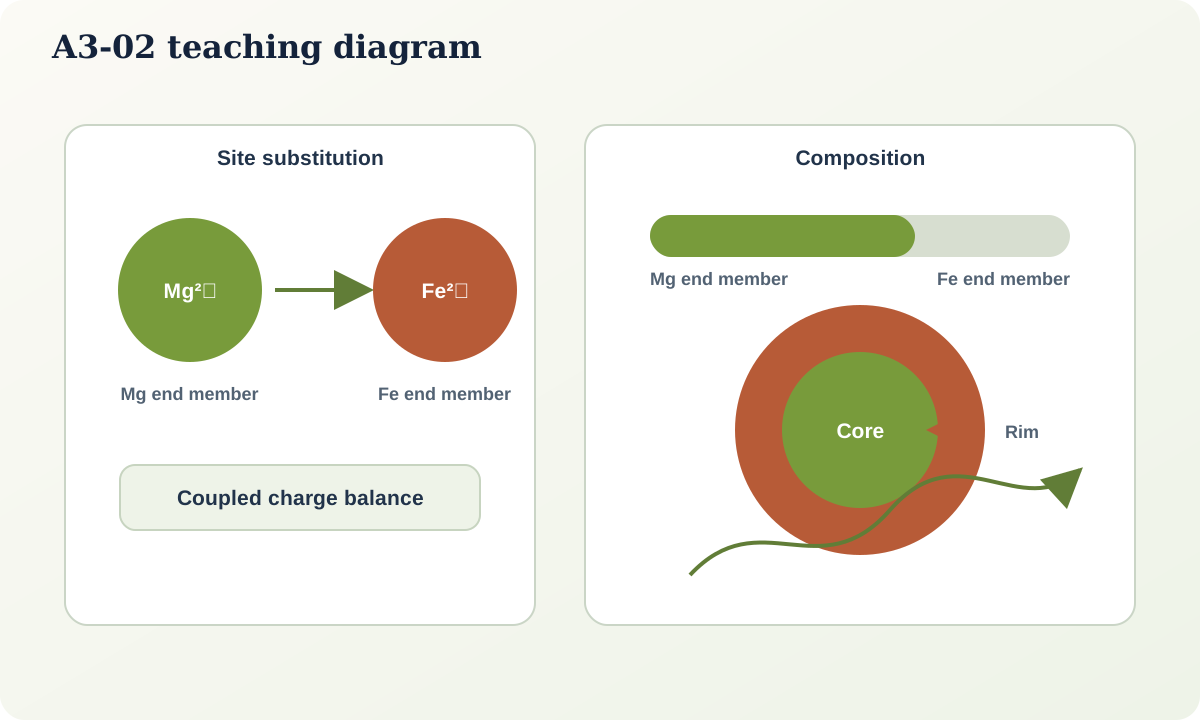
One ion can substitute for another when size, charge and bonding requirements can be accommodated by the structure. Common patterns include:
- homovalent substitution, such as
\mathrm{Mg^{2+}}for\mathrm{Fe^{2+}}; - coupled substitution, in which two or more changes maintain charge balance;
- vacancy substitution, where an unoccupied site participates in balance; and
- heterovalent substitution, which requires compensation elsewhere in the structure.
Plagioclase illustrates coupled substitution between albite and anorthite components. Replacing \mathrm{Na^+} with \mathrm{Ca^{2+}} is balanced by replacing one \mathrm{Si^{4+}} with \mathrm{Al^{3+}}. Writing both changes prevents the misleading suggestion that charge can be ignored.
Charge balance is a necessary check, not a complete structural solution. A bulk analysis can be charge balanced while placing elements in the wrong sites or combining multiple phases.
End members and solid solutions
An end member is an ideal limiting composition used to describe a compositional space. A solid solution is a single structural phase whose composition varies over some range through substitution or vacancies. A binary join is often represented by two end-member fractions that sum to one, but natural systems may require more components.
For the forsterite–fayalite join in olivine, a simple molar magnesium number is
X_{\mathrm{Fo}}=\frac{n_{\mathrm{Mg}}}{n_{\mathrm{Mg}}+n_{\mathrm{Fe^{2+}}}}
and X_{\mathrm{Fa}}=1-X_{\mathrm{Fo}}. Reporting “Fo70” means approximately 70 mol% forsterite component under the stated calculation; it is not 70 weight% Mg, and it should not silently include ferric iron or other cations.
Mineral nomenclature does not reduce every series to a casual 50% rule. The IMA Commission on New Minerals, Nomenclature and Classification uses dominant constituents, site occupancies, valence and structural distinctions under published guidelines. Use current approved nomenclature when a species boundary matters.
Miscibility, ordering and exsolution
A structure may accept a wide compositional range at high temperature but a narrower range at lower temperature. If a homogeneous phase becomes unstable during cooling, it can separate into two compositions by exsolution, producing lamellae or other intergrowths. Ordering redistributes constituents among sites without necessarily changing bulk composition. Both processes mean that present texture and composition can record cooling, not just initial crystallisation.
Zoning is spatial variation within a grain. It can result from changing growth conditions, diffusion, resorption and regrowth, deformation-assisted reaction or alteration. A core-to-rim profile is a time-ordered record only after the geometry and overprinting have been tested.
Analytical composition and uncertainty
Electron-beam or bulk chemical results require quality control. Questions include:
- Is the analysis from one phase or a mixture?
- Were background, matrix and spectral-overlap corrections suitable?
- Are totals low because of porosity, water, carbon dioxide, beam damage or missing elements?
- Which oxidation states were measured and which were assigned?
- How was the formula normalised?
- Does the calculated formula occupy plausible sites and balance charge?
More decimal places do not resolve these questions.
Worked example: calculate an olivine component
An analysis normalised to four oxygens gives \mathrm{Mg}=1.40 and total divalent iron \mathrm{Fe^{2+}}=0.60 atoms per formula unit, with other octahedral cations negligible.
X_{\mathrm{Fo}}=\frac{1.40}{1.40+0.60}=0.70
The composition is therefore reported as Fo70Fa30 for the binary Mg–Fe model. The arithmetic is exact for the supplied numbers, but the interpretation remains conditional: iron valence, analytical uncertainty, zoning and minor cations must be checked. If the spot crossed an exsolution boundary or mixed two grains, the calculated component would not describe a single homogeneous phase.
Practical investigation
Create a spreadsheet for a hypothetical binary mineral series. Enter ten analyses as cation proportions, calculate both end-member fractions, test that they sum to one, and plot position across a grain against composition. Add one analysis with an unbalanced total and one mixed-phase analysis. Write rules that flag them instead of forcing every row into the series.
Mastery check
- Why can an ideal formula differ from a measured composition without invalidating the mineral name?
- Give an example of coupled substitution and show how charge is maintained.
- Distinguish solid solution, zoning and exsolution.
- Why is a bulk chemical analysis insufficient to prove a mineral species in a multiphase rock?
- What assumptions are embedded in an Fo-number calculation?
Sources and further reading
- IMA mineral nomenclature e-booklet, International Mineralogical Association.
- Standards for mineral names and nomenclature, Mineralogical Society of America.
- American Mineralogist Crystal Structure Database, hosted for the Mineralogical Society of America.