A3 · Publication Volume 4
Hand-Specimen Identification Properties
colour, streak, lustre, hardness, cleavage, fracture, density and magnetism
Learning objectives
After this lesson, you should be able to prepare a reproducible hand-specimen description, perform or interpret common non-destructive property tests, distinguish cleavage from fracture, use hardness as an ordinal comparison, and stop at a defensible identification level when key tests are missing.
Describe before naming
Assign a stable specimen identifier and record provenance before testing. Observe both a fresh surface and any weathered rind. Use neutral terms for colour, transparency, grain size, habit, aggregation and relationships with neighbouring phases. Record the illumination, wet or dry state and magnification when appearance matters.
Writing “brassy yellow, opaque, submetallic to metallic, cubic grains up to 3 mm within white vein material” preserves evidence. Writing only “pyrite” discards the observations and makes later review difficult.
Colour, streak and lustre
Colour can be diagnostic for some minerals but is commonly altered by trace elements, defects, inclusions, tarnish and weathering. Streak is the colour of a mineral's fine powder on an appropriate unglazed plate. It can be more consistent than surface colour, but a mineral harder than the plate may scratch it without producing a useful streak.
Lustre describes how a surface reflects light: metallic, submetallic, vitreous, resinous, pearly, silky, greasy or dull are common descriptive classes. Lustre depends on surface quality and is not a direct measurement of composition. Transparency should be recorded separately as transparent, translucent or opaque at the observed thickness.
Hardness is ordinal
Mohs hardness ranks resistance to scratching from talc at 1 to diamond at 10. The intervals are not equal: a hardness of 8 is not twice a hardness of 4. A scratch test asks whether one material produces a permanent groove in another, not whether it leaves loose powder or a metal mark.
Use reference points cautiously: a fingernail is near 2.5, copper is near 3, a steel tool may be around 5–5.5 and common glass around 5.5, but actual objects vary. Test an inconspicuous fresh surface, compare in both directions where safe, and examine the mark with magnification. Do not scratch valuable, friable, hazardous or archive specimens.
Cleavage, parting and fracture
Cleavage is repeated breakage along planes of relatively weak bonding in a crystal structure. Describe the number of directions, quality and approximate angles. One perfect basal cleavage produces sheets in micas; two prismatic cleavages can intersect near 90° in pyroxenes or near 60°/120° in many amphiboles. Small grains and poor surfaces may hide these distinctions.
Parting resembles cleavage but results from features such as twinning, exsolution or deformation and is not present in every grain of a species. Fracture is breakage not controlled by cleavage; conchoidal, uneven, hackly and splintery are descriptive terms. Quartz commonly shows conchoidal fracture, but a conchoidal surface alone is not proof of quartz.
Density and specific gravity
Density is mass divided by volume. For a compact specimen that can be immersed safely, volume can be estimated by displacement. A hydrostatic estimate of specific gravity is
SG=\frac{m_{\mathrm{air}}}{m_{\mathrm{air}}-m_{\mathrm{water}}}
when the measurement conditions and water-density approximation are appropriate. Pores, trapped bubbles, absorbent surfaces, soluble phases, attached matrix and balance precision can bias the result. “Heft” is useful for screening but is not a measurement.
Magnetism and other targeted tests
A hand magnet can reveal strong attraction, but specimen shape, grain size, matrix and remanent magnetisation affect the response. Record test distance and whether the grain itself or the whole rock responds. Conductivity, fluorescence and reaction with dilute acid can be valuable targeted tests, but they need suitable equipment, safety controls and a documented method. Do not taste, inhale, burn or apply uncontrolled chemicals to unknown minerals.
Carbonate reaction is especially condition-dependent: acid concentration, surface freshness, powdering, mineral species and temperature matter. A weak or delayed response is not equivalent to “not carbonate.”
Combine evidence as a decision table
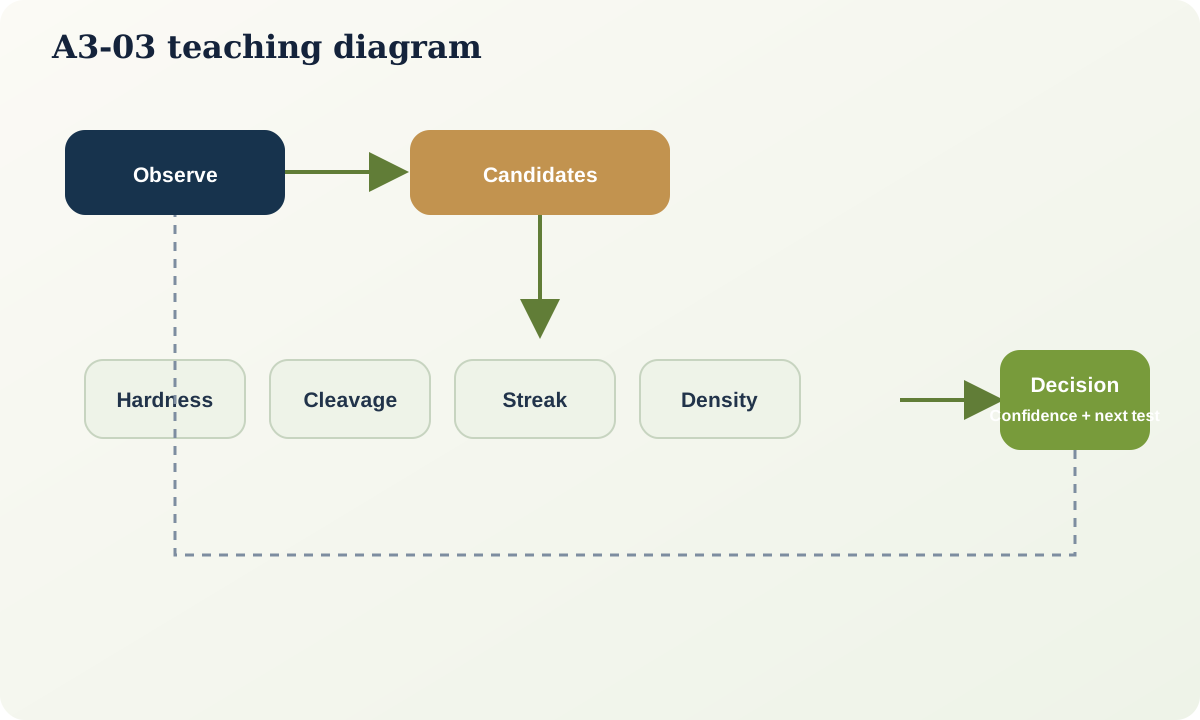
Identification is a process of eliminating candidates with independent properties. A practical table has candidates in rows and tests in columns. Record expected result, observed result and reliability. Give more weight to diagnostic measurements than to variable colour. If two candidates remain, name the group or describe the material and specify the next discriminator.
A digital image cannot supply tactile or instrument-dependent results. Never fill absent properties from a guessed name.
Worked example: three pale minerals
A pale translucent grain has vitreous lustre. Possible candidates are quartz, calcite and feldspar.
- Hardness: it scratches glass clearly. Calcite becomes unlikely; quartz and many feldspars remain.
- Breakage: repeated planar surfaces occur in two directions near 90°. Quartz becomes less likely because it lacks cleavage; feldspar remains plausible.
- Surface details: fine parallel striations occur on one cleavage face. Plagioclase is a stronger candidate, but not all grains show striations.
- Decision: “feldspar, likely plagioclase” is supported at hand-specimen scale. Species and composition require optical, diffraction or chemical evidence.
The workflow also preserves a route back: if the supposed planes are polishing artefacts rather than cleavage, quartz must be reconsidered.
Practical investigation
Create a blind identification matrix for six safe reference specimens. Record colour, streak, lustre, transparency, habit, hardness brackets, cleavage or fracture, magnetism and measured or estimated density. Begin with at least three candidates per specimen. After every test, state which candidates changed probability and why. End with a confidence class and the single most useful additional test.
Mastery check
- Why is colour commonly weaker evidence than streak or cleavage?
- Explain why Mohs numbers cannot be averaged as a linear physical scale.
- How can you distinguish a scratch from a transferred mark?
- What observations separate cleavage from repeated accidental fractures?
- When is a group-level identification more defensible than a species name?
Sources and further reading
- Mineral Identification Key, Mineralogical Society of America.
- Rocks and minerals, British Geological Survey.
- Handbook of Mineralogy, Mineralogical Society of America reference descriptions.