A3 · Publication Volume 4
Common Rock-Forming Minerals
quartz, feldspar, mica, amphibole, pyroxene, olivine and related mineral groups
Learning objectives
After this lesson, you should be able to recognise the principal rock-forming mineral groups, relate their structures to diagnostic properties, distinguish a group from a species, describe a mineral assemblage, and avoid turning an assemblage into a unique process interpretation without supporting evidence.
Rock-forming abundance is not the same as diagnostic value
Most crustal rocks are built from a limited set of silicates plus carbonates, oxides, sulfides, phosphates and other accessory phases. A mineral may be abundant but visually inconspicuous, or sparse but highly informative. “Rock forming” therefore describes geological abundance, not economic importance or ease of identification.
At hand-specimen scale, first describe grains and relationships. Then assign the least specific defensible group. Feldspar, mica, amphibole and pyroxene are mineral groups containing multiple species and compositional variants. An exact species name may require optical, diffraction or chemical evidence.
Silicate tetrahedra and polymerisation
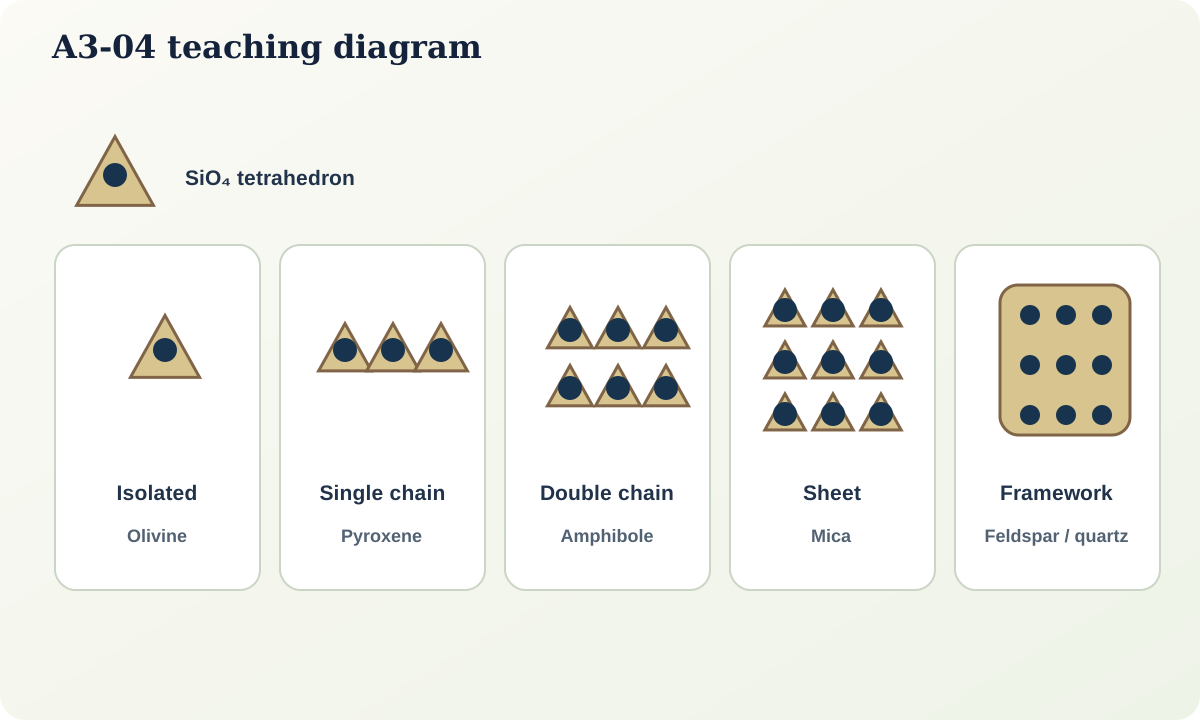
The silicate tetrahedron contains silicon coordinated by four oxygen atoms. Tetrahedra can remain isolated or share oxygen atoms to form pairs, rings, chains, sheets and frameworks. This structural organisation helps explain cleavage, habit and chemical capacity, but natural mineral structures include distortions, substitutions and larger polyhedral sites. A simple polymerisation sequence is a teaching framework, not a complete classification algorithm.
- Olivines contain isolated tetrahedra linked through divalent-cation sites.
- Pyroxenes are commonly represented by single chains.
- Amphiboles contain double-chain silicate units and structural hydroxyl.
- Micas and many clay minerals have sheet structures.
- Feldspars and quartz are framework silicates.
Quartz
Quartz has ideal composition \mathrm{SiO_2} and no cleavage. It commonly shows vitreous lustre, hardness near 7 and conchoidal fracture, although grain boundaries and deformation may obscure fracture. Colour varies widely because of defects, inclusions and irradiation. Quartz occurs in many igneous, sedimentary, metamorphic and hydrothermal settings, so its presence alone rarely identifies a process.
Silica polymorphs have the same bulk composition but different structures and stability ranges. Do not use “quartz” as a generic name for every silica phase or glass.
Feldspars
Feldspars are framework aluminosilicates and are among the most abundant crustal minerals. Two broad compositional families are important:
- alkali feldspars, described largely by K–Na components; and
- plagioclase feldspars, forming an albite–anorthite solid-solution series with coupled Na–Si and Ca–Al substitution.
Feldspars commonly have hardness near 6 and two good cleavages near 90°. Plagioclase may show fine striations from twinning; alkali feldspar may show perthitic intergrowth or characteristic twinning, but these features are not guaranteed in a hand specimen. Weathering can cloud feldspar and replace it with clay or fine mica, changing colour and apparent hardness.
Micas
Micas have a sheet structure and one excellent basal cleavage, allowing thin elastic or flexible sheets. Muscovite is commonly pale, whereas biotite is commonly dark brown to black, but colour is only a first screen. Fine-grained white mica may be described as sericite in textural usage; that field term does not by itself establish a species or origin.
Aligned micas can define igneous flow fabric, sedimentary parting, metamorphic foliation or hydrothermal alteration. Texture and cross-cutting relationships are needed to distinguish these histories.
Pyroxenes and amphiboles
Pyroxenes and amphiboles are commonly dark, prismatic silicates containing Fe, Mg, Ca, Na and other constituents in variable proportions. A useful hand-specimen distinction is cleavage geometry: many pyroxenes show two cleavages close to 90°, while many amphiboles show intersections near 60° and 120°. Grain size, orientation and broken surfaces can make this test unreliable.
Amphiboles contain structural hydroxyl and have double-chain structures; pyroxenes have single chains. These differences affect composition, habit and stability, but black colour and elongate form alone cannot securely separate the groups.
Olivines
Common olivine ranges along the forsterite–fayalite join. It is typically granular, lacks good cleavage, shows uneven to conchoidal fracture and is commonly olive green, although alteration can turn grains brown, red or green through secondary products. Olivine is important in mantle-derived and mafic to ultramafic rocks. Its reaction or replacement textures may be more informative than its presence alone.
Other common and accessory phases
Carbonate minerals such as calcite and dolomite dominate many carbonate rocks and occur in veins and alteration. Clay minerals are essential in soils, sedimentary rocks and altered materials but are commonly too fine grained for secure visual identification. Garnet, epidote, chlorite, serpentine-group minerals, kyanite, andalusite, sillimanite, apatite, zircon, titanite and iron oxides can be important accessory or index phases.
The word “accessory” means low modal abundance in a rock, not low scientific value. Zircon can carry age and trace-element information; magnetite can dominate magnetic response; a small sulfide fraction can control metal content.
A practical comparison
| Group | Useful hand-specimen clues | Common ambiguity | Stronger follow-up | | --- | --- | --- | --- | | Quartz | Hard, vitreous, no cleavage, conchoidal fracture | Feldspar or glass on poor surfaces | Thin section or XRD | | Feldspar | Two cleavages near 90°, hardness near 6 | Quartz, pale pyroxene, altered grains | Twinning in thin section, chemistry | | Mica | One perfect basal cleavage, sheet habit | Chlorite or fine foliated aggregate | Optical properties, XRD | | Pyroxene | Stubby prisms, two near-90° cleavages | Amphibole or altered mafic mineral | Thin section, chemistry | | Amphibole | Elongate prisms, 60°/120° cleavage tendency | Pyroxene, tourmaline | Thin section, chemistry | | Olivine | Granular, no good cleavage, common green tint | Epidote, glass, altered aggregate | Thin section, XRD or chemistry |
Worked reasoning example: a coarse pale rock
A coarse crystalline specimen contains approximately 25% transparent grey grains with no visible cleavage, 50% pale blocky grains with cleavage, 15% white blocky grains with fine striations and 10% dark flaky grains.
- The grey grains are quartz candidates; blocky grains are feldspar candidates; dark flakes are mica candidates.
- Striations support plagioclase for part of the feldspar population.
- An interlocking coarse texture and quartz–feldspar–mica assemblage support a granitoid candidate.
- A formal igneous name still requires reliable modal proportions and the relation between alkali feldspar and plagioclase. A gneissic rock with similar minerals must be excluded by fabric, field context and microstructure.
The correct output at this stage is an assemblage and a rock-class candidate, not an unsupported precise name.
Practical investigation
Construct an assemblage card for six common mineral groups. For each group, draw or photograph fresh grains at the same scale and record cleavage, habit, hardness bracket, lustre, alteration and two look-alikes. Then examine three rocks and estimate mineral modes in broad bins. Compare visual estimates with a point-count grid and report the difference.
Mastery check
- Why is “feldspar” usually a group-level rather than species-level hand identification?
- Relate sheet structure to a common mica property.
- Why is cleavage angle generally more useful than dark colour for separating pyroxene and amphibole?
- Give two reasons a small accessory-mineral fraction can be geologically important.
- Why does a quartz–feldspar–mica assemblage not prove a unique rock origin?
Sources and further reading
- Mineral Identification Key, Mineralogical Society of America.
- Handbook of Mineralogy, Mineralogical Society of America.
- Rocks and minerals, British Geological Survey.