A3 · Publication Volume 4
Common Ore Minerals
sulfides, oxides, carbonates, native elements and their economic significance
Learning objectives
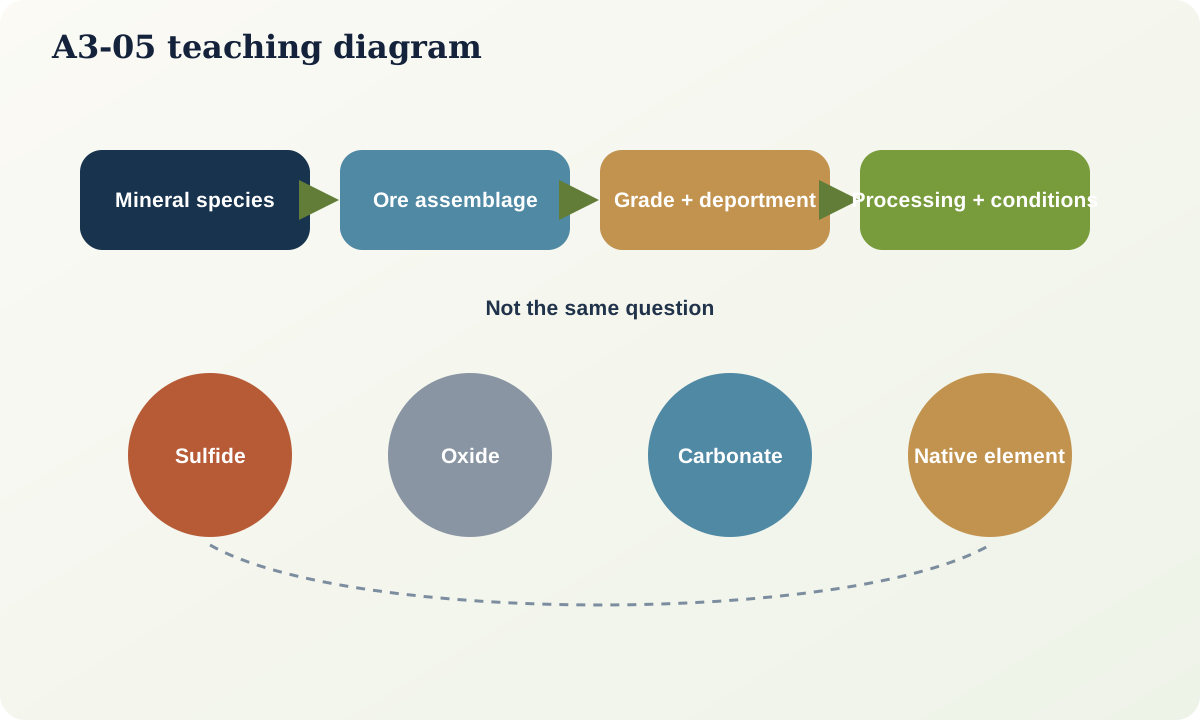
After this lesson, you should be able to distinguish an ore mineral from ore, recognise common sulfide, oxide, carbonate and native-element candidates, explain why assay grade does not specify mineralogy, and identify the additional observations needed to evaluate recoverability and risk.
Economic labels are conditional
An ore mineral contains an element or compound of potential value. Gangue refers to minerals or rock components that are not the intended valuable product in a stated process, although a gangue mineral in one operation may be a product or penalty phase in another. Ore is material that can be mined and processed under technical, economic, environmental, legal and social conditions defined for a particular assessment.
These terms must not be collapsed. Chalcopyrite remains chalcopyrite whether it occurs as a museum grain, a trace accessory or part of an economic copper ore. A high bulk copper assay does not reveal whether copper occurs in chalcopyrite, bornite, chalcocite, oxides, carbonates, silicates or an analytical mixture.
Common sulfide candidates
Sulfide and related minerals host many metals:
- pyrite
\mathrm{FeS_2}is common, brassy and hard, but is not a reliable gold indicator by appearance; - chalcopyrite
\mathrm{CuFeS_2}is a major copper mineral and is generally softer and more yellow than pyrite; - bornite
\mathrm{Cu_5FeS_4}can tarnish iridescently, but tarnish is variable; - galena
\mathrm{PbS}is dense, metallic and commonly shows cubic cleavage; - sphalerite
\mathrm{ZnS}varies greatly in colour and may show resinous to submetallic lustre; - molybdenite
\mathrm{MoS_2}is soft, platy and can resemble graphite; and - arsenopyrite
\mathrm{FeAsS}requires careful handling because arsenic-bearing material must not be tested by smell, heating or uncontrolled powdering.
Visual identification of fine intergrowths is unreliable. Reflected-light microscopy, XRD, SEM-based mineralogy or microanalysis may be required.
Oxides, hydroxides and weathered products
Magnetite \mathrm{Fe_3O_4} can be strongly magnetic; hematite \mathrm{Fe_2O_3} commonly gives a red-brown streak even when the specimen is steel grey. Cassiterite \mathrm{SnO_2}, chromite-group minerals, ilmenite \mathrm{FeTiO_3} and uranium oxides can be important ore minerals, but many are difficult to distinguish confidently in dark granular aggregates.
Weathering can transform primary sulfides into oxides, hydroxides, sulfates, carbonates and native metals. Iron-oxide staining records oxidation but does not identify the original sulfide or prove a valuable metal. Secondary copper minerals such as malachite can provide evidence of copper mobility, yet surface abundance may not represent unweathered material at depth.
Unknown heavy, radioactive, arsenic-bearing or sulfide-rich specimens require appropriate radiation, dust and chemical controls. Educational testing should be non-destructive unless a competent laboratory procedure is in place.
Carbonates and native elements
Carbonate minerals can be ore, gangue or alteration phases. Malachite and azurite can host copper; smithsonite can host zinc; siderite can host iron; calcite and dolomite commonly form gangue or industrial mineral products. Acid response, colour and density are useful but not sufficient for species-level identification.
Native gold, silver, copper and platinum-group minerals occur as elements or alloys. Gold is dense, sectile and malleable rather than brittle. Brassy colour alone cannot separate gold from pyrite or chalcopyrite, and tiny bright grains in photographs may be mica reflections. A reported native-metal identification should state how composition was confirmed.
Mineralogy, grade and deportment
Grade reports the concentration of a commodity in a defined sample. Mineral mode reports phase proportions. Deportment describes where the element resides among minerals and textures. Recovery depends on these together with grain size, intergrowth, surface condition and process design.
For example, two samples can both contain 1% Cu:
- in one, coarse liberated chalcopyrite may respond to a conventional concentration route;
- in another, copper may be finely locked, occur in multiple phases or be incorporated at trace levels in a host mineral.
The same assay number therefore does not imply the same recovery, product quality or waste behaviour. Penalty elements may occur in the target mineral, a separate phase or inclusions; that location matters.
Texture controls interpretation
Record whether ore minerals are disseminated, massive, vein hosted, fracture filling, breccia cement, stratiform, nodular, rimmed, exsolved or replacing another phase. Cross-cutting and inclusion relations constrain relative timing. Weathering rims and supergene enrichment can overprint primary textures.
Automated mineral maps can quantify phase and liberation at a selected polished section, but representativeness remains a sampling question. A two-dimensional section can intersect three-dimensional grains in biased ways.
Worked reasoning example: a brassy metallic grain
A specimen contains brassy metallic grains in quartz. Initial candidates are pyrite, chalcopyrite and native gold.
- The grains are hard enough to scratch a steel point and break brittly. Gold becomes unlikely.
- They show pale brass colour, cubic outlines and dark greenish-black streak. Pyrite is favoured over chalcopyrite, but surface tarnish and mixed grains remain possible.
- Bulk assay reports elevated copper and gold. This does not convert every brassy grain into chalcopyrite or gold.
- Reflected-light microscopy and spot chemistry show most cubes are pyrite, with fine chalcopyrite inclusions and gold below hand-specimen visibility.
The final interpretation separates visible host mineral, included phases and commodity assay rather than assigning one identity to all three.
Practical investigation
Build a candidate table for pyrite, chalcopyrite, galena, sphalerite, magnetite, hematite, molybdenite and native gold. Include safe hand properties, common look-alikes, likely commodity association and the minimum confirmatory test. Then take a public micrograph or mineral map and describe grain boundaries, inclusions, locking and possible sampling bias without estimating recovery from the image alone.
Mastery check
- Why can an ore mineral occur in material that is not ore?
- Give three possible mineralogical explanations for the same bulk metal grade.
- Why is iron staining weak evidence for the identity of a primary sulfide?
- Distinguish mineral mode, grade, liberation and deportment.
- What safety limits apply before testing an unknown metallic mineral?
Sources and further reading
- Mineral Commodity Summaries 2026, U.S. Geological Survey.
- Commodity statistics and information, U.S. Geological Survey.
- Handbook of Mineralogy, Mineralogical Society of America.