A3 · Publication Volume 4
Igneous Rock Classification and Texture
composition, grain size, intrusive and extrusive settings, and IUGS classification intuition
Learning objectives
After this lesson, you should be able to describe igneous texture before interpreting cooling history, choose between modal and chemical classification routes, normalise QAPF components, assign a provisional name from a stated diagram, and recognise when glass, alteration or pyroclastic texture prevents that route.
Classification has an input contract
Igneous rocks can be named from mineral mode, whole-rock chemistry, texture and special genetic or compositional criteria. These inputs are not interchangeable. A formal name is defensible only when the chosen scheme accepts the available observations.
The BGS Rock Classification Scheme draws substantially on IUGS recommendations while adding a hierarchical naming structure. Its central practical principle is useful beyond one scheme: classify what the material is from descriptive attributes before adding interpretation. Always record the scheme and version because boundaries and qualifiers differ.
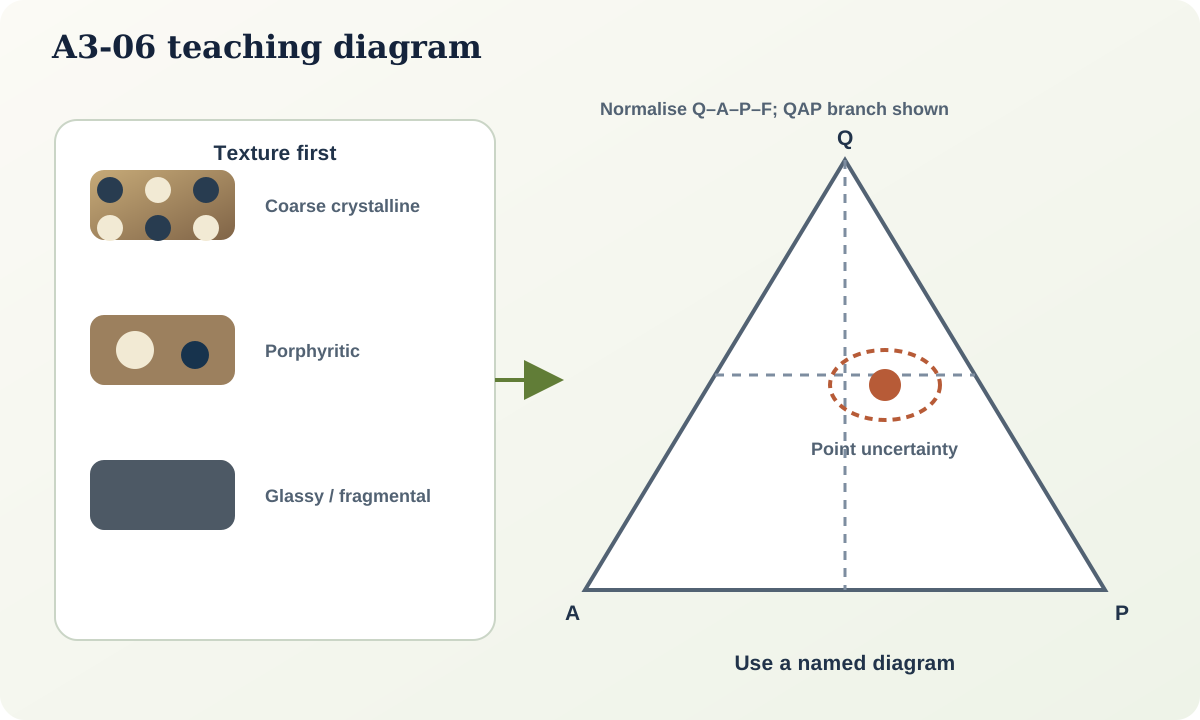
Describe texture first
Texture records grain size, shape, crystallinity and relationships:
- phaneritic rocks have crystals generally visible to the unaided eye;
- aphanitic rocks are dominated by crystals too fine for unaided identification;
- porphyritic texture contains larger phenocrysts in a finer groundmass;
- glassy material lacks sufficient crystalline order for modal mineral classification;
- vesicular texture contains former gas cavities; and
- pyroclastic material consists of fragments produced by explosive volcanic processes.
Coarse texture is consistent with time for crystal growth, and fine or glassy texture with rapid cooling or strong undercooling, but cooling rate is not the only control. Nucleation, melt composition, volatile content, pressure, reheating, mixing and deformation also affect texture. A porphyritic texture supports a change in crystallisation conditions; it does not by itself prove one simple two-stage cooling story.
Modal QAPF classification
For many sufficiently crystalline plutonic rocks, modal proportions of four felsic components are used:
Q: quartz;A: alkali feldspar;P: plagioclase; andF: feldspathoids.
Mafic minerals are described but excluded from the QAPF denominator. The applicable components are normalised to 100%:
Q' = 100\frac{Q}{Q+A+P+F}
with equivalent expressions for A', P' and F'. Quartz and feldspathoids normally do not coexist as stable primary modal components, so the appropriate upper or lower part of the double triangle is selected. The plotted field supplies a root name; colour index, grain size, fabric and other qualifiers are recorded separately.
QAPF should not be forced onto a glassy rock, a strongly altered rock whose primary mode is unrecoverable, or a fragmental rock requiring pyroclastic classification. A visual hand estimate may support a provisional field but not false precision near a boundary.
Chemical classification is a different route
Fine-grained volcanic rocks may be classified from whole-rock chemical analyses when primary mineral modes cannot be measured. Total-alkali–silica diagrams use specified oxide values and analytical preparation. They are not a translation of colour or a substitute for petrography. Alteration can mobilise alkalis and make a bulk analysis unsuitable; volatile-rich totals, weathered surfaces and mixed clasts require review.
Terms such as felsic, intermediate, mafic and ultramafic are broad compositional descriptors. Light colour commonly correlates with felsic mineralogy and dark colour with mafic minerals, but weathering, glass, grain size and unusual phases break that shortcut.
Mineral and textural pairs
Common introductory pairs connect broadly similar composition at contrasting grain size: granite–rhyolite, granodiorite–dacite, diorite–andesite and gabbro–basalt. These pairs are useful orientation, not a complete formal classification. A rock can have mixed, glassy, porphyritic or cumulate texture, and volcanic names may depend on chemistry rather than direct modal equivalence.
Cumulate rocks require attention to accumulated crystals and intercumulus material. Pegmatitic texture describes exceptionally coarse crystals and does not alone fix composition. Pyroclastic terms depend on fragment origin, size and consolidation and should not be replaced by a lava name merely because the fragments are volcanic.
Worked example: normalise and plot a mode
A coarse crystalline rock has measured modal percentages: quartz 20, alkali feldspar 12, plagioclase 48, biotite 12, hornblende 8. The QAPF sum is 20+12+48=80 because mafic minerals are excluded.
Q'=25,\qquad A'=15,\qquad P'=60
Within a commonly used IUGS-style plutonic QAPF diagram, Q'=25 places the rock in the quartz-rich upper fields and plagioclase forms 80% of total feldspar. The corresponding field is granodiorite. Report “biotite–hornblende granodiorite” only if qualifier order and abundance follow the selected naming convention.
Uncertainty matters: if visual mode errors of several percent could move the point across a field boundary, report the adjacent alternatives and obtain a point count or image analysis.
Practical investigation
Use a grid to estimate modes in three coarse crystalline specimen images at known scale. Repeat the count with a shifted grid and compare results. Normalise Q, A, P and F, plot each result on a named diagram and record boundary distance. For one fine-grained or altered specimen, explain why the QAPF route fails and specify a chemical, petrographic or descriptive alternative.
Mastery check
- Why are mafic minerals excluded from the QAPF denominator but retained in the rock description?
- When is a chemical classification preferable to a modal classification?
- Give three controls on igneous texture besides a simple cooling-rate statement.
- Why should a glassy or pyroclastic rock not be forced into a plutonic QAPF field?
- How would modal uncertainty affect a name near a field boundary?
Sources and further reading
- BGS Rock Classification Scheme, including Volume 1 for igneous rocks.
- BGS Rock Classification Scheme: igneous download, British Geological Survey.
- Rocks and minerals, British Geological Survey.