A3 · Publication Volume 4
Sedimentary Rock Classification and Texture
clastic, chemical and biogenic rocks, grain size, sorting and sedimentary structures
Learning objectives
After this lesson, you should be able to classify clastic grain size using a named scale, calculate phi size, describe sorting, roundness, matrix, cement and fabric, distinguish clastic from chemical and biogenic components, and keep depositional-environment interpretation separate from the rock name.
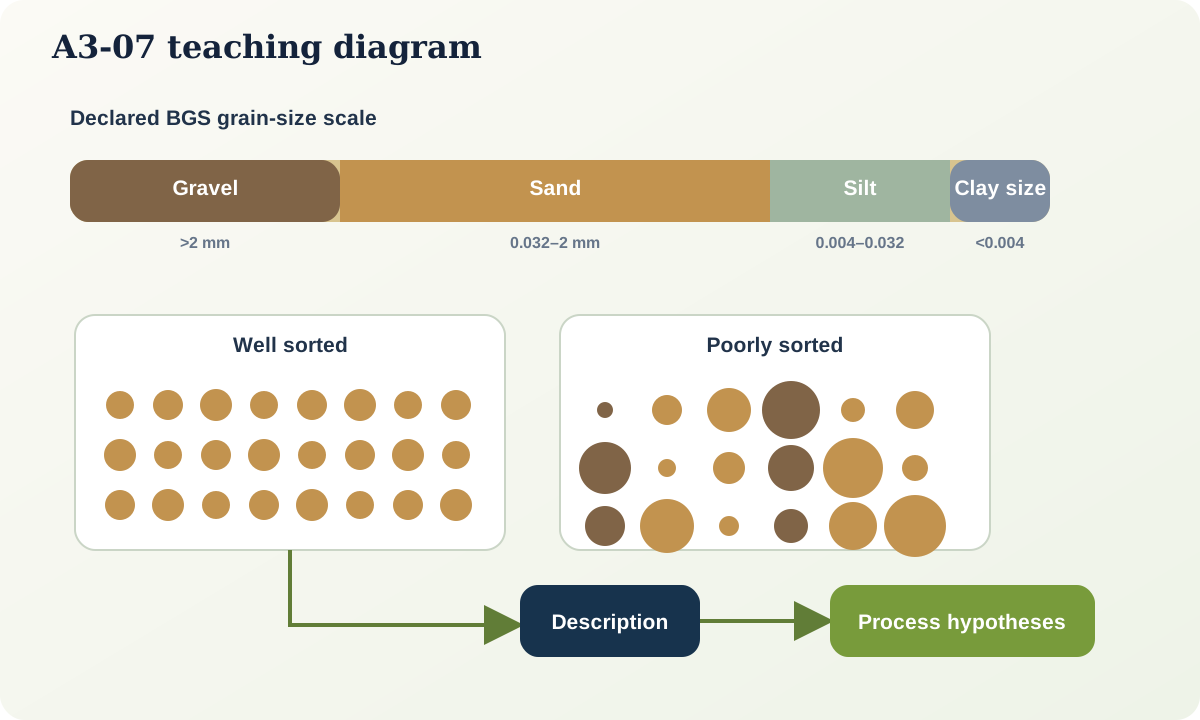
Describe the material before its environment
Sedimentary names have historically mixed grain size, composition, texture, origin, depositional setting and local usage. A reproducible scheme begins with observable material. The BGS Rock Classification Scheme is explicitly designed so that sediments and sedimentary rocks can be named without assuming their field setting or mode of origin.
This does not make process unimportant. It preserves a clean evidence chain: describe grains, matrix, cement, structures and fossils first; then test alternative transport, depositional and diagenetic explanations.
Grain-size schemes must be named
Boundaries vary among conventions. In the BGS RCS modified Wentworth scheme:
- gravel is greater than 2 mm;
- sand is 0.032 to 2 mm;
- silt is 0.004 to 0.032 mm; and
- clay-size material is less than 0.004 mm.
Other widely used Wentworth-style schemes place the sand–silt boundary at 0.0625 mm. Neither boundary should be applied silently. Record the scheme, whether the measurement is sieve, image, laser or settling based, and whether “clay” means a size fraction or clay-mineral composition.
The phi transform expresses diameter d in millimetres as
\phi=-\log_2(d)
so larger positive \phi means finer grains. A 0.25 mm grain has \phi=2; a 4 mm granule has \phi=-2. The logarithmic scale is convenient for size distributions, but it does not eliminate method or shape effects.
Texture includes more than size
Record:
- sorting: the spread of grain sizes under a stated visual or statistical method;
- roundness: sharpness of grain corners, distinct from overall sphericity;
- fabric: preferred orientation, packing and grain support;
- matrix: finer material between framework grains;
- cement: post-depositional material binding grains; and
- porosity: visible or measured void space, including dissolution and fracture pores.
A sandstone can be grain supported or matrix rich, well sorted or poorly sorted, quartz rich or lithic rich, porous or tightly cemented. “Sandstone” alone does not contain these properties.
Clastic components and names
Clastic sedimentary rocks are built from transported fragments. Conglomerate and breccia contain gravel-size clasts, commonly distinguished by rounded versus angular dominant clasts under a stated scheme. Sandstones are sand dominated; siltstones and claystones are finer grained. Mudstone is used in several ways and must be tied to the selected classification.
Sandstone composition can be described with quartz–feldspar–lithic proportions after defining how polycrystalline and altered grains are counted. A provenance triangle is not a depositional-environment diagram. Grain survival, recycling, weathering, transport, diagenesis and counting rules all influence the plotted composition.
Carbonate, chemical and biogenic materials
Carbonate rocks can contain skeletal grains, coated grains, peloids, intraclasts, carbonate mud and cement. Classification schemes emphasise different combinations of components and depositional texture. Acid reaction can screen carbonate presence but does not determine a carbonate-rock name.
Evaporites, iron-rich rocks, phosphatic rocks, organic-rich materials and siliceous sedimentary rocks require compositional observations beyond clastic grain size. Biogenic contribution can be substantial even when later recrystallisation obscures original forms. Hybrid rocks should not be forced into a pure end member when two components are significant.
Sedimentary structures and diagenesis
Bedding, lamination, cross-stratification, grading, ripples, mud cracks, bioturbation and sole structures can constrain processes and palaeoflow. Their interpretation depends on orientation, scale and preservation. A hand specimen may not contain enough context to distinguish a bed top from a cut surface.
Compaction, cementation, dissolution, recrystallisation and replacement modify sediment after deposition. Cement can reduce porosity; dissolution can create secondary pores; pressure solution can create stylolites; mineral replacement can preserve a ghost of original texture. A final description should separate depositional grains from diagenetic products where evidence allows.
Worked example: classify before interpreting
A sample contains 70% subrounded 0.15–0.45 mm grains, 20% finer matrix and 10% cement. Framework grains are about 65% quartz, 20% feldspar and 15% lithic fragments. Sorting is moderate and weak planar lamination is present.
- Under the declared BGS scale, the framework is sand size, mostly fine to medium sand.
- The material is a matrix-bearing sandstone; a more specific root name depends on the adopted matrix and compositional thresholds.
- Quartz–feldspar–lithic proportions are reported separately with the counting rule.
- Moderate sorting and lamination are compatible with several fluvial, coastal, aeolian or subaqueous processes. They do not uniquely identify an environment.
- Grain-size distributions, sedimentary structures at outcrop scale, palaeoflow, fossils and stratigraphic relationships are proposed as discriminating evidence.
Practical investigation
Measure at least 100 grains on a calibrated sediment image. Convert diameters to phi units and plot a histogram. Record the imaging selection and whether long, short or equivalent diameter was used. Describe sorting and compare the numerical distribution with a visual class. Then write two depositional hypotheses and list evidence outside the grain-size image that would distinguish them.
Mastery check
- Why must a grain-size boundary be accompanied by a named scheme?
- Distinguish grain size, sorting, roundness and sphericity.
- Why does “clay” need clarification in a sediment description?
- Give two diagenetic processes that can change porosity.
- Why cannot a sandstone composition triangle prove a unique depositional environment?
Sources and further reading
- BGS Rock Classification Scheme, including Volume 3 for sediments and sedimentary rocks.
- BGS modified Wentworth grain-size vocabulary, British Geological Survey.
- BGS Geology: bedrock descriptions, British Geological Survey.