A3 · Publication Volume 4
Metamorphic Rock Classification and Fabric
foliation, lineation, mineral assemblages and metamorphic rock naming
Learning objectives
After this lesson, you should be able to distinguish metamorphism from melting, describe foliation and lineation, use mineral assemblage and protolith evidence in naming, explain why an index mineral is not a universal pressure–temperature gauge, and recognise overprinting and retrogression.
Metamorphism changes a rock in the solid state
Metamorphism is dominated by changes in mineral content, composition and microstructure while the rock remains substantially solid. Temperature, pressure, differential stress, fluid composition, reaction kinetics and protolith chemistry all matter. Partial melting marks a transition into migmatitic and igneous processes; a rock can preserve evidence of both.
The protolith is the precursor material. It may be igneous, sedimentary, metamorphic or uncertain. A confident protolith name requires preserved composition, relic textures, field relationships or chemical evidence. Do not infer “metasedimentary” from foliation alone.
Describe fabric at the observed scale
Fabric is the spatial and geometric arrangement of components. Important metamorphic fabrics include:
- foliation: a penetrative planar arrangement or compositional layering;
- lineation: a penetrative linear alignment or intersection feature;
- slaty cleavage: closely spaced planar fabric in very fine-grained rocks;
- schistosity: foliation defined by visible platy or elongate minerals;
- gneissosity: compositional or mineralogical banding characteristic of many gneisses; and
- granofelsic fabric: broadly equigranular, non-foliated metamorphic texture.
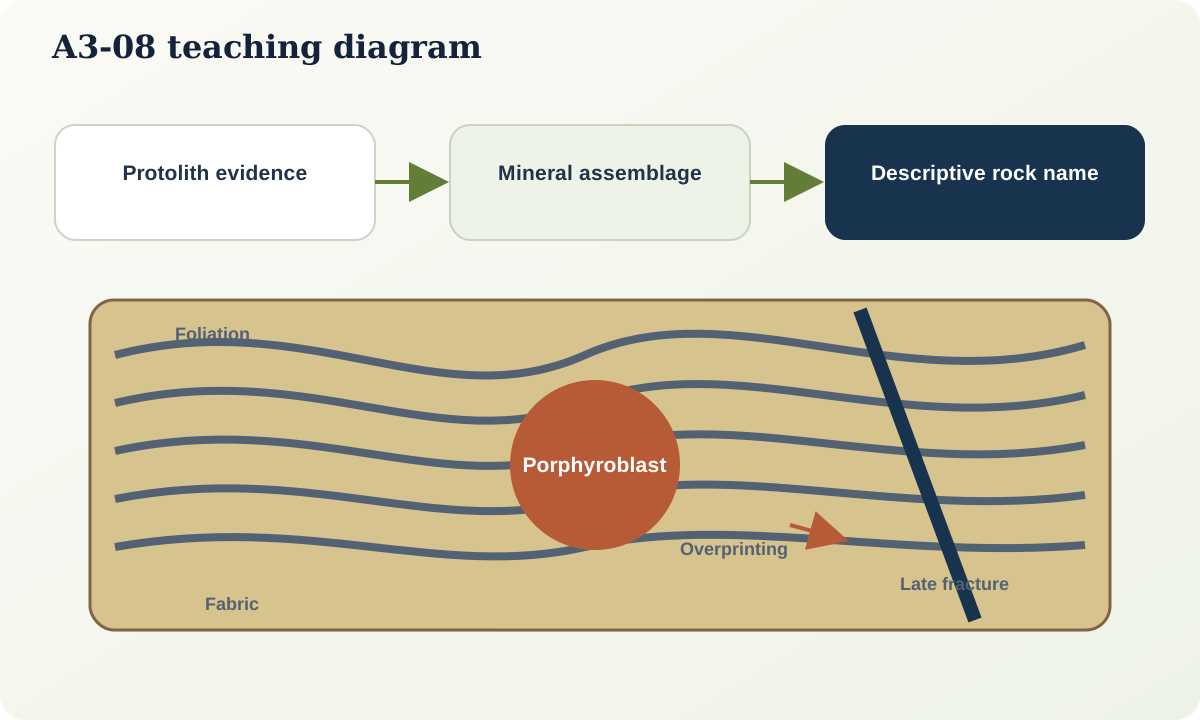
Record spacing, continuity, grain size, mineral definition, orientation and overprinting. A “foliated rock” may contain more than one foliation. Crenulation, porphyroblast inclusion trails, shear bands and cross-cutting veins can reveal event order.
Naming combines several valid bases
Metamorphic nomenclature may use protolith, mineral content, fabric or a special traditional root name. Examples include metabasalt, garnet–mica schist, quartzofeldspathic gneiss, marble, quartzite, amphibolite and hornfels. The BGS and IUGS-related schemes emphasise descriptive attributes and defined qualifiers.
No single naming sequence works for every rock. A useful record separates:
- root name and scheme;
- principal and characteristic minerals;
- fabric and grain size;
- protolith interpretation and confidence; and
- overprinting, alteration and weathering.
Traditional sequences such as shale → slate → phyllite → schist → gneiss are useful for visualising increasing recrystallisation and changing fabric in some pelitic rocks. They are not a universal thermometer, a mandatory path or a complete classification of metamorphic grade.
Mineral assemblages constrain conditions
An assemblage is the set of minerals interpreted to have coexisted in a selected domain. Equilibrium phase relations depend on pressure P, temperature T, bulk composition X, fluid composition and oxidation state. A stable assemblage in one protolith may be impossible in another at the same P and T.
Index minerals such as chlorite, biotite, garnet, staurolite, kyanite, andalusite or sillimanite can organise regional patterns in suitable bulk compositions. Their presence is not a universal grade label. A grain may be detrital, inherited, metastable, compositionally restricted or produced by a later event. Textural equilibrium and reaction relationships matter.
A metamorphic facies groups assemblages formed under a broad range of conditions. Facies names describe mineralogical response, not depth alone, and boundaries vary with composition and fluid conditions.
Overprinting, reaction and retrogression
Metamorphic rocks commonly preserve incomplete reactions. Porphyroblasts may contain relic cores and younger rims. Reaction coronas, symplectites and pseudomorphs record replacement. Deformation can enhance reaction by creating pathways and new surfaces.
Retrogression is lower-temperature re-equilibration during cooling, uplift or fluid ingress. It may replace pyroxene with amphibole, biotite with chlorite, or feldspar with fine mica and other products depending on chemistry and conditions. Retrogression can be local along fractures or pervasive. The youngest visible mineral is not necessarily the mineral that records peak conditions.
Worked reasoning example: a garnet-bearing foliated rock
A medium-grained rock contains quartz, white mica, biotite and red-brown garnet. Micas define a strong foliation that wraps garnet. Some garnets contain an internal fabric at an angle to the external foliation; chlorite occurs along late fractures.
- The visible mica-rich foliation and grain size support a schist root name.
- Garnet is a characteristic qualifier: “garnet–mica schist” is a defensible descriptive name.
- The internal–external fabric relation suggests garnet growth during a changing deformation history, but geometry must be tested in multiple sections.
- Chlorite on fractures may represent later fluid-assisted retrogression rather than peak assemblage.
- Protolith and pressure–temperature path require bulk chemistry, mineral composition, microtextures and regional relations; they are not established by the hand specimen.
Practical investigation
On a high-resolution image of a foliated metamorphic rock, map domains for matrix, porphyroblasts, veins and late alteration. Draw at least two foliations or state that only one is observed. Build a relative sequence from inclusion, wrapping, truncation and replacement relations. Give the rock a descriptive name, then list the data needed for a protolith and pressure–temperature interpretation.
Mastery check
- Why is metamorphism described as a solid-state process even though fluids may be present?
- Distinguish foliation, schistosity, gneissosity and lineation.
- Why can the same index mineral imply different conditions in different bulk compositions?
- What evidence distinguishes peak mineral growth from retrogression?
- When is a protolith-based name less defensible than a fabric-based name?
Sources and further reading
- BGS Rock Classification Scheme, including Volume 2 for metamorphic rocks.
- BGS metamorphic-rock classification download, British Geological Survey.
- IUGS Subcommission on the Systematics of Metamorphic Rocks recommendations, terminology and nomenclature papers.