A3 · Publication Volume 4
Alteration, Veins and Replacement
alteration minerals, veins, replacement textures and fluid–rock interaction
Learning objectives
After this lesson, you should be able to distinguish open-space filling from replacement, describe alteration with mineral evidence rather than colour alone, use cross-cutting and reaction textures to order events, explain host-rock control, and identify uncertainty in common alteration-zone labels.
Alteration is an observed change plus an interpreted cause
Alteration describes mineralogical, chemical or physical modification of a pre-existing material. Hydrothermal alteration involves reaction with hot aqueous fluids; weathering involves near-surface fluids, gases and organisms; metamorphic reaction occurs over a broad range of crustal conditions. Their products can overlap. Fine white mica, clay, carbonate, chlorite, silica and iron oxides do not carry a unique process label by themselves.
Describe the changed mineral, texture and geometry before assigning an alteration type. Compare altered rock with the least altered available equivalent, while recognising that the apparent precursor may already differ in primary composition.
Vein filling and replacement are different geometries
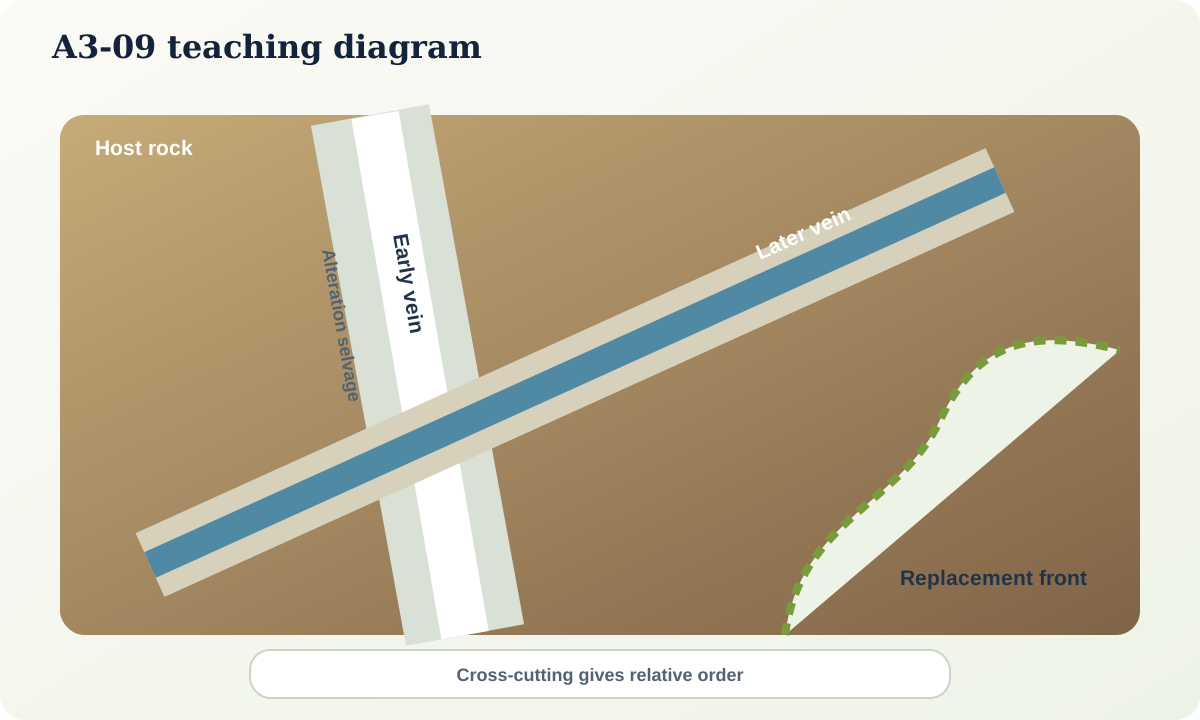
A vein is mineral material occupying a fracture or other opening. Evidence for open-space growth can include comb crystals growing from walls, symmetrical bands, crustiform layers, vugs and matching wall geometry. A replacement forms when new minerals consume an earlier mineral or rock while approximately preserving some external volume or texture. Pseudomorphs, embayed fronts, relic islands and reaction rims support replacement.
The two processes can occur together. A fracture may open, fill, seal, reopen and react with its walls. A vein can contain replaced fragments; a replacement front can follow a permeable fracture. Record observed geometry instead of forcing one label.
Alteration assemblages are conditional indicators
Common field terms include potassic, propylitic, phyllic or sericitic, argillic, advanced argillic, silicic and carbonate alteration. Their mineral definitions and usage vary among deposit models and regions. A robust record lists actual minerals and textures, for example “quartz + fine white mica + pyrite replacing feldspar,” then states the scheme under which that assemblage is called phyllic.
Assemblages depend on temperature, pressure, fluid composition, water–rock ratio, permeability, reaction progress, redox state and host composition. Published studies show that the same fluid can produce contrasting products in different wall rocks. Consequently, an alteration mineral is not a unique thermometer or proof of a deposit type.
Mass transfer and volume change
Metasomatic alteration includes chemical mass transfer. Comparing raw concentrations can mislead if the rock gained or lost total mass. An element assumed to be relatively immobile may be used as a reference, but immobility is a hypothesis that must be tested across samples and mineral hosts.
For a simple element i, the concentration ratio C_i^{\mathrm{alt}}/C_i^{\mathrm{fresh}} does not by itself equal mass gain. Density, volume change and the reference-frame choice matter. Isocon or mass-balance methods formalise the comparison, but their result inherits sample matching and immobile-element assumptions.
Textural evidence provides an independent check. Added quartz may fill fractures, replace feldspar or do both; bulk silica enrichment alone cannot choose among them.
Vein textures and relative sequence
Describe vein mineralogy, width, orientation, wall contacts, internal bands, brecciation, crystal growth direction and alteration selvage. Cross-cutting provides relative age only at the intersection observed. Apparent truncation can result from sectioning or poor exposure.
A useful sequence might be:
- early quartz vein with wall-rock fragments;
- reopening and sulfide infill along the centreline;
- later carbonate vein that cuts both;
- oxidation along a surface fracture.
Absolute age and duration remain unknown until suitable material and dating methods are available. Similar-looking veins in separated outcrops are not automatically the same generation.
Replacement and preservation of ghosts
Replacement can preserve original grain outlines, cleavage traces, fossils, clasts or banding as ghost textures. These relics support a precursor interpretation but need microstructural confirmation. Complete replacement may erase evidence and create equigranular aggregates that resemble primary rocks.
Reaction fronts are often zoned because fluid composition changes as it reacts, and because transport competes with reaction. A visible alteration halo can therefore record both pathway and host buffering. Its present width is not simply fluid-flow duration.
Worked reasoning example: two veins and an altered wall
A mafic rock is cut by a quartz–pyrite vein with a pale mica-rich selvage. A later calcite vein cuts the quartz–pyrite vein and has a narrow chlorite rim.
- Cross-cutting establishes calcite veining after the observed quartz–pyrite segment.
- Fine white mica replacing feldspar supports fluid–rock reaction adjacent to the early vein; “sericitic” can be used only with its mineral definition stated.
- Chlorite near the later vein may reflect lower-temperature fluid, host control or reaction progress; it is not a unique temperature reading.
- Pyrite in the early vein does not prove an economic commodity.
- Thin section, mineral chemistry, bulk mass balance and repeated structural observations are proposed to test replacement, event correlation and element transfer.
Practical investigation
Map a veined specimen or outcrop image using separate layers for host lithology, fractures, vein generations, breccia, replacement and weathering. Number only relations that are directly observed. For every alteration label, list the minerals that define it and at least one alternative origin. End with a sampling plan that crosses the least-altered host, outer halo, inner selvage and vein.
Mastery check
- What observations distinguish open-space vein growth from replacement?
- Why is alteration colour alone weak evidence?
- Give three controls that can make the same fluid produce different wall-rock assemblages.
- Why does concentration change not directly equal mass gain or loss?
- What does a cross-cutting relation establish, and what does it leave unresolved?
Sources and further reading
- Hydrothermal alteration in Yellowstone, U.S. Geological Survey.
- Hydrothermal alteration and mineralisation, U.S. Geological Survey Open-File Report.
- Porphyry and epithermal mineral deposits, U.S. Geological Survey.