A3 · Publication Volume 4
Physical Properties of Earth Materials
density, porosity, magnetic susceptibility, electrical properties, elasticity, strength and anisotropy
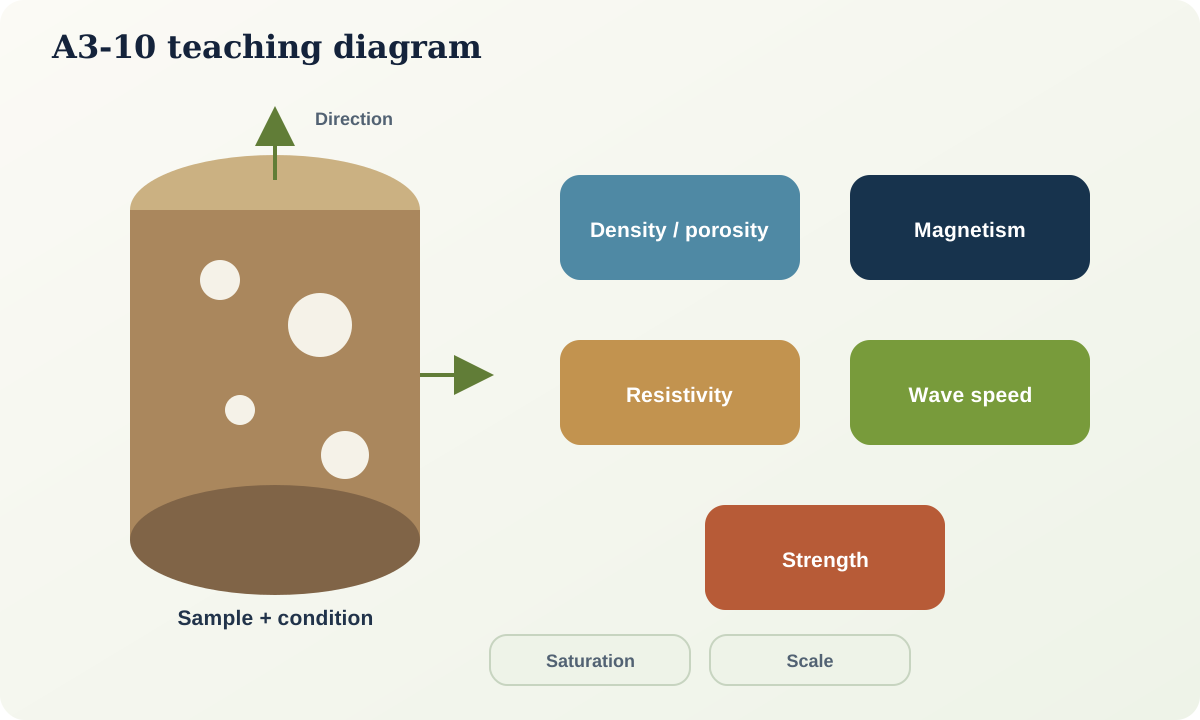
Learning objectives
After this lesson, you should be able to distinguish grain from bulk density, calculate simple porosity, separate porosity from permeability, describe magnetic and electrical properties with units and conditions, relate elastic moduli to wave speed, and explain why strength and anisotropy depend on sample support and test method.
A property belongs to a material under conditions
Earth-material properties depend on composition, phase proportions, pores, cracks, fluids, weathering, stress, temperature, frequency, direction and sample scale. A number copied from a table is not automatically applicable to an outcrop or geophysical cell. A complete record states material, specimen support, preparation, saturation, confining condition, direction, instrument, unit and uncertainty.
Rock-property reference frameworks emphasise that measured properties connect geophysical observations to geological interpretation. The connection is conditional: a gravity anomaly responds to density contrast and geometry, not to a rock name directly; a magnetic anomaly depends on susceptibility, remanence, field direction and body geometry.
Density and porosity
Grain density excludes connected and isolated pore volume. Dry bulk density divides dry mass by total bulk volume. Saturated bulk density includes pore fluid mass. For dry mass m_d and bulk volume V_b,
\rho_{b,d}=\frac{m_d}{V_b}
Porosity is the void fraction
\phi=\frac{V_v}{V_b}
and, under a simple two-component assumption with measured grain density \rho_g,
\phi \approx 1-\frac{\rho_{b,d}}{\rho_g}
This estimate assumes representative dry mass, compatible volume measurements and negligible inaccessible complications. Clay-bound water, rough surfaces, vesicles, sealed pores and fractures require suitable methods.
Permeability describes the capacity to transmit fluid under a pressure gradient. High porosity can be poorly connected and have low permeability; a low-porosity fractured rock can transmit fluid efficiently. Neither property should be inferred from the other without pore-network evidence.
Magnetic properties
Magnetic susceptibility relates induced magnetisation \mathbf{M} to applied field \mathbf{H} in a simple linear form:
\mathbf{M}=\boldsymbol{\chi}\mathbf{H}
\boldsymbol{\chi} may be direction dependent. Volume susceptibility is dimensionless in SI; mass susceptibility has different units and must not be mixed with it. Natural remanent magnetisation persists without the current applied field and can dominate or oppose the induced response. Magnetite abundance, grain size, oxidation, domain state and fabric all matter.
A hand magnet detects only a qualitative part of this behaviour. “Non-magnetic by hand magnet” does not mean zero susceptibility.
Electrical properties
Electrical resistivity for a simple uniform specimen is related to resistance R, length L and cross-sectional area A by
\rho_e=R\frac{A}{L}, \qquad \sigma=\frac{1}{\rho_e}
where \sigma is conductivity. Mineral conduction, interconnected sulfides or graphite, saline pore fluid, clay surface conduction, saturation, temperature and measurement frequency can change results by orders of magnitude. Contact resistance and electrode polarisation must be controlled.
Induced-polarisation response is not equivalent to conductivity. It depends on charge storage and interfacial processes as well as geometry and measurement parameters.
Elasticity and wave speed
For an ideal isotropic elastic material, P- and S-wave velocities can be written
v_P=\sqrt{\frac{K+\tfrac{4}{3}\mu}{\rho}}, \qquad
v_S=\sqrt{\frac{\mu}{\rho}}
where K is bulk modulus, \mu is shear modulus and \rho is density. Real rocks are heterogeneous, cracked, anisotropic and may be partially saturated. Effective velocity varies with confining pressure as cracks close, and frequency can matter when fluids redistribute.
Static elastic moduli from a loading test and dynamic moduli from wave velocities need not agree. Record which is used.
Strength is not a single intrinsic constant
Uniaxial compressive strength, tensile strength, cohesion, friction angle and fracture toughness describe different responses. Results depend on specimen size and shape, loading rate, end preparation, moisture, confining pressure, weathering, discontinuities and loading direction. Intact-rock strength cannot be substituted for rock-mass strength without accounting for joints, faults and scale.
Anisotropy means that a property changes with direction. Bedding, foliation, aligned cracks, mineral shape and stress history can produce anisotropic velocity, conductivity, permeability and strength. Report measurement orientation relative to fabric.
Worked example: density and porosity
A dry, intact core plug has mass 260 g and bulk volume 100 cm³, so dry bulk density is 2.60 g cm⁻³. Helium pycnometry on crushed representative material gives grain density 2.72 g cm⁻³.
\phi\approx 1-\frac{2.60}{2.72}=0.044
Estimated porosity is 4.4%. Reported uncertainty must include both measurements and representativeness. If the plug contains sealed vugs not accessed by the grain-density preparation, or if crushing samples a different mineral proportion, the simple estimate can be biased. Permeability still requires a flow test or validated pore-network relation.
Practical investigation
Design a property sheet for five specimens. Measure dimensions, mass and dry bulk density; record saturation and visible pores. Measure susceptibility in three orientations if an instrument is available, or document a controlled qualitative magnet test. Plot density against lithology only after marking alteration, porosity and support. Explain which contrasts could influence gravity or magnetic observations and which cannot be inferred.
Mastery check
- Distinguish grain, dry-bulk and saturated-bulk density.
- Why can high porosity coexist with low permeability?
- What is the difference between susceptibility and remanent magnetisation?
- Give three controls on rock resistivity besides mineral name.
- Why should intact-core strength not be assigned directly to a fractured rock mass?
Sources and further reading
- Rock properties, Geoscience Australia.
- Rock Properties Web Service, Geoscience Australia data and method metadata.
- Density and magnetic properties of selected rock samples, U.S. Geological Survey data release.
- Electrical and magnetic properties of rock and soil, U.S. Geological Survey.