D4 · Publication Volume 20
Mine Planning and Scheduling
strategic, tactical and short-term horizons and constraints
Learning objectives
By the end of this lesson, the learner should be able to distinguish strategic, tactical and short-term planning; connect spatial reserves to activities and time; model precedence, capacity, access, blending and control constraints; reconcile plans across support and horizon; assess robustness under uncertainty; and maintain a schedule basis that separates targets from executable work.
Planning horizons and decisions
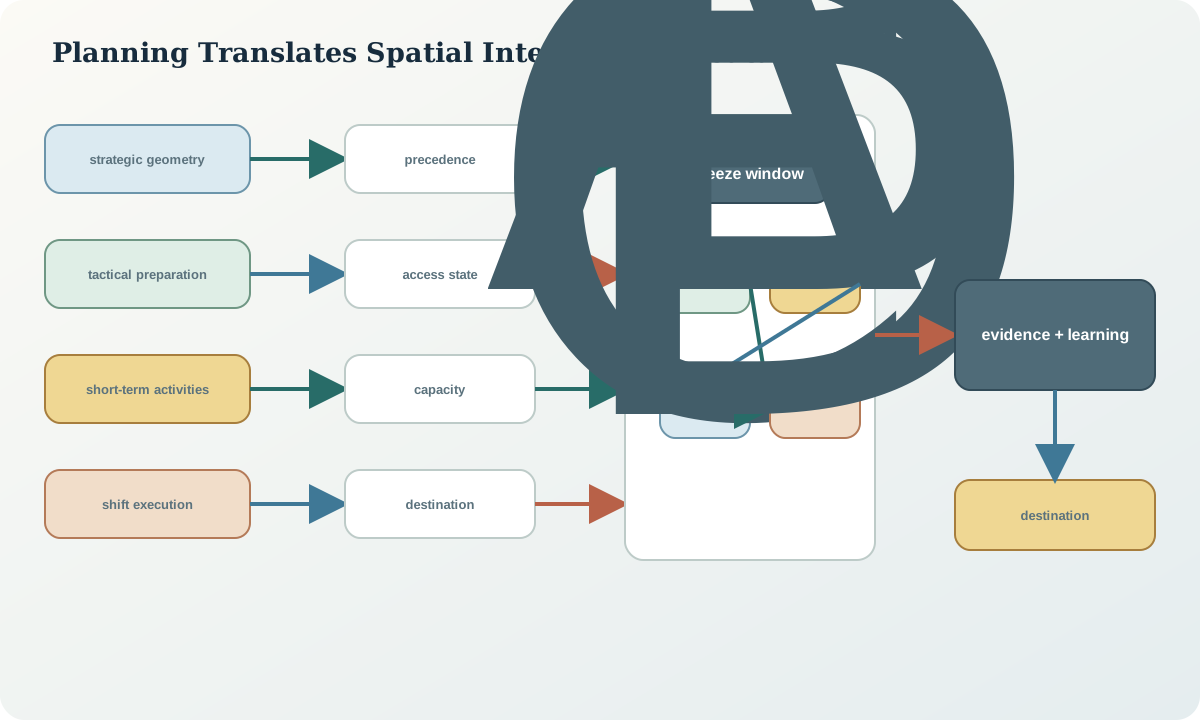
Strategic planning defines broad method, scale, infrastructure, sequence and value choices over the life of the system. Tactical planning translates those choices into phases, levels, development, annual or periodic capacities and preparation. Short-term planning allocates executable locations, crews, equipment, services and destinations over weeks, days or shifts. The names are less important than the decision resolution and commitment boundary.
Each horizon needs its own spatial support and uncertainty. A life-of-mine block or stope model may be adequate for alternatives but too coarse for a daily loading instruction. A short-term schedule cannot repair inaccessible reserves created by a strategic decision. Record how one horizon constrains and hands off to the next.
From spatial objects to activities
Convert design objects into activities with identity, location, quantity, duration basis, predecessors, resources, release criteria and completion evidence. Activities may include development, drilling, blasting, ventilation clearance, support, loading, haulage, fill, pumping, survey, sampling, construction and rehabilitation. A tonne target without activities is not a schedule.
Quantities must share a basis. Distinguish in-situ volume, broken volume, dry mass, wet mass, contained product and equipment hours. Link each activity to the design and material-model version from which its quantity was derived. When geometry changes, identify which downstream activities and totals are stale.
Precedence, access and state constraints
Precedence expresses physical or control logic: access before production, support before exposure, clearance before re-entry, fill curing before adjacent extraction. Spatial exclusion prevents incompatible simultaneous work. Network capacity limits haulage, hoisting, ventilation, pumping and utilities. State constraints require a location to be surveyed, released or serviced before it is executable.
Use directed graphs to expose loops and missing dependencies. A calendar start date does not prove readiness. Build a “make ready” check that tests geometry, access, ground, water, ventilation, services, survey, material destination and permits before an activity enters the frozen schedule.
Capacity and cycle representation
Capacity is conditional on route, material, equipment state, interaction and time. Separate nominal, effective and demonstrated capacity. Model bottlenecks across the complete chain rather than balancing each component independently. Adding production equipment can reduce output if haulage, ventilation or destination capacity is already binding.
Cycle-time distributions reveal variability hidden by averages. Include move, queue, delay, maintenance and rework where supported. Do not use a single utilisation factor to absorb every cause. Causal detail allows schedule learning and control improvement.
Material quality and destination constraints
Schedules move material with uncertain quantity and quality. Define material classes, destination acceptance, blending windows, stockpile capacity, contaminants, moisture and decision time. Maintain parcel lineage from source geometry to destination event. A schedule that meets total tonnes while violating quality or storage constraints is infeasible.
Use scenarios for uncertain boundaries and grades. Test whether destination plans remain feasible when a high-impact parcel changes class. Keep stockpile opening and closing inventory in the period balance. Do not force future assay knowledge into the schedule state that existed when a decision was made.
Reconciliation across horizons
Reconciliation asks whether strategic intent, tactical preparation, short-term commitment and actual execution remain comparable. Map objects between horizons: phase to bench to blast, level to stope to ring, or domain to parcel. Record splits and merges. Compare geometry, quantity, timing and state separately.
Variance does not automatically mean poor execution. It may reflect revised geology, deliberate risk control, equipment failure, inaccessible ground, water, survey correction or an unrealistic plan. Classify cause and update the appropriate horizon. Reforecasting must preserve the original baseline and decision history.
Freeze windows and controlled change
A freeze window protects execution from uncontrolled churn, but it cannot suppress new hazard evidence. Define what can change, who authorises it, what dependent objects are checked and how the field receives the revision. Emergency or safety changes override production convenience and must still be recorded.
Use immutable schedule versions with effective time. Late data should enter the next valid decision gate unless it triggers an explicit exception. Comparing actuals to a continuously overwritten plan destroys learning.
Robustness and uncertainty
Test schedules against geological, duration, equipment, access and service scenarios. Robustness is the ability to maintain essential objectives and controls across plausible variation, not the absence of variance. Measure alternative faces, development buffer, route redundancy, destination flexibility and recovery after disruption.
Optimisation can help explore large decision spaces, but its result inherits the objective, constraints and data. Validate feasibility independently, inspect binding constraints and run sensitivity. A mathematically optimal schedule that omits a ground-control hold point is not an acceptable plan.
Performance and leading indicators
Lagging measures include tonnes, metres, quality, cost and schedule adherence. Leading measures include development-ready inventory, supported headings, drilled inventory, water storage, survey release, service availability, control verification and unresolved exceptions. Choose indicators tied to causal models and action.
Avoid rewarding local output that transfers risk or work downstream. A high drilling rate may create unusable inventory; a loading target may overload a destination. Review the system constraint and safety controls together.
Synthetic worked example
A synthetic four-week plan schedules two surface blasts and three underground stopes. The nominal plan meets the material target but assumes the same pump capacity for a wet surface phase and an underground probe-drilling campaign. It also schedules a secondary stope before the adjacent fill acceptance record is available.
The feasibility review adds the shared pumping constraint, a fill-release predecessor and one alternative underground face. The nominal target decreases slightly, but the plan remains executable under a pump-outage scenario and preserves a controlled production path. The original plan is retained as a baseline; the approved revision records causes rather than rewriting history.
Practice and schedule-basis record
Create a ten-activity network containing one access dependency, one safety hold point, one shared resource, one destination constraint and one uncertain duration. Identify the critical dependency and build a disruption scenario. Then record schedule horizon, source versions, quantity bases, constraints, capacities, freeze rules, readiness tests, scenarios, indicators and approval state.
The record passes when a reader can reproduce why each activity was executable at the time, distinguish target from actual, and see how new geological information enters without retrospective leakage.
Sources
- Short-term planning optimisation model for underground mines, peer-reviewed research article.
- Short-term underground mine planning with uncertain activity durations, peer-reviewed research article.
- Improving productivity through enhanced short-term mine planning, peer-reviewed open-access article.
- Underground mine scheduling under uncertainty, peer-reviewed research article.