D4 · Publication Volume 20
Rock-Mechanics Foundations
stress, strength, discontinuities and failure modes
Learning objectives
By the end of this lesson, the learner should be able to distinguish stress, strain, strength and deformation; separate intact rock from discontinuity and rock-mass behaviour; explain scale, anisotropy and effective stress; identify basic failure modes; treat classifications and numerical models as evidence-dependent tools; and formulate a rock-mechanics question with testable assumptions.
Stress, traction and convention
Stress describes internal force intensity acting through a material. At a point it is represented by a tensor \boldsymbol{\sigma}; traction on a plane with unit normal \mathbf{n} is \mathbf{t}=\boldsymbol{\sigma}\mathbf{n}. Resolve traction into normal and shear components. State the sign convention, coordinate axes and whether reported values are total or effective.
Initial stress arises from gravity, tectonic history, topography, pore pressure and material contrasts. Excavation redistributes it, creating concentration, relief and rotation. A scalar “stress level” cannot describe direction-dependent response. Measurements and models sample limited volumes and require interpretation.
Strain, deformation and stiffness
Strain describes relative deformation. In a simple linear elastic idealisation, stress and strain are related by stiffness, but real rock may be nonlinear, anisotropic, fractured, time-dependent and damaged. Deformation may be recoverable, permanent or localised. Displacement at an opening combines material response, structure movement and measurement reference.
Stiffness is not strength. A stiff brittle material can fail at small strain; a weaker ductile or yielding system can accommodate displacement. Design questions often require both load capacity and displacement compatibility. Instrument range and anchorage must match the expected mechanism.
Intact rock, discontinuities and rock mass
Intact tests describe prepared specimens under specified loading, moisture, orientation and rate. Their results do not directly equal rock-mass strength. Joints, bedding, foliation, faults, veins and alteration divide the mass into blocks and introduce roughness, infill, persistence, aperture and water effects. Sampling can preferentially recover stronger pieces and miss weak seams.
Build a scale ladder from mineral and specimen to block, bench or opening, inter-ramp or mine scale. State which observations inform each scale. A property field can vary by domain and direction. Do not average across a thin persistent weak layer merely because it occupies little volume.
Strength and failure envelopes
Strength is conditional on confinement, stress path, orientation, water, rate and damage. A simple frictional-cohesive representation may be written \tau=c+\sigma_n'\tan\phi, where sigma_n' is effective normal stress. This is a model over a calibrated range, not a universal material identity. Tensile, shear, crushing, buckling and spalling mechanisms require different evidence.
Peak strength, residual strength and dilation affect post-failure behaviour. For brittle rock, crack initiation and damage may occur below peak. For discontinuities, roughness can mobilise high peak resistance that decreases with displacement. Match parameters to the displacement and confinement relevant to the decision.
Effective stress and water coupling
Fluid pressure reduces effective normal stress on connected features and can change shear resistance, deformation and fracture opening. A simplified relation is \boldsymbol{\sigma}'=\boldsymbol{\sigma}-\alpha p\mathbf{I}, with coefficient and assumptions stated. Rapid pressure change, incomplete drainage and multiphase conditions may require more complex treatment.
Dewatering can improve effective strength yet increase settlement, induce new gradients or change stress paths. Conversely, recharge or blocked drainage can raise pressure behind a slope or around an opening. Geomechanical and hydrogeological models therefore need shared domains, time steps and monitoring.
Structural and stress-driven failure modes
Structurally controlled modes include planar sliding, wedge release, toppling and block fall where discontinuity geometry permits movement. Rock-mass modes include circular or composite failure in weak material. Underground stress-driven modes include spalling, slabbing, squeezing, pillar yielding and dynamic rupture. Several mechanisms may interact or change as excavation advances.
Kinematic feasibility is not stability, and absence of a mapped daylighting set is not proof of safety. Persistence, bridges, water, confinement, blast damage and support affect behaviour. Maintain more than one failure hypothesis when evidence does not discriminate.
Classification systems as communication tools
Rock-mass classifications combine selected observations into categories or indices. They can organise data, support empirical comparison and improve communication when applied within their calibration context. They do not automatically generate support, slope angle or stope dimension. Different systems weight structure, strength, water and stress differently.
Store the underlying observations and calculation version, not only the class. Record mapping scale, orientation bias, missing data and adjustments. Use classification alongside mechanism-based analysis, monitoring and professional judgement.
Testing and parameter selection
Design a test programme backwards from the model and decision. Select specimens and orientations that represent domains, preserve moisture where relevant, document preparation and record failures. Field mapping, index tests, laboratory tests, borehole observations, stress measurements and back-analysis have different supports and biases.
Parameter selection is an inference with provenance. Report distribution, spatial assignment, scale adjustment, correlations and bounds. Calibrate against observations not already used to choose parameters where possible. A precise model input without a defensible evidence chain is false precision.
Models, sensitivity and validation
Analytical, empirical, limit-equilibrium, discontinuum and continuum models answer different questions. Define geometry, boundary conditions, constitutive behaviour, initial state, excavation sequence and output acceptance before running. Numerical convergence only shows that an algorithm solved its equations; it does not validate the geological or mechanical model.
Use simple checks, limiting cases, mesh or block sensitivity, parameter ranges and alternative mechanisms. Compare predicted displacement, damage, load or failure location with monitored response at the right scale and time. Update assumptions through controlled back-analysis without forcing a fit.
Synthetic worked example
A synthetic 12 m wide underground opening crosses competent massive rock and approaches a 1.5 m altered shear corridor. Intact specimens from outside the corridor are strong, while orientation core recovery in the corridor is poor. A model using only intact strength predicts small deformation, but mapping shows clay-coated structures subparallel to the wall and piezometers show elevated pressure.
The review creates two mechanisms: block sliding along persistent structures and yielding within the altered corridor. It requests targeted mapping, moisture-sensitive testing, pressure monitoring and an excavation-sequence assessment. The current model is limited to the competent domain; no support design is inferred from the strong specimens.
Practice and mechanics record
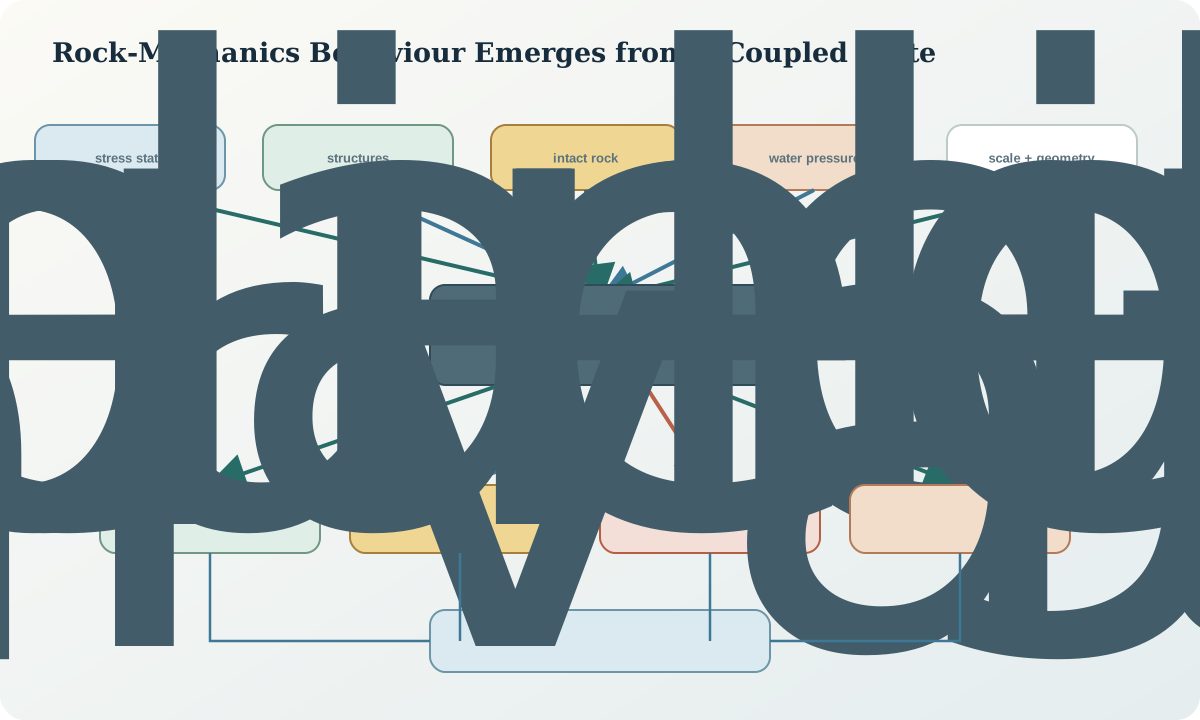
For a synthetic excavation, draw the stress path, two discontinuity sets and water pressure. State two plausible failure modes and the observations that discriminate them. Prepare a mechanics record containing purpose, domain, scale, coordinate and sign conventions, geometry, initial state, parameters with sources, model form, sensitivities, validation evidence, limitations and review authority.
A passing record never converts a classification number into an automatic design and never uses intact strength as an undocumented rock-mass property.
Sources
- Mining and ground falls, National Institute for Occupational Safety and Health.
- Proceedings on rock-mass classification in underground mining, National Institute for Occupational Safety and Health.
- Ground control management guideline, WorkSafe Western Australia.
- Guidance supporting the Mines Regulations, United Kingdom Health and Safety Executive.