D4 · Publication Volume 20
Ventilation and Services Overview
airflow, heat, gas and infrastructure data
Learning objectives
By the end of this lesson, the learner should be able to read a conceptual mine-ventilation network; relate airflow, velocity, pressure loss and resistance; distinguish primary and auxiliary ventilation; identify contaminant, heat and recirculation questions; map critical services and isolation; integrate geometry and operational state; and specify measurement and change controls without designing a real system.
Ventilation purpose and system boundary
Ventilation supplies suitable air, dilutes or removes contaminants and heat, and supports escape and emergency arrangements. Define the system boundary: openings, fans, shafts or portals, stoppings, doors, regulators, ducts, active workplaces, returns and sealed areas. Include surface conditions and time-varying production state. Air follows connected pressure paths, not lines drawn for convenience.
This lesson is conceptual. Required quantities, contaminant limits, fan selection, fire scenarios and statutory examinations are determined by applicable law and authorised ventilation professionals. Coal, metal, nonmetal, surface and underground settings differ materially.
Air quantity, velocity and continuity
Volumetric airflow is Q=Av, where A is cross-sectional area and v is representative average velocity. Area and velocity both vary; a single centre reading may not represent the section. Continuity requires flow balance at a node after accounting for leakage, storage approximations and measurement uncertainty.
Report sign and direction. Use compatible conditions when density changes matter. Compare measurement sum at junctions as a quality check, but do not force closure by distributing residual without investigating doors, leakage, timing and instrument limits.
Pressure and resistance
Fans create pressure difference that drives airflow through resistance. A common network idealisation is \Delta P=RQ^2, with resistance dependent on geometry, roughness, obstructions and air properties. Series paths add resistance; parallel paths divide flow according to resistance. Small geometric changes can redistribute the network.
Pressure surveys and fan operating data help diagnose the system. A calculated solution inherits the airway model and state. Door position, damaged control, new breakthrough, equipment and partial obstruction can invalidate it. Record effective time and inspection state.
Primary and auxiliary systems
Primary ventilation serves the mine network through main fans and major airways. Auxiliary systems deliver air to blind headings using ducts, fans or other arrangements. Their performance depends on duct condition, placement, leakage, recirculation and face geometry. Development advance continuously changes the required configuration.
Define installation, inspection, extension and re-entry controls. A fan running does not prove that air reaches the work area. Measure or verify at locations tied to the hazard and ensure return air does not short-circuit into intake.
Contaminants, heat and exposure
Potential airborne hazards include dust, diesel or combustion products, blasting fumes, gases, radon, welding emissions and oxygen deficiency, depending on the setting. Ventilation is one engineering control within a hierarchy; source reduction, enclosure, substitution and work organisation may also be required. Personal protection does not replace feasible higher-order controls.
Heat load can arise from rock temperature, equipment, water, oxidation and surface air. Humidity affects heat stress. Design and monitoring need metabolic work, acclimatisation and exposure criteria beyond an air-temperature reading. This tutorial gives no exposure limits.
Recirculation, leakage and controls
Recirculation occurs when return air re-enters an intake path. Leakage bypasses the intended route. Both can arise from pressure distribution, damaged or open controls, parallel connections and auxiliary arrangements. Trace airflow direction and contaminant transport under normal and abnormal states.
Stoppings, doors and regulators need identifiers, design function, inspection, leakage or pressure performance and change authority. Their failure can affect distant workplaces. A control inventory should connect the physical object to the network model.
Ventilation measurements and uncertainty
Measure section geometry, velocity profile, pressure, temperature, humidity and contaminants using appropriate instruments and procedures. Record location, time, operational state, instrument, calibration, method and uncertainty. Repeated values at different production states are not duplicates.
Use mass or flow balance, independent instruments and trend checks. Time synchronisation matters when fans, doors or equipment change. Identify inaccessible and inferred branches. A model that balances only after assigning implausible leakage needs investigation.
Mine services and infrastructure data
Services include power, communications, water supply and removal, compressed air, fuel, backfill, refuge, fire systems and monitoring networks. Each has source, route, capacity, state, isolation and dependency. Spatial congestion and shared crossings can create common-cause failure.
Build a service graph linked to surveyed openings. Record voltage or pressure class where appropriate, cable or pipe identity, isolation points, protected routes, inspection and effective state. Do not infer installed service from a design layer.
Change, outage and emergency states
New headings, breakthroughs, seals, fans, production equipment and fires can alter network behaviour. Apply management of change before planned alterations; retain emergency configurations and communication. Test fan outage, door failure, blocked airway, pump loss, fire location and communications loss at a conceptual level.
Emergency plans require current geometry and services. A refuge or escapeway is only functional if access, air, communications and capacity are maintained. Do not publish sensitive operational detail outside its authorised context.
Integration with geology and planning
Geology informs gas, heat, dust, oxidation, radon and structure-related pathways where relevant, but measurements determine current atmospheric state. Planning supplies active workplaces and sequence. Survey supplies airway geometry. Geotechnics supplies access or collapse constraints. Ventilation returns clearance, capacity and exclusion constraints.
Exchange by object and state. A heading is not “ventilated” as a timeless attribute; record configuration, verification and validity. New geological conditions that change gas or dust potential trigger review, not informal reinterpretation of measurements.
Synthetic worked example
A synthetic underground network has an intake splitting into two production districts. The total measured intake is 92\,\mathrm{m^3/s}, while branch readings sum to 84\,\mathrm{m^3/s} under nominally steady state. A new crosscut has opened between one return and the second intake, and the model still represents it as closed.
The review does not distribute the 8\,\mathrm{m^3/s} residual. It verifies measurement timing and sections, inspects the crosscut control, updates the network state and checks contaminant direction. The second district becomes conditional until recirculation is excluded and the network is rebalanced by the authorised role.
Practice and network record
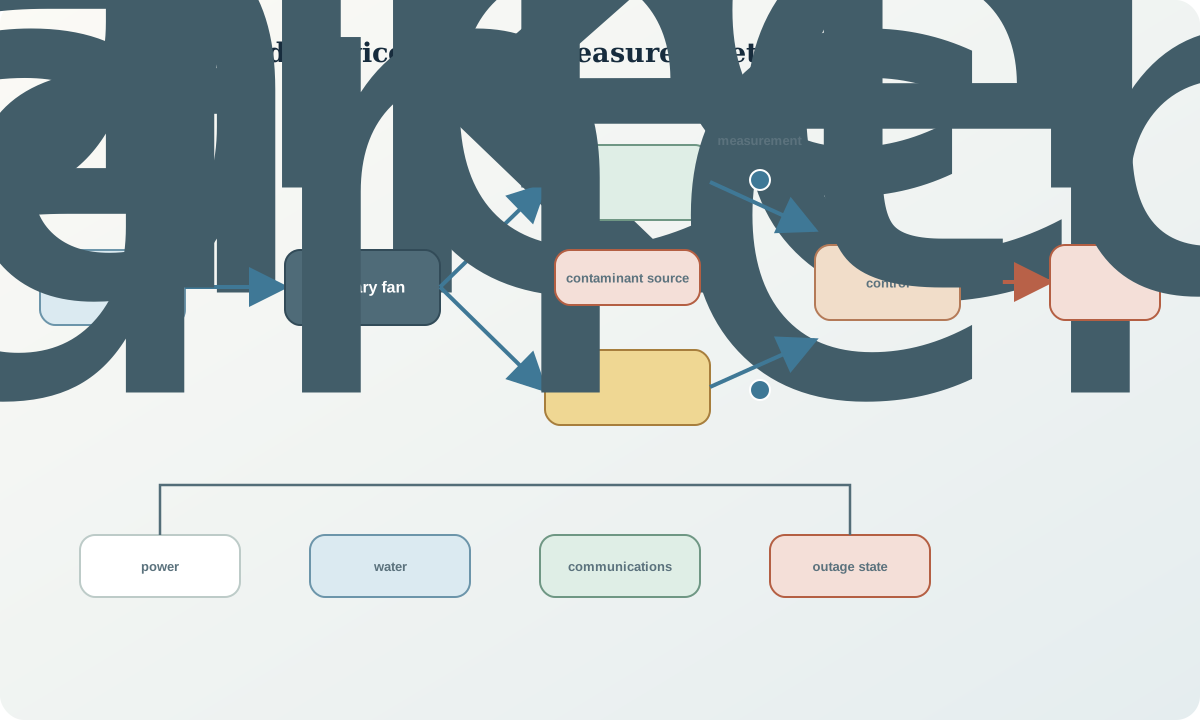
Draw a six-branch network with a fan, regulator, door, blind heading and possible leakage path. Assign synthetic areas and velocities, check node continuity and explain the residual. Add power, pumping and communications dependencies. Record model version, surveyed geometry, state, measurements, controls, anomalies, outage scenarios and approval boundary.
A passing record never supplies real ventilation settings or legal limits and never treats a calculated balanced network as proof of safe atmosphere.
Sources
- Technology note on directing ventilation airflow in large-opening mines, National Institute for Occupational Safety and Health.
- Handbook for dust control in mining, National Institute for Occupational Safety and Health.
- Mining fires and explosions, National Institute for Occupational Safety and Health.
- Research on ventilation and contaminant control in mines, National Institute for Occupational Safety and Health.