F1 · Publication Volume 30
Source Register and Accessibility Audit
public, industry and research sources, licences, versions and access
Learning objectives and boundary
- Explain public, industry and research sources, licences, versions and access as an auditable evidence problem.
- Separate source observations, controlled derivatives, interpretation and decision state.
- Apply identity, spatial, semantic, lineage, quality and review checks.
- Produce a versioned source register, accessibility log and admission decision table.
This lesson is part of a general, institution-neutral tutorial and has no relationship to any company or individual. All identifiers, geometries and values in the worked case are explicitly synthetic. The method does not confer professional authority and must not be transferred to a real decision without appropriate sources, competence, law and review.
Core method
A source register is an evidence-control record, not a bookmark list. Give every candidate source a stable local identifier and capture its title, responsible source role, edition or retrieval time, persistent locator, distribution format, spatial and temporal coverage, licence or access condition, checksum and relationship to earlier or derived versions. “Publicly reachable” does not mean unrestricted reuse, current, authoritative or suitable for the question.
Audit discovery and admission separately. Discovery records what may exist; admission decides what may support a stated claim. A source can be useful context but inadmissible for measurement because its scale, lineage or validity is unclear. Failed access is evidence too: preserve the attempted locator, response state and date instead of silently replacing the source. Cache only when conditions permit, and retain enough metadata to distinguish an immutable snapshot from a changing service response.
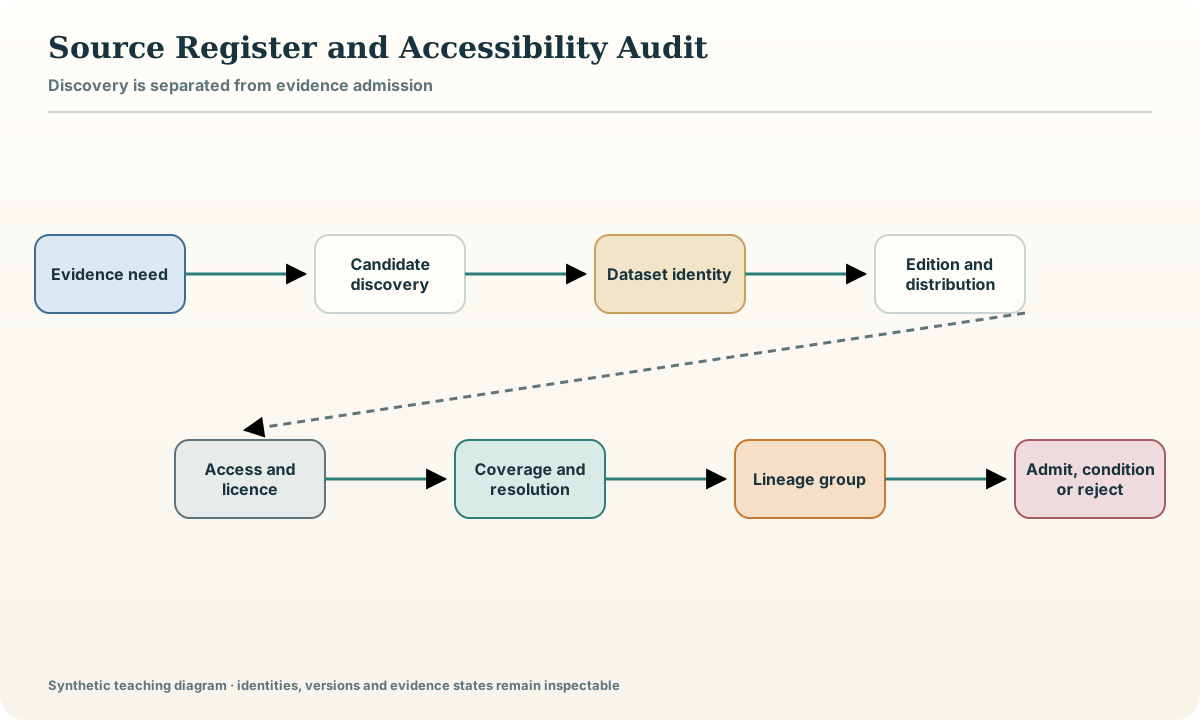
Record and evidence model
| Field or object | Operational meaning | |---|---| | source_id and version_id | identity of the conceptual source and exact edition | | locator and retrieved_at | where and when the distribution was obtained | | licence and access_state | reuse condition and observed accessibility | | coverage and resolution | valid space, time, scale and support | | digest and lineage | content identity and derivation family |
Every record carries a version, validity interval, source or derivation link, quality state and review state. Missing, unknown, not applicable and failed are separate states; none is silently represented as zero or an empty string.
Controlled workflow
- Translate each charter question into source requirements.
- Search catalogues and source pages while recording failed searches.
- Resolve conceptual dataset, edition and distribution identities.
- Capture licence, access, coverage, format, resolution and checksum.
- Group mirrors and derivatives by lineage before counting evidence.
- Admit, conditionally admit or reject each source with a reason.
Record each step as an activity with declared inputs, parameters, outputs and checks. A rerun creates the same content or a documented difference; it never overwrites the evidence needed to explain the previous state.
Worked synthetic example
SYN-WB registers twelve fictitious candidates: four immutable files, two changing service responses, two reports, two derived rasters and two inaccessible references. Lineage review shows that one report and both rasters descend from the same map compilation. They remain useful objects but count as one evidence family. One file is readable yet rejected for measurement because its scale is unspecified; an inaccessible reference remains in the register with status “not inspected”.
The example is deliberately small enough to inspect row by row. Its names and numbers are fictional teaching values and cannot be used to infer a real place, right, resource, hazard or organisation.
Quality control and failure modes
Run six gates before accepting the lesson artefact: identity resolves the exact objects; spatial control confirms coordinate and extent validity; semantics preserve units, vocabularies and epistemic class; lineage exposes every transformation and dependency; quality records passed, failed and not-run checks; review binds a disposition to the exact content digest. A failed gate is retained as evidence and blocks only the affected use. It is never converted into a favourable value or hidden to simplify the display.
Common failure modes:
- Treating search results as admitted evidence
- Assuming open access permits every reuse
- Counting mirrors as independent support
- Omitting failed access attempts
- Citing a landing page without identifying the exact distribution
Practical exercise
Complete the following tasks against a new copy of the synthetic package:
- Build a 12-row synthetic source register.
- Separate dataset, edition and distribution identifiers.
- Assign admissibility and lineage groups.
- Explain how a changing endpoint can be made reproducible.
For every answer, cite the package object IDs, show the failed as well as passed checks, and state which conclusion would change if one assumption were reversed.
Completion artefact and verification
Deliver a versioned source register, accessibility log and admission decision table. Include a manifest, exact input identities, transformation or reasoning record, machine-readable validation results, human-readable limitations and the current review state. A second reader must be able to trace one accepted conclusion to its source support, one rejected path to its first failed gate and one unknown to the evidence required to resolve it. Rebuild the artefact from a clean location and compare content digests. Completion is withheld when a required source, parameter, permission or review is missing; no substitute data are invented.
Sources
- Data Catalog Vocabulary version 3, a vocabulary for interoperable catalogues, datasets, distributions and data services.
- DataCite Metadata Schema, current metadata properties for identifying and citing research outputs.
- FAIR Guiding Principles, principles for findable, accessible, interoperable and reusable digital objects.