F1 · Publication Volume 30
Regional Geological Story
stratigraphy, structure, magmatism, metamorphism, mineralisation and competing histories
Learning objectives and boundary
- Explain stratigraphy, structure, magmatism, metamorphism, mineralisation and competing histories as an auditable evidence problem.
- Separate source observations, controlled derivatives, interpretation and decision state.
- Apply identity, spatial, semantic, lineage, quality and review checks.
- Produce a versioned regional event graph, alternative narratives and discrimination plan.
This lesson is part of a general, institution-neutral tutorial and has no relationship to any company or individual. All identifiers, geometries and values in the worked case are explicitly synthetic. The method does not confer professional authority and must not be transferred to a real decision without appropriate sources, competence, law and review.
Core method
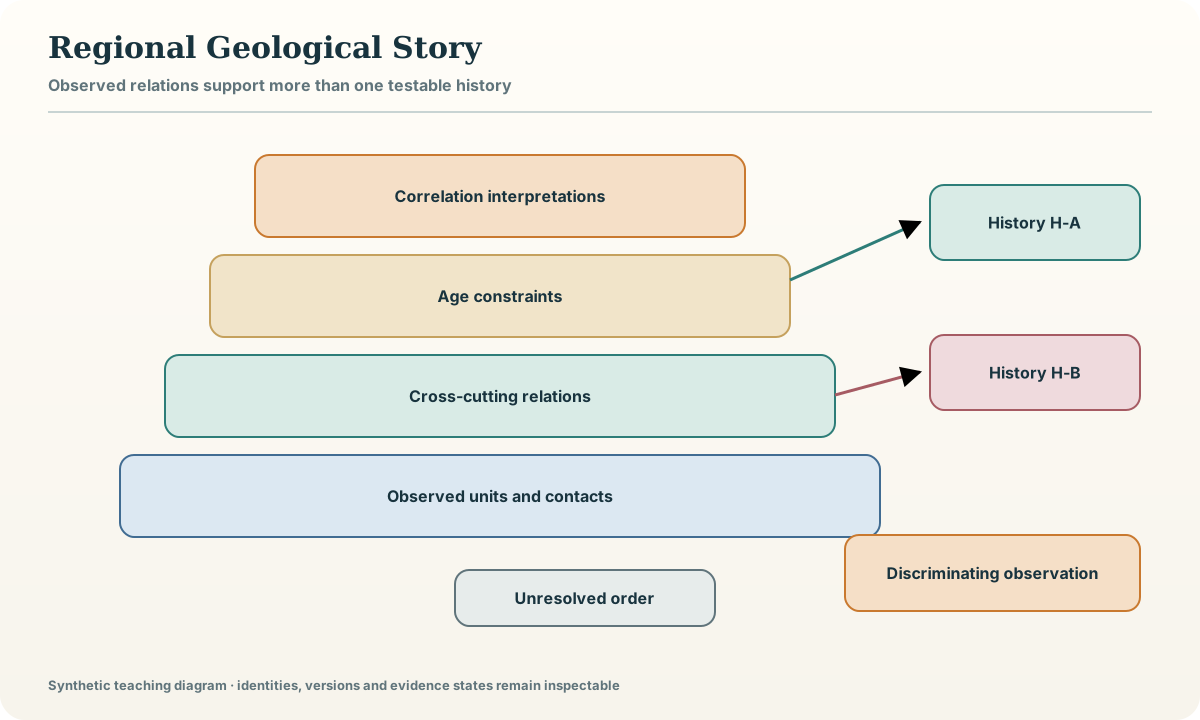
A regional story is a testable event model, not a polished paragraph assembled from the newest map. Begin with observed units, contacts, structures, cross-cutting relations, ages and alteration. Record correlation as an interpretation with its own evidence and confidence. Convert relative relations into a directed event graph, then ask where ordering is incomplete or contradictory.
Maintain at least two histories whenever the available evidence permits alternatives. For example, an intrusive contact may predate deformation, postdate it or have been reactivated; a map pattern alone may not discriminate. Each narrative sentence should resolve to observations, derived products or cited interpretations. Scale transitions must be explicit: a regional terrane boundary does not determine the position of a local contact, and a local drill intersection does not establish regional continuity.
Record and evidence model
| Field or object | Operational meaning | |---|---| | event_id and relation | event identity and before/after constraint | | observation_ids | direct evidence used for the relation | | interpretation_id and version | explicit correlation or event assignment | | scale and validity_extent | level at which the statement applies | | alternative_set and discriminator | competing histories and resolving test |
Every record carries a version, validity interval, source or derivation link, quality state and review state. Missing, unknown, not applicable and failed are separate states; none is silently represented as zero or an empty string.
Controlled workflow
- Compile units and relations without forcing a narrative.
- Separate observation, correlation and regional interpretation.
- Construct a partial-order event graph and detect cycles.
- Write two or more histories where ordering is unresolved.
- Map the evidence and validity scale for every sentence.
- Select observations that could discriminate among histories.
Record each step as an activity with declared inputs, parameters, outputs and checks. A rerun creates the same content or a documented difference; it never overwrites the evidence needed to explain the previous state.
Worked synthetic example
In SYN-WB, three synthetic observations establish that unit U3 cuts U1, a foliation crosses both, and a dyke cuts the foliation. An age product constrains U3 but not the foliation. History H-A places mineralising fluid with U3; H-B links it to later deformation. Both fit the current order. A planned test targets vein–foliation microstructures because another regional map would add context but little discrimination.
The example is deliberately small enough to inspect row by row. Its names and numbers are fictional teaching values and cannot be used to infer a real place, right, resource, hazard or organisation.
Quality control and failure modes
Run six gates before accepting the lesson artefact: identity resolves the exact objects; spatial control confirms coordinate and extent validity; semantics preserve units, vocabularies and epistemic class; lineage exposes every transformation and dependency; quality records passed, failed and not-run checks; review binds a disposition to the exact content digest. A failed gate is retained as evidence and blocks only the affected use. It is never converted into a favourable value or hidden to simplify the display.
Common failure modes:
- Copying a narrative without resolving its evidence
- Treating correlation as observation
- Forcing a total event order from partial evidence
- Mixing scales without a validity statement
- Discarding a viable alternative because it is less familiar
Practical exercise
Complete the following tasks against a new copy of the synthetic package:
- Build an event graph from eight synthetic relations.
- Identify one cycle and diagnose its source.
- Write two competing histories.
- Choose a discriminating observation rather than another confirming map.
For every answer, cite the package object IDs, show the failed as well as passed checks, and state which conclusion would change if one assumption were reversed.
Completion artefact and verification
Deliver a versioned regional event graph, alternative narratives and discrimination plan. Include a manifest, exact input identities, transformation or reasoning record, machine-readable validation results, human-readable limitations and the current review state. A second reader must be able to trace one accepted conclusion to its source support, one rejected path to its first failed gate and one unknown to the evidence required to resolve it. Rebuild the artefact from a clean location and compare content digests. Completion is withheld when a required source, parameter, permission or review is missing; no substitute data are invented.
Sources
- GeoSciML standard, a conceptual and encoding standard for exchanging geological map and borehole information.
- PROV-O provenance ontology, a standard model for entities, activities, responsibility roles and derivation.
- Strong Inference, a primary account of testing multiple alternative explanations with discriminating evidence.