F1 · Publication Volume 30
Drillhole Evidence Model
collar, survey, lithology, assay, status and QC
Learning objectives and boundary
- Explain collar, survey, lithology, assay, status and QC as an auditable evidence problem.
- Separate source observations, controlled derivatives, interpretation and decision state.
- Apply identity, spatial, semantic, lineage, quality and review checks.
- Produce a validated synthetic drillhole package, issue register and dependency rebuild record.
This lesson is part of a general, institution-neutral tutorial and has no relationship to any company or individual. All identifiers, geometries and values in the worked case are explicitly synthetic. The method does not confer professional authority and must not be transferred to a real decision without appropriate sources, competence, law and review.
Core method
A drillhole is a set of related observations, not a coloured line. Separate collar identity and position, downhole survey stations, trajectory method, interval observations, samples, analytical results, recovery, quality-control events and lifecycle status. Preserve measured depth as the primary interval axis; three-dimensional coordinates are derived from collar and survey versions.
Validate referential integrity before geological interpretation. Check unique identifiers, monotonic surveys, depth bounds, interval order, overlap and gap policy, sample support, units, detection limits, qualifiers, duplicate relationships and status. Missing intervals are not automatically barren, and an absent assay is not zero. Any trajectory or collar correction creates new spatial derivatives and invalidates cached section intersections until rebuilt.
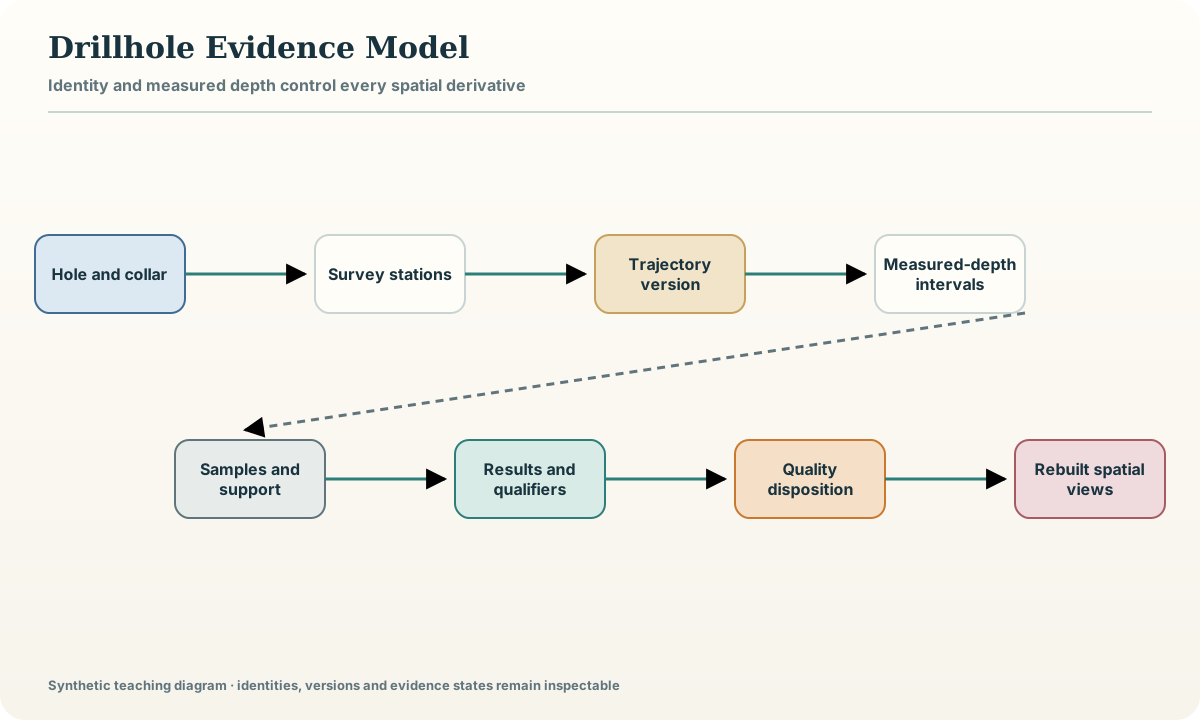
Record and evidence model
| Field or object | Operational meaning | |---|---| | hole_id, collar_version and status | identity, origin and lifecycle state | | survey_id, depth, azimuth and inclination | ordered directional evidence | | interval_id, from, to and scheme | measured-depth support and vocabulary | | sample_id, method and support | material identity and sampling basis | | result, unit, qualifier and qc_state | analytical value and usability |
Every record carries a version, validity interval, source or derivation link, quality state and review state. Missing, unknown, not applicable and failed are separate states; none is silently represented as zero or an empty string.
Controlled workflow
- Resolve hole, survey, interval, sample and result identities.
- Validate collars, coordinate frames and survey sequence.
- Apply explicit interval gap and overlap policies.
- Preserve qualifiers, detection limits, units and support.
- Run quality-control rules before deriving interpretation.
- Version trajectory products and rebuild dependent views.
Record each step as an activity with declared inputs, parameters, outputs and checks. A rerun creates the same content or a documented difference; it never overwrites the evidence needed to explain the previous state.
Worked synthetic example
Synthetic hole DH-S07 has a collar version change of 0.8 m east after control review. Two survey stations share a depth, one lithology interval overlaps by 0.15 m and three assays are qualified below detection. The workbench blocks trajectory release until the duplicate survey is dispositioned, flags rather than fills the overlap, preserves qualified values and rebuilds every section and target intersection under the new collar digest.
The example is deliberately small enough to inspect row by row. Its names and numbers are fictional teaching values and cannot be used to infer a real place, right, resource, hazard or organisation.
Quality control and failure modes
Run six gates before accepting the lesson artefact: identity resolves the exact objects; spatial control confirms coordinate and extent validity; semantics preserve units, vocabularies and epistemic class; lineage exposes every transformation and dependency; quality records passed, failed and not-run checks; review binds a disposition to the exact content digest. A failed gate is retained as evidence and blocks only the affected use. It is never converted into a favourable value or hidden to simplify the display.
Common failure modes:
- Using a rendered trace as the source record
- Replacing missing assays with zero
- Ignoring interval support and qualifiers
- Correcting collars without invalidating derivatives
- Combining quality-control failures with geological absence
Practical exercise
Complete the following tasks against a new copy of the synthetic package:
- Design normalized drillhole entities and keys.
- Classify interval gaps, overlaps and boundary contacts.
- Propagate a collar-version change.
- Write acceptance rules for qualified analytical results.
For every answer, cite the package object IDs, show the failed as well as passed checks, and state which conclusion would change if one assumption were reversed.
Completion artefact and verification
Deliver a validated synthetic drillhole package, issue register and dependency rebuild record. Include a manifest, exact input identities, transformation or reasoning record, machine-readable validation results, human-readable limitations and the current review state. A second reader must be able to trace one accepted conclusion to its source support, one rejected path to its first failed gate and one unknown to the evidence required to resolve it. Rebuild the artefact from a clean location and compare content digests. Completion is withheld when a required source, parameter, permission or review is missing; no substitute data are invented.
Sources
- GeoSciML standard, a conceptual and encoding standard for exchanging geological map and borehole information.
- Shapes Constraint Language, machine-readable graph constraints and validation reports.
- Data Quality Vocabulary, a vocabulary for quality dimensions, measurements, policies and annotations.