F1 · Publication Volume 30
Observation–Interpretation–Hypothesis Layers
tiered display, versioning, conflicting interpretations and uncertainty
Learning objectives and boundary
- Explain tiered display, versioning, conflicting interpretations and uncertainty as an auditable evidence problem.
- Separate source observations, controlled derivatives, interpretation and decision state.
- Apply identity, spatial, semantic, lineage, quality and review checks.
- Produce a tiered evidence model, alternative interpretation set and traceable preferred view.
This lesson is part of a general, institution-neutral tutorial and has no relationship to any company or individual. All identifiers, geometries and values in the worked case are explicitly synthetic. The method does not confer professional authority and must not be transferred to a real decision without appropriate sources, competence, law and review.
Core method
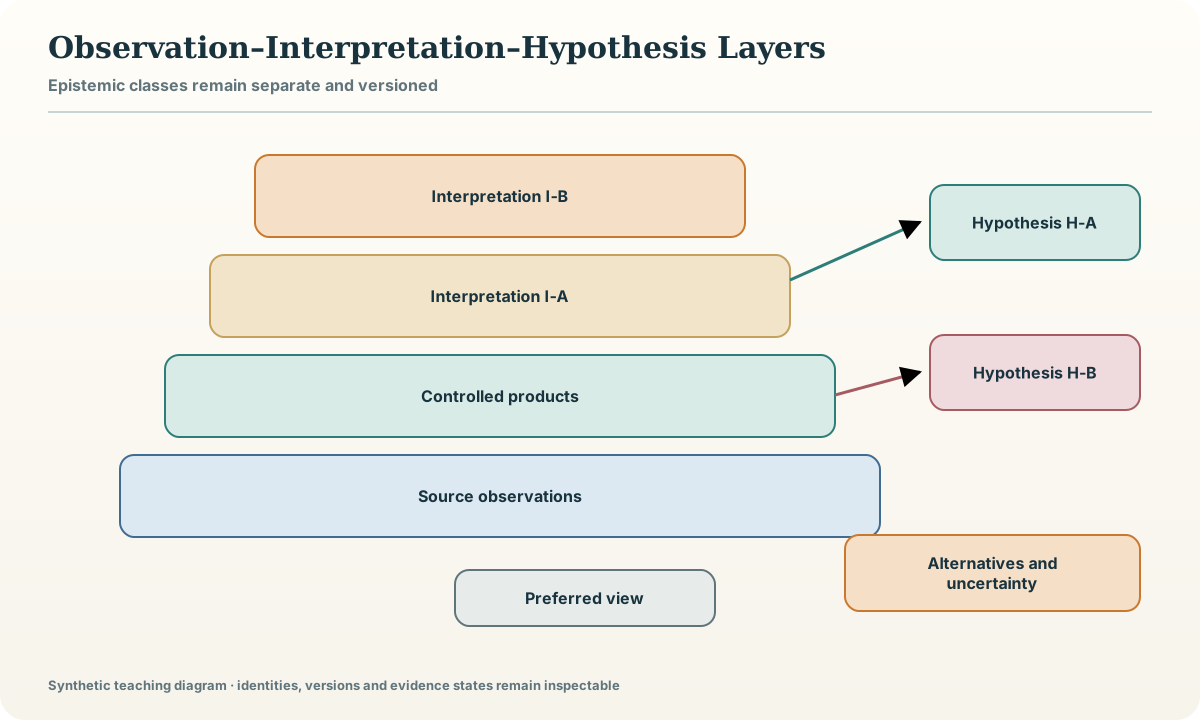
Observation, derived product, interpretation, hypothesis and decision are different object classes. Keep them in separate layers with explicit relations. An observation records what was measured or described under a method; a derived product records a reproducible transformation; an interpretation assigns meaning; a hypothesis predicts; a decision selects an action. Editing an interpretation must never overwrite its observations.
Conflicting interpretations may coexist against the same evidence snapshot. Store authoring as a generic responsibility role, not a personal identity required by the tutorial. Version geometry and attributes together, record rationale and supersession, and expose uncertainty in terms appropriate to the object: positional envelopes, categorical alternatives, confidence classes or unresolved boundaries. A flattened “best geology” layer can be a view, but it must remain traceable to the alternatives it hides.
Record and evidence model
| Field or object | Operational meaning | |---|---| | object_id and epistemic_class | identity and observation/product/interpretation/hypothesis type | | evidence_snapshot | exact supporting source and product versions | | geometry_version and attribute_version | jointly controlled state | | rationale and relation | explains, supports, contradicts or supersedes | | uncertainty_representation | envelope, alternatives, class or unresolved state |
Every record carries a version, validity interval, source or derivation link, quality state and review state. Missing, unknown, not applicable and failed are separate states; none is silently represented as zero or an empty string.
Controlled workflow
- Classify each object before loading it into a view.
- Preserve observations and immutable derived products.
- Create interpretations as new versioned objects.
- Link alternatives to the same evidence snapshot.
- Represent uncertainty without collapsing unknowns.
- Generate flattened views only as traceable queries.
Record each step as an activity with declared inputs, parameters, outputs and checks. A rerun creates the same content or a documented difference; it never overwrites the evidence needed to explain the previous state.
Worked synthetic example
Two synthetic interpreters assign the same conductivity edge to different structures. Interpretation I-A draws a continuous fault with a 60 m positional envelope; I-B models two discontinuous contacts. Both reference the same source product and neither edits it. The preferred display selects I-A under review state R2, while a toggle reveals I-B, the shared observations and the evidence that would distinguish them.
The example is deliberately small enough to inspect row by row. Its names and numbers are fictional teaching values and cannot be used to infer a real place, right, resource, hazard or organisation.
Quality control and failure modes
Run six gates before accepting the lesson artefact: identity resolves the exact objects; spatial control confirms coordinate and extent validity; semantics preserve units, vocabularies and epistemic class; lineage exposes every transformation and dependency; quality records passed, failed and not-run checks; review binds a disposition to the exact content digest. A failed gate is retained as evidence and blocks only the affected use. It is never converted into a favourable value or hidden to simplify the display.
Common failure modes:
- Overwriting observations with interpretation
- Storing confidence as opacity only
- Allowing only one interpretation per evidence snapshot
- Versioning attributes but not geometry
- Publishing a flattened layer without its query and alternatives
Practical exercise
Complete the following tasks against a new copy of the synthetic package:
- Classify 15 synthetic objects by epistemic tier.
- Create two conflicting versions without duplicating observations.
- Choose uncertainty representations for three object types.
- Audit a flattened layer for hidden alternatives.
For every answer, cite the package object IDs, show the failed as well as passed checks, and state which conclusion would change if one assumption were reversed.
Completion artefact and verification
Deliver a tiered evidence model, alternative interpretation set and traceable preferred view. Include a manifest, exact input identities, transformation or reasoning record, machine-readable validation results, human-readable limitations and the current review state. A second reader must be able to trace one accepted conclusion to its source support, one rejected path to its first failed gate and one unknown to the evidence required to resolve it. Rebuild the artefact from a clean location and compare content digests. Completion is withheld when a required source, parameter, permission or review is missing; no substitute data are invented.
Sources
- PROV-O provenance ontology, a standard model for entities, activities, responsibility roles and derivation.
- GeoSciML standard, a conceptual and encoding standard for exchanging geological map and borehole information.
- Data Quality Vocabulary, a vocabulary for quality dimensions, measurements, policies and annotations.