F1 · Publication Volume 30
Evidence Graphs and Target Statements
claims, support, contradiction, dependency and unknowns
Learning objectives and boundary
- Explain claims, support, contradiction, dependency and unknowns as an auditable evidence problem.
- Separate source observations, controlled derivatives, interpretation and decision state.
- Apply identity, spatial, semantic, lineage, quality and review checks.
- Produce a validated evidence graph, atomic target statement set and reviewable target card.
This lesson is part of a general, institution-neutral tutorial and has no relationship to any company or individual. All identifiers, geometries and values in the worked case are explicitly synthetic. The method does not confer professional authority and must not be transferred to a real decision without appropriate sources, competence, law and review.
Core method
A target statement is an atomic, bounded claim: subject, predicate, value or category, spatial and temporal scope, evidence snapshot, uncertainty, status and decision relevance. Avoid labels such as “high priority” without the facts and policy that produce them. Decompose summaries until each claim can be supported, contradicted or left unresolved by identifiable evidence.
The evidence graph uses typed nodes and relations. Sources generate observations; controlled transformations generate products; products and observations may support or contradict interpretations and claims; claims depend on assumptions; hypotheses predict observations. Dependency groups prevent one ancestral dataset from appearing as repeated confirmation. Unknown nodes are explicit requirements, not empty cells. A graph query may create a target card, but the card never replaces the underlying claim–evidence structure.
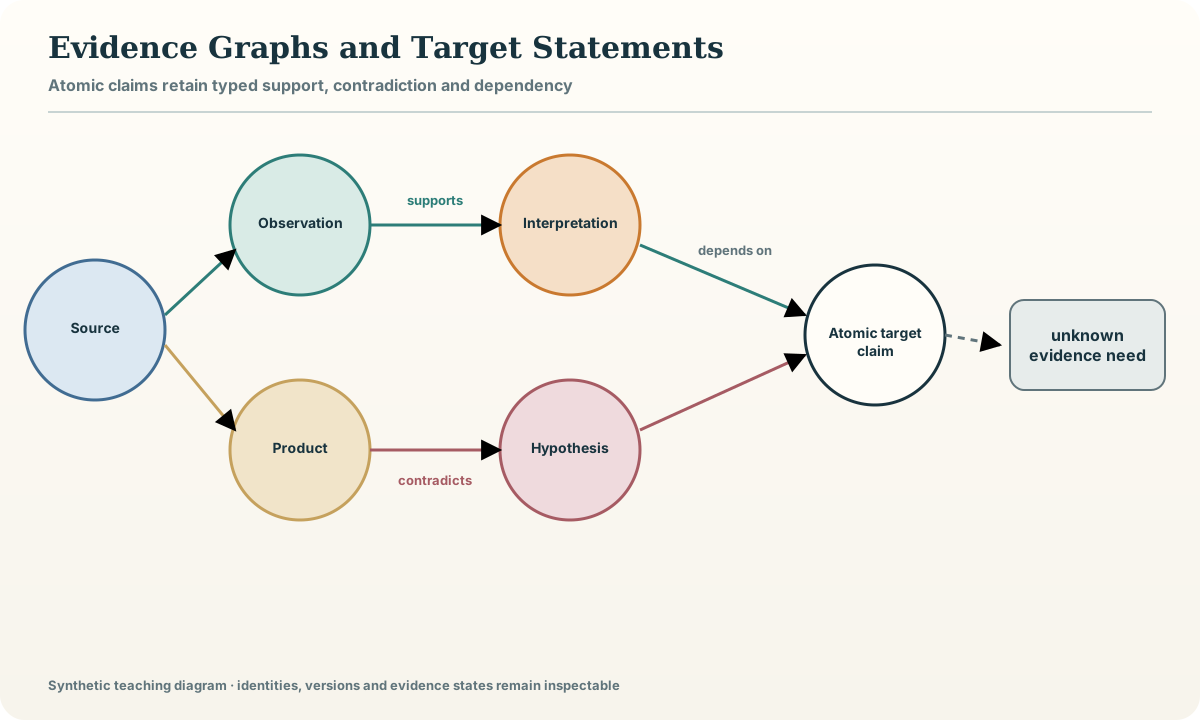
Record and evidence model
| Field or object | Operational meaning | |---|---| | claim_id and atomic_statement | stable identity and bounded proposition | | scope and evidence_snapshot | space, time, scale and exact evidence state | | edge_type and rationale | support, contradict, depend, predict or unknown | | lineage_group and independence | ancestry and dependence assessment | | status and disposition | draft, reviewed, accepted, withheld or retired |
Every record carries a version, validity interval, source or derivation link, quality state and review state. Missing, unknown, not applicable and failed are separate states; none is silently represented as zero or an empty string.
Controlled workflow
- Decompose each target summary into atomic claims.
- Bind scope, evidence snapshot and uncertainty.
- Connect evidence with typed, reasoned relations.
- Group dependencies and detect circular support.
- Create explicit unknowns and contradiction paths.
- Generate a target card only from reviewed graph state.
Record each step as an activity with declared inputs, parameters, outputs and checks. A rerun creates the same content or a documented difference; it never overwrites the evidence needed to explain the previous state.
Worked synthetic example
Synthetic target T-03 contains four atomic claims. Two alteration claims share one raster ancestor and form one support family. A drill intersection supports structural proximity but contradicts predicted orientation. Continuity beneath cover remains an explicit unknown. The target card states “evidence-gathering candidate under H-A” rather than “deposit”, lists the contradiction and proposes one discriminating section.
The example is deliberately small enough to inspect row by row. Its names and numbers are fictional teaching values and cannot be used to infer a real place, right, resource, hazard or organisation.
Quality control and failure modes
Run six gates before accepting the lesson artefact: identity resolves the exact objects; spatial control confirms coordinate and extent validity; semantics preserve units, vocabularies and epistemic class; lineage exposes every transformation and dependency; quality records passed, failed and not-run checks; review binds a disposition to the exact content digest. A failed gate is retained as evidence and blocks only the affected use. It is never converted into a favourable value or hidden to simplify the display.
Common failure modes:
- Using an adjective as an unevidenced target statement
- Counting descendants as independent support
- Omitting contradictions from the summary card
- Representing unknowns as negative evidence
- Allowing a graph cycle to manufacture confirmation
Practical exercise
Complete the following tasks against a new copy of the synthetic package:
- Decompose a target paragraph into atomic claims.
- Build typed support and contradiction edges.
- Detect a circular evidence path.
- Generate a target card that keeps unknowns visible.
For every answer, cite the package object IDs, show the failed as well as passed checks, and state which conclusion would change if one assumption were reversed.
Completion artefact and verification
Deliver a validated evidence graph, atomic target statement set and reviewable target card. Include a manifest, exact input identities, transformation or reasoning record, machine-readable validation results, human-readable limitations and the current review state. A second reader must be able to trace one accepted conclusion to its source support, one rejected path to its first failed gate and one unknown to the evidence required to resolve it. Rebuild the artefact from a clean location and compare content digests. Completion is withheld when a required source, parameter, permission or review is missing; no substitute data are invented.
Sources
- PROV-O provenance ontology, a standard model for entities, activities, responsibility roles and derivation.
- Shapes Constraint Language, machine-readable graph constraints and validation reports.
- Strong Inference, a primary account of testing multiple alternative explanations with discriminating evidence.