F1 · Publication Volume 30
Professional Review and Limitations
integrated geological, geophysical, data and system review
Learning objectives and boundary
- Explain integrated geological, geophysical, data and system review as an auditable evidence problem.
- Separate source observations, controlled derivatives, interpretation and decision state.
- Apply identity, spatial, semantic, lineage, quality and review checks.
- Produce a package-bound review record, limitations register and release disposition.
This lesson is part of a general, institution-neutral tutorial and has no relationship to any company or individual. All identifiers, geometries and values in the worked case are explicitly synthetic. The method does not confer professional authority and must not be transferred to a real decision without appropriate sources, competence, law and review.
Core method
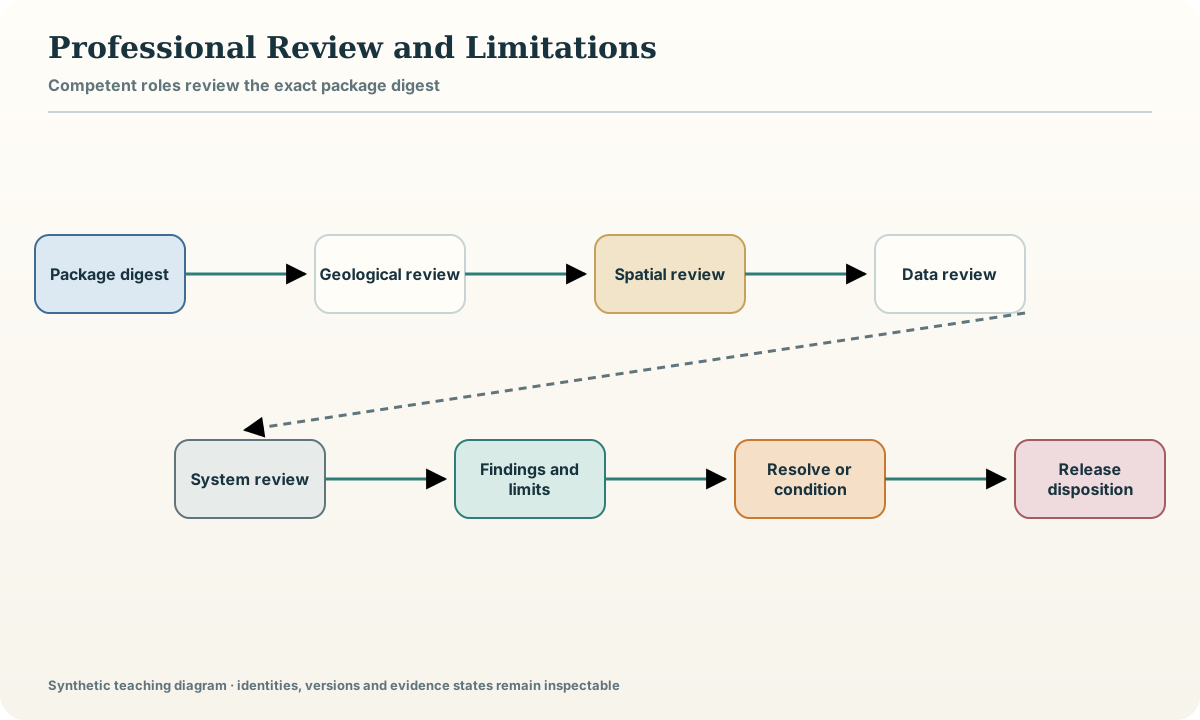
Review evaluates the exact evidence package, not the reputation of a contributor or the fluency of a report. Define generic competence roles for geological reasoning, geophysics or remote sensing, spatial control, drillhole data, reproducibility and release. A reviewer records scope, inspected versions, tests performed, findings, severity, required action and disposition. The tutorial never grants professional authority; real uses must follow applicable law, standards and competent practice outside the course.
Limitations are first-class evidence. Separate unavailable sources, measurement limitations, spatial uncertainty, processing assumptions, interpretation alternatives, validation coverage, implementation constraints and prohibited uses. A limitation must state consequence and mitigation where known. “Use with caution” is not enough. Review disagreement remains visible, and conditional acceptance states the conditions that must stay true. Any material change after review invalidates the affected disposition.
Record and evidence model
| Field or object | Operational meaning | |---|---| | review_id and package_digest | review identity and exact subject | | competence_role and scope | required expertise without organisational affiliation | | finding, severity and evidence | reproducible issue statement | | limitation, consequence and mitigation | bounded release condition | | disposition and invalidation_trigger | decision and material-change rule |
Every record carries a version, validity interval, source or derivation link, quality state and review state. Missing, unknown, not applicable and failed are separate states; none is silently represented as zero or an empty string.
Controlled workflow
- Bind review to a package digest and declared scope.
- Assign independent generic competence roles.
- Inspect evidence, methods, uncertainty, tests and holdout results.
- Record findings and limitations with consequences.
- Resolve, accept conditionally, return, reject or escalate.
- Invalidate dispositions when relevant evidence or configuration changes.
Record each step as an activity with declared inputs, parameters, outputs and checks. A rerun creates the same content or a documented difference; it never overwrites the evidence needed to explain the previous state.
Worked synthetic example
The synthetic review board is represented only by roles. Spatial review accepts coordinate control; data review conditionally accepts assays subject to a qualifier filter; geological review records unresolved H-A versus H-B continuity; reproducibility review finds one missing raster parameter and returns the build. Release occurs only after that parameter is restored and the package digest is reviewed again. The public summary retains the unresolved alternative and prohibited-use statement.
The example is deliberately small enough to inspect row by row. Its names and numbers are fictional teaching values and cannot be used to infer a real place, right, resource, hazard or organisation.
Quality control and failure modes
Run six gates before accepting the lesson artefact: identity resolves the exact objects; spatial control confirms coordinate and extent validity; semantics preserve units, vocabularies and epistemic class; lineage exposes every transformation and dependency; quality records passed, failed and not-run checks; review binds a disposition to the exact content digest. A failed gate is retained as evidence and blocks only the affected use. It is never converted into a favourable value or hidden to simplify the display.
Common failure modes:
- Reviewing a report without binding its data version
- Treating generic approval as unlimited authority
- Hiding disagreement to simplify the summary
- Writing limitations without consequences
- Keeping approval after a material rebuild
Practical exercise
Complete the following tasks against a new copy of the synthetic package:
- Design a role-separated review matrix.
- Write three consequential limitations.
- Create conditional acceptance and invalidation rules.
- Review a changed package using a semantic difference report.
For every answer, cite the package object IDs, show the failed as well as passed checks, and state which conclusion would change if one assumption were reversed.
Completion artefact and verification
Deliver a package-bound review record, limitations register and release disposition. Include a manifest, exact input identities, transformation or reasoning record, machine-readable validation results, human-readable limitations and the current review state. A second reader must be able to trace one accepted conclusion to its source support, one rejected path to its first failed gate and one unknown to the evidence required to resolve it. Rebuild the artefact from a clean location and compare content digests. Completion is withheld when a required source, parameter, permission or review is missing; no substitute data are invented.
Sources
- Data Quality Vocabulary, a vocabulary for quality dimensions, measurements, policies and annotations.
- PROV-O provenance ontology, a standard model for entities, activities, responsibility roles and derivation.
- FAIR Guiding Principles, principles for findable, accessible, interoperable and reusable digital objects.