E4 · Publication Volume 26
Meshes and Surfaces
vertices, faces, normals, manifold geometry and self-intersection
Learning objectives
- Explain the decision and evidence boundary for vertices, faces, normals, manifold geometry and self-intersection.
- Select and implement the relevant representation or algorithm without hidden coordinate, support or topology assumptions.
- Separate exact predicates, approximation error, source uncertainty and visual delivery.
- Produce a mesh-quality report with manifold, orientation and self-intersection fixtures from synthetic evidence.
The lesson is complete only when the learner can defend the representation, transform, predicates, tests and release decision. A visually clean map or 3D scene without executable invariants and provenance remains unverified.
This is a general, institution-neutral tutorial with no relationship to any company or individual. All coordinates, geometries, grids, points, surfaces, volumes, attributes and review events in the lesson are synthetic and must not be used for an operational decision.
Decision context
The decision is whether a mesh represents an open sampled surface, a closed boundary, a visual skin or another explicitly defined object. The same triangle array can render successfully while being unsuitable for volume, inside-outside, Boolean or section operations. The contract declares vertex and face identity, coordinate frame, winding convention, attribute association, expected boundaries, component policy, manifold requirement, permitted degeneracy, self-intersection policy and whether normals are source observations or derived display data.
Write the intended use, consequence of error, required evidence, spatial support and release authority before selecting a representation or transformation. Fitness is evaluated against a versioned contract and use, not attached permanently to a file extension.
Core concept
A polygon mesh combines a vertex table with face connectivity. Geometry and connectivity must both be valid. For a two-manifold interior, each edge has exactly two incident faces with compatible orientation; a boundary edge has one. More than two incident faces is non-manifold. A zero-area face, duplicated face, bow-tie vertex or self-intersection can violate downstream assumptions without being visible from a distant camera. Face normals follow ordered vertices, while smoothed vertex normals are rendering derivatives and cannot repair reversed topology.
Keep received evidence, accepted analytical views and derived representations as distinct objects. This allows corrected evidence, a changed transform or a new level of detail to generate a new result without rewriting history. Every coordinate and primitive therefore answers both a spatial question and a provenance question.
Algorithm and data model
Validate indices and finite coordinates first, then face cardinality, repeated indices, zero-length edges, area, duplicate faces, edge incidence, orientation consistency, components, boundaries and self-intersections. Preserve per-vertex, per-face and per-corner attributes with their association. A repair may weld selected vertices, remove degenerate faces, orient components, stitch declared matching boundaries or fill reviewed holes, but each action reports affected identities and geometric change. Recomputed normals are attached to the repaired derivative, never written back as if observed.
Define parsing, semantic validation, canonicalisation, indexing, exact or approximate calculation, quality evaluation and encoding as separate stages. Each stage emits structured output and does not depend on interface state, file order, graphics-driver behaviour or undocumented defaults.
Constraints and invariants
| Invariant | Executable or review test | | --- | --- | | Mesh purpose and required boundary or manifold state are declared. | Reject or quarantine the exact affected object and preserve the received representation. | | Connectivity, geometry and attribute association are validated separately. | Evaluate this condition before creating a derived geometry, grid, surface or volume. | | Self-intersection tests exclude only explicitly adjacent primitive pairs. | Record the predicate, tolerance policy, observed values and coordinate frame. | | Repair reports changed primitives, distances, components and topology. | Make every repair a new version and rerun all dependent golden cases. |
An invariant must survive import, transformation, processing, export and rerun. A failed hard invariant produces no apparently valid substitute. Diagnostics remain visible with predicate, threshold, coordinate frame, scope and evidence, and require a reviewed rule before they can trigger repair.
Quantitative reasoning
For triangle (a,b,c), area is A=\tfrac12\|(b-a)\times(c-a)\| and the unnormalised cross product gives oriented normal direction. Report vertex and face counts, connected components, boundary loops, non-manifold edges, inconsistent edge orientations, degenerate faces under a scale-aware area rule, duplicate faces, self-intersection pairs, minimum angle and edge-length distribution. For a known analytic surface report one-sided and symmetric distance statistics. Test isolated vertices, repeated indices, one triangle, an open disk, a closed tetrahedron, reversed component, pinched vertex, coincident but unshared edges and crossing triangles.
Every metric includes units, support, numerator and denominator where applicable, exclusions, comparison policy and evaluation version. Aggregate metrics are stratified when pooling can hide local geometry failure. A performance gain cannot overrule invalid topology, missing reference metadata or broken lineage.
Evidence and uncertainty
Keep acquisition uncertainty, interpretation uncertainty, discretisation error, numeric round-off and delivery error separate. Increasing coordinate digits or triangle count does not improve the original evidence. A sampled surface may be smooth and watertight while remaining poorly constrained between observations. Report uncertainty in the quantity and support to which it belongs.
Build an evidence packet containing immutable received objects, semantic declarations, validation findings, transform inputs and outputs, measured errors, test results, reviewer decisions and fingerprints. Contradictory evidence remains available. When a required reference, topology state or classification cannot be resolved, return unknown, conflict or blocked rather than inventing geometry.
Interfaces and storage
Interfaces transmit identity, coordinate reference, units, axis order, support, topology expectations, attribute association, null state, version and lineage beside coordinates. Structured errors identify the object, primitive, predicate, observed value, expected condition and rule. An interface that carries vertices but drops the transform or face orientation has not preserved the object.
Store authoritative received evidence separately from reproducible analytical derivatives and disposable delivery artefacts. Indexes, caches, pyramids and render meshes improve access but cannot become the only copy of source attributes or coordinate metadata. Round-trip tests verify identity, precision, topology, ordering, missingness and association after encoding changes.
Governance and review
Assign responsibilities to roles rather than named organisations or people: evidence custodian, representation author, algorithm maintainer, independent validator and release reviewer. A role may propose a repair but cannot erase the received geometry. Transform, predicate and tolerance changes are versioned and evaluated against fixed regression fixtures before release.
Exceptions are explicit decisions with scope, rationale, evidence, approving role, affected versions and review trigger. They never turn invalid topology into valid topology by label. The host website has no ownership or scientific-authority role in this workflow; it only delivers the tutorial.
Integration checkpoint
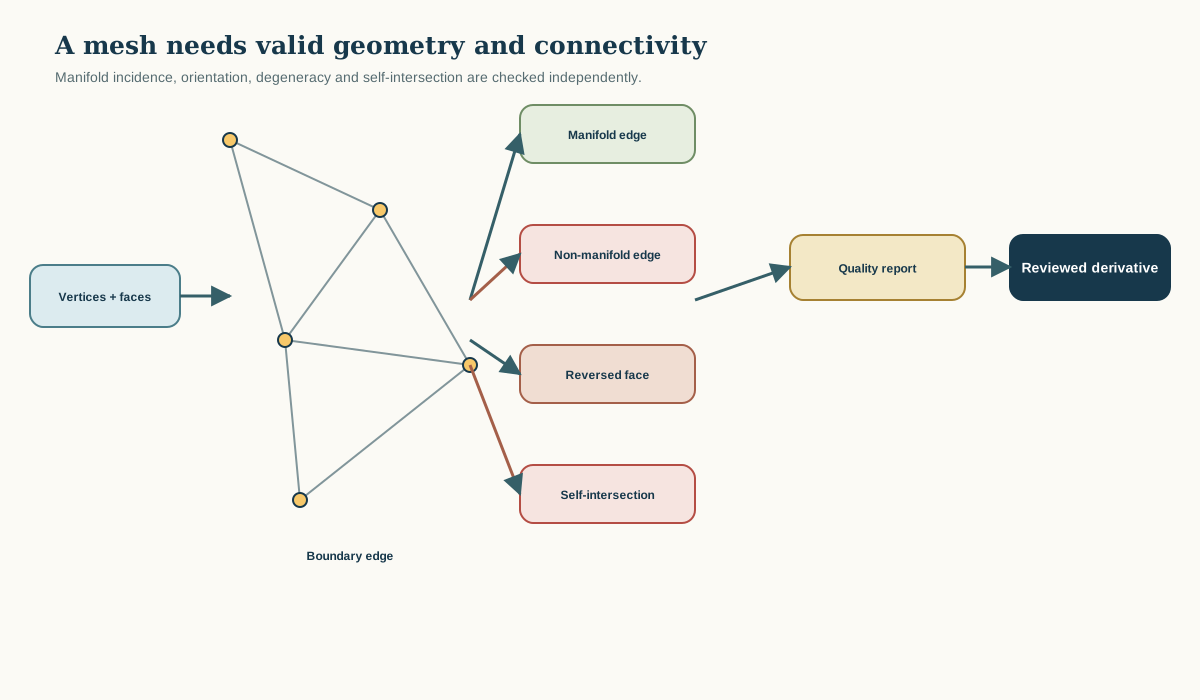
Read the figure as a reasoning map from preserved evidence through declared support and coordinates, controlled transformation, validation and scoped release. Each arrow represents a declared relationship. Integrate a mesh-quality report with manifold, orientation and self-intersection fixtures into SYN-SPATIAL, rerun earlier fixtures and record every changed assumption.
Synthetic worked example
Synthetic mesh SYN-M01 looks like a closed box. Inspection finds one face duplicated, one face reversed and a narrow triangle crossing a non-adjacent face. A renderer hides the problems through two-sided shading and smoothed normals. The analytical validator reports exact face pairs and edge incidence, blocks volume and inside-outside operations, and creates a candidate repair that removes the duplicate and orients one component. The crossing face remains quarantined because moving it would require geological interpretation rather than mechanical repair.
- Preserve the received object and state the intended decision without repair.
- Resolve identity, reference, units, support, topology and evidence eligibility.
- Run the versioned transform or predicate while retaining intermediate diagnostics.
- Issue accept, reject or quarantine and show how an independent reviewer reproduces it.
Practice task
Implement the chapter artefact against a synthetic fixture containing one normal case, one boundary case, one invalid case and one unresolved-evidence case. Preserve the received fixture. Produce canonical input, validation findings, derivative output, processing manifest, measured error and a short release decision.
Acceptance criteria:
- Every required identity, coordinate reference, unit, support and convention is explicit.
- The implementation is deterministic under stable ordering and the declared numerical policy.
- No repair overwrites received evidence or converts unknown into a guessed value.
- All hard failures block the affected derivative and remain machine-readable.
- A second implementation or reviewer can reproduce the result from the package alone.
Submit a mesh-quality report with manifold, orientation and self-intersection fixtures, golden and adversarial fixtures, exact findings, measured error and a limitations note. A screenshot is not sufficient evidence because it does not identify input versions, transforms, algorithms or rule configuration.
Common failure modes
- Assuming successful rendering proves mesh validity.
- Using smoothed normals to hide reversed face orientation.
- Welding every vertex pair within one tolerance regardless of feature boundaries.
- Filling every hole even when the missing surface is scientifically unknown.
These failures share a pattern: implicit convenience is substituted for evidence. Diagnose the earliest boundary where the assumption entered, restore the source statement, make the transform or predicate explicit, rerun all dependent derivatives and supersede rather than overwrite the affected release.
Review questions
- Which conditions distinguish a manifold interior edge from a boundary edge?
- Why do rendering normals not repair topology?
- Which mesh defects must be reported before volume calculation?
- When does repair require interpretation rather than mechanics?
For every answer, identify the governing invariant, evidence needed to evaluate it, numerical or semantic policy involved and correct behaviour when the condition fails.
Sources and further reading
- CGAL Polygon Mesh Processing manual, documenting manifold assumptions, self-intersection tests, point-side predicates and mesh repair.
- ISO 19107:2019 spatial schema, specifying conceptual geometry, topology and spatial operations for geographic information.
- Fast robust predicates for computational geometry, the primary implementation note and paper resources for adaptive orientation and in-circle predicates.
- ISO 19157-1:2023 geographic data quality, providing a framework for describing and evaluating geographic-data quality.