E4 · Publication Volume 26
Voxels and Block Models
regular and rotated grids, subcells and sparse storage
Learning objectives
- Explain the decision and evidence boundary for regular and rotated grids, subcells and sparse storage.
- Select and implement the relevant representation or algorithm without hidden coordinate, support or topology assumptions.
- Separate exact predicates, approximation error, source uncertainty and visual delivery.
- Produce a voxel and block-model transform with support and volume-conservation tests from synthetic evidence.
The lesson is complete only when the learner can defend the representation, transform, predicates, tests and release decision. A visually clean map or 3D scene without executable invariants and provenance remains unverified.
This is a general, institution-neutral tutorial with no relationship to any company or individual. All coordinates, geometries, grids, points, surfaces, volumes, attributes and review events in the lesson are synthetic and must not be used for an operational decision.
Decision context
The decision is how a three-dimensional indexed cell represents spatial support and attributes. A voxel grid, mining block model and occupancy volume may all use integer indices but differ in orientation, parent-child structure, active state, attribute support and intended queries. The contract declares origin, basis or rotation, cell dimensions, index order, centre-versus-corner convention, extents, subcell rules, parent identity, active and inactive semantics, null policy, attribute association and whether stored values are measurements, estimates, classes or fractions.
Write the intended use, consequence of error, required evidence, spatial support and release authority before selecting a representation or transformation. Fitness is evaluated against a versioned contract and use, not attached permanently to a file extension.
Core concept
A regular grid has implicit topology and an explicit index-to-world transform. A rotated grid remains regular in index space even though world-space bounds are not axis aligned. Cell-centred values describe volumes; point-centred values describe lattice nodes and interpolate differently. Subcells partition or selectively refine parent support and require exact parent relationships. Sparse storage distinguishes absent allocation from a stored background, inactive known value, unknown value and zero. Collapsing those states changes both volume accounting and scientific meaning.
Keep received evidence, accepted analytical views and derived representations as distinct objects. This allows corrected evidence, a changed transform or a new level of detail to generate a new result without rewriting history. Every coordinate and primitive therefore answers both a spatial question and a provenance question.
Algorithm and data model
Represent the transform as origin plus three basis vectors or as origin, rotation and cell scale. Keep logical indices as integers and derive world corners and centres on demand. For a parent cell, store child index ranges, dimensions and fraction of parent support; validate that children neither overlap nor exceed the parent unless the model explicitly permits alternatives. Attributes identify cell support and estimation or classification version. A sparse hierarchy records background semantics and active topology separately from compressed byte layout so another implementation can reconstruct the same logical grid.
Define parsing, semantic validation, canonicalisation, indexing, exact or approximate calculation, quality evaluation and encoding as separate stages. Each stage emits structured output and does not depend on interface state, file order, graphics-driver behaviour or undocumented defaults.
Constraints and invariants
| Invariant | Executable or review test | | --- | --- | | Index-to-world transform, cell support and index order are explicit. | Reject or quarantine the exact affected object and preserve the received representation. | | Inactive, background, unknown and zero remain distinct value states. | Evaluate this condition before creating a derived geometry, grid, surface or volume. | | Subcell relationships preserve parent identity and declared support volume. | Record the predicate, tolerance policy, observed values and coordinate frame. | | Sparse encoding round trips to the same logical active topology. | Make every repair a new version and rerun all dependent golden cases. |
An invariant must survive import, transformation, processing, export and rerun. A failed hard invariant produces no apparently valid substitute. Diagnostics remain visible with predicate, threshold, coordinate frame, scope and evidence, and require a reviewed rule before they can trigger repair.
Quantitative reasoning
With origin \mathbf{o}, rotation R, cell-size matrix S and integer index \mathbf{i}, a cell centre is \mathbf{x}_c=\mathbf{o}+RS(\mathbf{i}+\tfrac12\mathbf{1}). Its volume is |\det(RS)|; for a pure rotation this reduces to the product of cell dimensions. Report logical dimensions, active and inactive counts, allocated nodes, parent and subcell volumes, overlap and uncovered volume, attribute coverage and compression ratio. Parent subdivision should satisfy \sum_j V_j=V_{parent} within the declared policy. Test negative indices, one-cell grids, rotated anisotropic cells, nested subcells, sparse all-background regions and round trips between index and world coordinates.
Every metric includes units, support, numerator and denominator where applicable, exclusions, comparison policy and evaluation version. Aggregate metrics are stratified when pooling can hide local geometry failure. A performance gain cannot overrule invalid topology, missing reference metadata or broken lineage.
Evidence and uncertainty
Keep acquisition uncertainty, interpretation uncertainty, discretisation error, numeric round-off and delivery error separate. Increasing coordinate digits or triangle count does not improve the original evidence. A sampled surface may be smooth and watertight while remaining poorly constrained between observations. Report uncertainty in the quantity and support to which it belongs.
Build an evidence packet containing immutable received objects, semantic declarations, validation findings, transform inputs and outputs, measured errors, test results, reviewer decisions and fingerprints. Contradictory evidence remains available. When a required reference, topology state or classification cannot be resolved, return unknown, conflict or blocked rather than inventing geometry.
Interfaces and storage
Interfaces transmit identity, coordinate reference, units, axis order, support, topology expectations, attribute association, null state, version and lineage beside coordinates. Structured errors identify the object, primitive, predicate, observed value, expected condition and rule. An interface that carries vertices but drops the transform or face orientation has not preserved the object.
Store authoritative received evidence separately from reproducible analytical derivatives and disposable delivery artefacts. Indexes, caches, pyramids and render meshes improve access but cannot become the only copy of source attributes or coordinate metadata. Round-trip tests verify identity, precision, topology, ordering, missingness and association after encoding changes.
Governance and review
Assign responsibilities to roles rather than named organisations or people: evidence custodian, representation author, algorithm maintainer, independent validator and release reviewer. A role may propose a repair but cannot erase the received geometry. Transform, predicate and tolerance changes are versioned and evaluated against fixed regression fixtures before release.
Exceptions are explicit decisions with scope, rationale, evidence, approving role, affected versions and review trigger. They never turn invalid topology into valid topology by label. The host website has no ownership or scientific-authority role in this workflow; it only delivers the tutorial.
Integration checkpoint
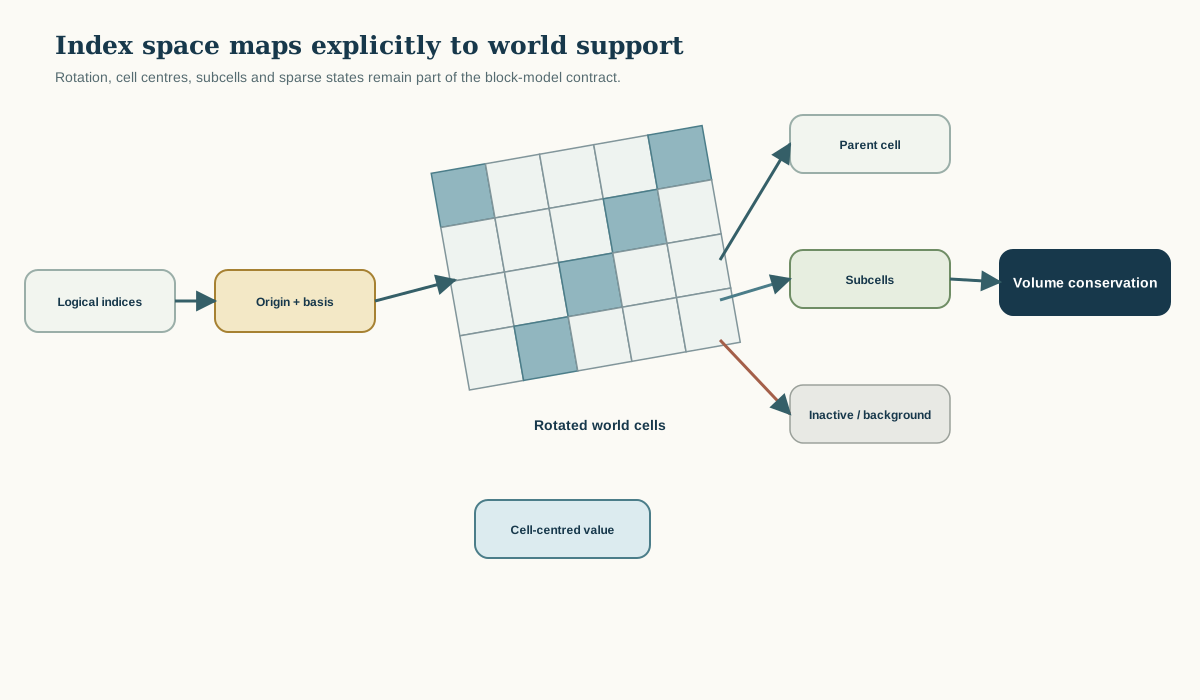
Read the figure as a reasoning map from preserved evidence through declared support and coordinates, controlled transformation, validation and scoped release. Each arrow represents a declared relationship. Integrate a voxel and block-model transform with support and volume-conservation tests into SYN-SPATIAL, rerun earlier fixtures and record every changed assumption.
Synthetic worked example
Synthetic block model SYN-BM01 has 20 by 10 by 6 parent cells, rotated 30 degrees around its vertical axis. An import that treats world-aligned minimum bounds as the origin displaces centres and creates apparent overlap with a synthetic surface. The repaired derivative restores the declared rotation and centre convention. One parent contains eight equal subcells; their volumes sum exactly to the parent. A ninth duplicated subcell is detected as overlap, quarantined and excluded from attribute-weighted aggregation without deleting the received record.
- Preserve the received object and state the intended decision without repair.
- Resolve identity, reference, units, support, topology and evidence eligibility.
- Run the versioned transform or predicate while retaining intermediate diagnostics.
- Issue accept, reject or quarantine and show how an independent reviewer reproduces it.
Practice task
Implement the chapter artefact against a synthetic fixture containing one normal case, one boundary case, one invalid case and one unresolved-evidence case. Preserve the received fixture. Produce canonical input, validation findings, derivative output, processing manifest, measured error and a short release decision.
Acceptance criteria:
- Every required identity, coordinate reference, unit, support and convention is explicit.
- The implementation is deterministic under stable ordering and the declared numerical policy.
- No repair overwrites received evidence or converts unknown into a guessed value.
- All hard failures block the affected derivative and remain machine-readable.
- A second implementation or reviewer can reproduce the result from the package alone.
Submit a voxel and block-model transform with support and volume-conservation tests, golden and adversarial fixtures, exact findings, measured error and a limitations note. A screenshot is not sufficient evidence because it does not identify input versions, transforms, algorithms or rule configuration.
Common failure modes
- Treating a rotated grid as axis aligned from its bounding box.
- Confusing cell-centred attributes with point-centred samples.
- Using absence in sparse storage as a scientific zero.
- Aggregating subcells without checking overlap or uncovered parent support.
These failures share a pattern: implicit convenience is substituted for evidence. Diagnose the earliest boundary where the assumption entered, restore the source statement, make the transform or predicate explicit, rerun all dependent derivatives and supersede rather than overwrite the affected release.
Review questions
- How does a rotated regular grid remain regular?
- What distinguishes a cell-centred from a point-centred value?
- Which states must sparse storage keep separate?
- How is subcell volume conservation tested?
For every answer, identify the governing invariant, evidence needed to evaluate it, numerical or semantic policy involved and correct behaviour when the condition fails.
Sources and further reading
- OpenVDB overview, describing sparse volumetric trees, active and inactive voxels, index space and world-space transforms.
- VTK file-format documentation, describing structured, unstructured, polygonal and image-data encodings.
- ISO 19107:2019 spatial schema, specifying conceptual geometry, topology and spatial operations for geographic information.
- ISO 19157-1:2023 geographic data quality, providing a framework for describing and evaluating geographic-data quality.