C5 · Publication Volume 15
Remote-Sensing Products and Provenance
scene identifiers, processing levels, cloud masks and licensing
Learning goals
This lesson makes product identity, quality and lineage part of scientific interpretation. The learner should be able to distinguish collection, granule, asset and derived product; decode processing level without assuming universal meaning; retain scale, offset, masks and known issues; record licence and citation; construct a provenance graph; verify files and versions; and release a reproducible package whose crawlable metadata does not assign tutorial ownership or affiliation.
A filename is not sufficient provenance. Products can be reprocessed, collections superseded, quality conventions changed and assets silently separated from their metadata. The interpretation must identify exactly which measurements and transformations it uses.
Collections, granules, assets and identifiers
A collection groups products generated under a defined mission, algorithm, version and policy. A granule or scene is an individual spatiotemporal unit. Assets are the science bands, masks, metadata, browse images or ancillary files associated with an item. A derived mosaic, index or classification is a new entity and needs its own identifier and lineage.
Record collection short and long name, version, persistent identifier where available, item or granule identifier, acquisition and production time, processing baseline, platform, sensor, spatial extent, coordinate reference and asset roles. Product identifiers often encode useful fields but should be parsed against current documentation, not guessed.
Use stable identifiers in tables and machine-readable metadata. Human labels may change. If a provider republishes or reprocesses data, keep the original version and document the migration rather than overwriting the source record.
Processing levels and physical quantities
Level numbers are useful within a documented system but are not universal physical definitions. In a common Earth-observation convention, Level 0 is reconstructed unprocessed instrument data, Level 1 adds calibration and geolocation, Level 2 derives geophysical variables, and Levels 3–4 add gridding, aggregation or models. Mission-specific variants must be checked.
For every asset, state stored type, scale, offset, valid range, no-data, saturation, units and uncertainty. A surface-reflectance integer band may require both multiplicative scale and additive offset. A quality band may pack many flags into bits. A browse image is usually unsuitable for quantitative analysis.
Do not mix processing levels casually. A Level-1 quantity and Level-2 quantity may differ by atmosphere, terrain or geometry. A named science product may incorporate static auxiliary data whose limitations become part of the result.
Quality masks, caveats and known issues
Quality information can include fill, saturation, cloud, cloud shadow, snow, water, aerosol retrieval, terrain occlusion, detector quality, uncertainty and algorithm status. Decode bit fields using the product version's specification. Store the original quality band and derived Boolean masks.
Known-issues pages, data alerts and version notes are part of provenance. Record the date checked and relevant issue. A later correction can change interpretation; a reproducible package should state whether results were rerun or remain tied to the earlier version.
Distinguish “valid code” from “fit for this question.” A pixel can pass general quality yet be too dark, too mixed or too poorly registered for subtle spectroscopy or change. Add task-specific masks with explicit rationale.
Licensing, citation and access conditions
Record licence, access date, required attribution or citation, use restrictions and redistribution conditions for every source and derived release. Open access does not remove citation or privacy obligations. Some imagery permits analysis but limits redistribution of source pixels or high-resolution location.
Licensing is separate from scientific endorsement. Citing a data provider does not make that provider the tutorial's author, publisher, sponsor, scientific authority or curriculum subject. Metadata for this general tutorial should not assign ownership or affiliation fields to a company or individual.
When a reproducible package cannot redistribute a source asset, provide its stable identifier, checksum where lawful, retrieval instructions, transformation code and a derived output permitted by the licence. Mark the external dependency and do not substitute synthetic or lower-quality data while claiming equivalence.
Provenance graphs and reproducible transformations
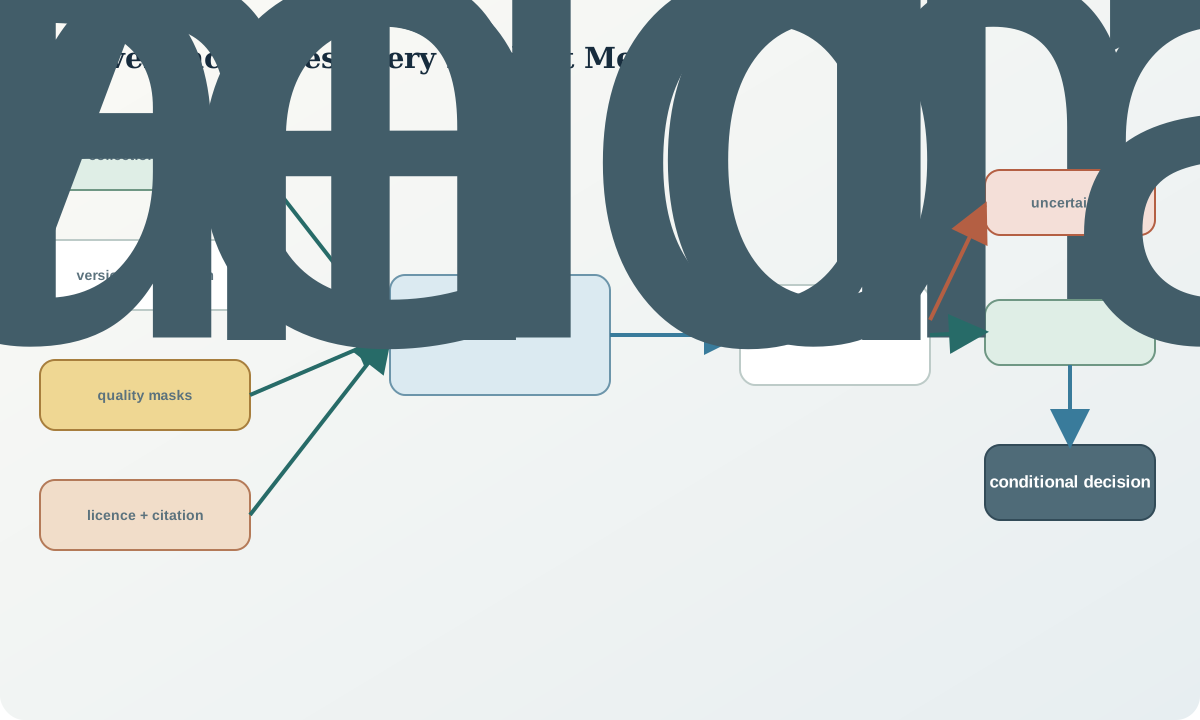
A provenance graph has entities, activities and roles. Source granules and masks are entities; calibration, masking, reprojection and classification are activities; an operator role or automated agent may be recorded without making a person owner of the curriculum. Each output links to its inputs and parameter record.
Store code version, environment lock, algorithm equations, configuration, random seed, grid definition, auxiliary inputs and execution logs. Use content hashes to detect file change. Prefer immutable object paths or versioned manifests. A notebook without frozen inputs and outputs is an incomplete record.
Provenance must cover manual edits. Preserve original polygons or labels, edited versions, editor role, timestamp, reason and affected support. Screenshots and email descriptions do not replace a machine-readable edit ledger.
Packaging, review and lifecycle.
An interpretation package should contain a source inventory, licence ledger, checksums, raw metadata, quality masks, transformation manifest, derived rasters, uncertainty, validation observations, map styles, citations and a human-readable decision report. Separate archive data from caches and thumbnails.
Validate paths, hashes, coordinate references, units, band order, no-data and mask counts automatically. Run a clean-environment rebuild and compare principal outputs within declared tolerances. Inspect representative imagery visually for clipping, seams, missing tiles and label errors.
Plan for supersession. Record product alerts and version checks, but do not silently update a released result. A new source version creates a new analysis release with a difference report. Retain enough metadata to explain why two releases differ.
Worked synthetic example
A synthetic analysis uses three scenes from Collection 1 and one from a newer Collection 2. Filenames look similar, but scale, offset, geometric control and quality-bit definitions differ. Applying the Collection 1 scaling to all assets shifts reflectance and creates a false temporal break. Reusing the old cloud-bit decoder marks some cloudy pixels clear.
The provenance audit finds mixed versions before interpretation. The scenes are reprocessed under one compatible collection, with source identifiers, checksums, scale/offset and decoder version recorded. The apparent break disappears. This is a product-lineage correction, not evidence that the landscape reversed.
Interpretation and decision. Product metadata is evidence about measurement meaning. If provenance is incomplete, narrow or suspend the claim. A reviewer should be able to identify every source observation and reproduce every derivative without depending on a branded interface or a private individual's memory.
Practice and audit checklist
Build a manifest for a synthetic four-scene analysis with mixed processing levels, one superseded item, bit-packed quality and a restrictive asset licence. Detect incompatibilities, define the permitted release and draw a provenance graph. Rebuild the final index from an empty output directory and verify hashes, masks and grid.
Audit questions: Are collection and item versions explicit? Are acquisition and production times separate? Are scale, offset and units correct? Is the quality decoder versioned? Were alerts and known issues checked? Are licences compatible with release? Are manual edits traceable? Does structured metadata avoid assigning a company or person as tutorial owner?
Sources
- Earth observation metadata and processing levels, defines collection metadata, identifiers, versions, processing levels and citation fields.
- Sentinel-2 product specification, provides a detailed official example of identifiers, metadata, quality masks and processing baselines.
- Collection 2 quality-assessment band specification, documents version-specific packed quality fields.
- SpatioTemporal Asset Catalog standard, standardises searchable collection, item and asset metadata.