E5 · Publication Volume 27
Geological Visual Grammar
observation and interpretation levels, line styles and patterns
Learning objectives
- Explain the analytical and evidence boundary for observation and interpretation levels, line styles and patterns.
- Translate the geological task into explicit entities, visual channels and state transitions.
- Test correctness, reading error, uncertainty communication and accessibility with ordinary and adversarial fixtures.
- Produce a geological visual-grammar registry with observation and interpretation tests from synthetic evidence and defend every transformation.
The lesson is complete only when the learner can identify the visual claim, reproduce the inspected state, cite the governing evidence, explain uncertainty and show that an equivalent core task remains possible through the required fallback. A polished screenshot without state, source and evaluation evidence remains unverified.
This lesson is general and institution-neutral. It uses no real company, individual, property, project or identifiable place. Generic roles such as evidence custodian, visualisation designer, domain reviewer and release reviewer describe responsibilities without implying affiliation.
Analytical decision
Decide which statements are direct observations, derived measurements, interpretations, alternatives or unknowns before assigning marks. A crisp solid boundary can be read as located and certain even when it is projected through cover. A filled body can be read as a measured extent even when it is a model scenario. The visual grammar must preserve epistemic level, spatial support and status across plan, section, three-dimensional and tabular views.
Write the intended conclusion and the evidence required to support or refuse it before choosing layout or interaction. Identify a comparison baseline and the cost of a false positive, false negative and unresolved result. A design requirement is testable only when an observer, input, state, expected output and pass condition are named.
Record non-goals as carefully as goals. A view intended for evidence inspection does not automatically support editing, publication or operational control. Restricting scope prevents an apparently convenient interface from acquiring authority that its evidence and validation do not support.
Scientific content
A visual grammar is a governed mapping from geological semantics to marks and channels. Identity may use hue or pattern, status may use line form, confidence may use boundary treatment, and selection may use a temporary halo, but these channels must not collide. Redundant encoding lets meaning survive monochrome output, colour-vision differences and partial occlusion. Legends are part of the grammar and must show ordinary, selected, uncertain, absent and unknown states rather than only ideal categories.
Distinguish data semantics from portrayal semantics. A geological object retains identity, geometry, support, status and lineage even when invisible; a mark has position, form, colour, texture, opacity and interaction state only within a view. The mapping between them is versioned and may be many-to-one through aggregation or one-to-many through multiple representations.
Perception is part of the measurement system. Position, length, area, angle, colour and depth are decoded with different accuracy and are affected by context. Use the most accurately read channel compatible with the task, reserve emphasis, and verify that a reader sees the intended ordering and distinctions rather than relying on the designer’s familiarity.
View and interaction model
Store every symbol rule with semantic predicate, applicable geometry, scale interval, visual channels, priority, interaction states, fallback representation and version. Separate persistent domain style from transient interface state: selection, hover, focus and validation findings must never rewrite geological status. A grammar linter detects two meanings assigned the same channel, rules with overlapping predicates, invisible states, missing legend entries and styles that disappear at delivery scale.
Separate source data, semantic model, analytical transformation, portrayal specification, interaction state and rendered output. Each boundary has an input contract, deterministic operation, structured diagnostics and output fingerprint. Rendering never becomes the authoritative store for values or identities, and interface defaults never fill missing scientific metadata.
The state model supports a clean initial state, deep link, save, restore, undo, reset, comparison and static export. Derived state is recalculated from canonical inputs. Concurrency or delayed loading cannot change selection membership, filter meaning or scenario identity; if required content is unavailable, the view exposes a pending or failed state with retained context.
Visual invariants and constraints
| Invariant | Required evidence | Failure behaviour | | --- | --- | --- | | Semantic identity survives every view and state | Stable object identifiers and version | Block linkage or label the object unresolved | | Visual encoding matches the declared quantity and support | Field definition, units, support and style rule | Remove the encoding until the contract is repaired | | Observation, interpretation, alternative and unknown remain distinct | Epistemic status and legend test | Preserve the states and issue a visible conflict | | Filtering, selection, camera and scenario state are inspectable | Serialised state and population counts | Do not publish an unexplained view | | The chapter artefact remains reproducible | Inputs, transforms, parameters, tests and fingerprints for a geological visual-grammar registry with observation and interpretation tests | Quarantine the derivative without replacing its sources |
Test invariants at import, transform, state transition, render, export and replay. A pixel snapshot can detect accidental layout change but cannot prove identity, quantity, membership or accessibility. Combine semantic assertions, numerical comparisons, task results, structural inspection and selected image comparisons. Every failure reports object, state, rule, observed result and expected condition.
Hard failures block only affected conclusions or derivatives and never suppress valid source evidence. Warnings state consequence and review path. Informational findings are not styled like errors. Severity follows scientific and decision consequence, not implementation convenience or the visual prominence of the affected mark.
Quantitative evaluation
Measure symbol discriminability with forced-choice tasks under normal colour, simulated colour-vision difference, greyscale and reduced size. If m symbol pairs are tested and c are confused, pair-confusion rate is R_c=c/m. Report it by epistemic level because confusing “observed” with “interpreted” is more consequential than confusing two low-priority background units. Also test minimum stroke visibility, pattern frequency, label collision and legend lookup time at each target scale.
Every reported measure includes population, support, unit, exclusions, aggregation, uncertainty where available, evaluation state and version. Stratify results when averaging can hide a consequential subgroup, device mode, scale, scenario or evidence class. A faster interface is not better when it increases wrong confident answers or hides unresolved evidence.
Define the reference answer and allowable tolerance before testing. Where expert interpretation is non-unique, score evidence retrieval, assumption disclosure, alternative comparison and appropriate unresolved behaviour instead of pretending that one geometry is the only correct answer. Preserve raw observations beside aggregate scores so review can diagnose why a task failed.
Evidence and uncertainty
Separate uncertainty in acquisition, location, classification, transformation, interpretation, model choice and visual reading. A thicker boundary, translucent surface or broad envelope is not self-explanatory. The view and its evidence card identify which quantity is uncertain, the spatial or temporal support, the construction method, calibration scope where one exists and the consequence for the current decision.
Preserve received objects, accepted semantic views, analytical derivatives and delivery artefacts as distinct versions. A rendered mark references the exact derivative and can be traced to inputs and activities. Contradictory evidence remains selectable. Missing or invalid metadata produces an unknown, conflict or blocked status; it does not trigger a guessed colour, coordinate, category or confidence.
Evidence completeness and visual clarity are evaluated separately. Removing a difficult record may make a view cleaner while making the scientific conclusion weaker. Every filter reports eligible, visible, selected, excluded and unresolved counts, with reasons. Aggregation retains links to members and exposes when a minority class or narrow feature disappears at the chosen scale.
Interaction, state and interoperability
Interaction is a typed transformation of analytical state. Selection identifies objects; filtering changes eligibility; focus directs attention; camera and clipping change projection; scenario changes an interpretation bundle; editing creates a new domain version. Controls name the state they change and show the result. Consequential changes enter history with prior and resulting fingerprints and can be undone or replayed.
Views exchange stable semantic identifiers, declared ranges and state events, never screen positions or colours as identity. When an object has no representation in a receiving view, the view reports it as unavailable rather than silently dropping it. Counts and evidence cards allow a reviewer to reconcile the same selection across plan, section, three-dimensional, log and table representations.
A saved analytical state contains dataset versions, transforms, classification and style versions, filters, selection, scenario, camera, clipping, layout and unresolved findings. A static representation serialises that state and supplies ordered figures, legends, summaries and evidence tables. It must preserve the claim and support even though exploratory gestures are no longer available.
Accessibility and responsive fallback
Every consequential state and control has a programmatic name, role, value and status, preferably through native structured elements. Keyboard order follows the analytical sequence; focus is visible and not hidden by overlays. Pointer and touch targets have a non-drag alternative. Colour, spatial position, hover and animation are never the sole carriers of identity, warning or uncertainty.
Complex graphics provide a concise purpose and conclusion, a detailed description of relationships, and access to the underlying structured evidence. State changes announce only information needed to continue the task. Dense scenes offer search, grouping and list navigation rather than thousands of meaningless focus stops. User zoom and text spacing do not remove controls or evidence.
Responsive layouts preserve reading and focus order, shared state, counts, legends and source access. At narrow widths, views may stack or use explicit tabs, but hidden panels remain discoverable and their selected-object counts remain visible. The static fallback records current state and limitations and is verified against the same task-and-evidence assertions as the interactive version.
Governance and review
Assign responsibilities to generic roles: evidence custodian preserves received material; domain reviewer defines geological meaning and consequence; visualisation designer implements portrayal and state; accessibility reviewer tests cross-mode access; independent validator challenges claims; release reviewer accepts, blocks or scopes publication. No role can erase contradictory evidence or approve its own unresolved hard failure without recorded review.
A portrayal change is versioned when it can alter interpretation: field choice, transform, aggregation, class breaks, palette, line grammar, projection, exaggeration, smoothing, camera default, clipping, opacity, filter, label priority or fallback. Regression fixtures compare expected membership, geometry, values, reading tasks and accessibility semantics, not only image pixels.
Exceptions state scope, rationale, evidence, risk, approving role, affected versions and review trigger. They do not turn unknown into known or a failed task into success by relabelling. The website hosting this lesson has no ownership or scientific-authority role; it only delivers the tutorial and is not part of the scientific evidence chain.
Integration checkpoint
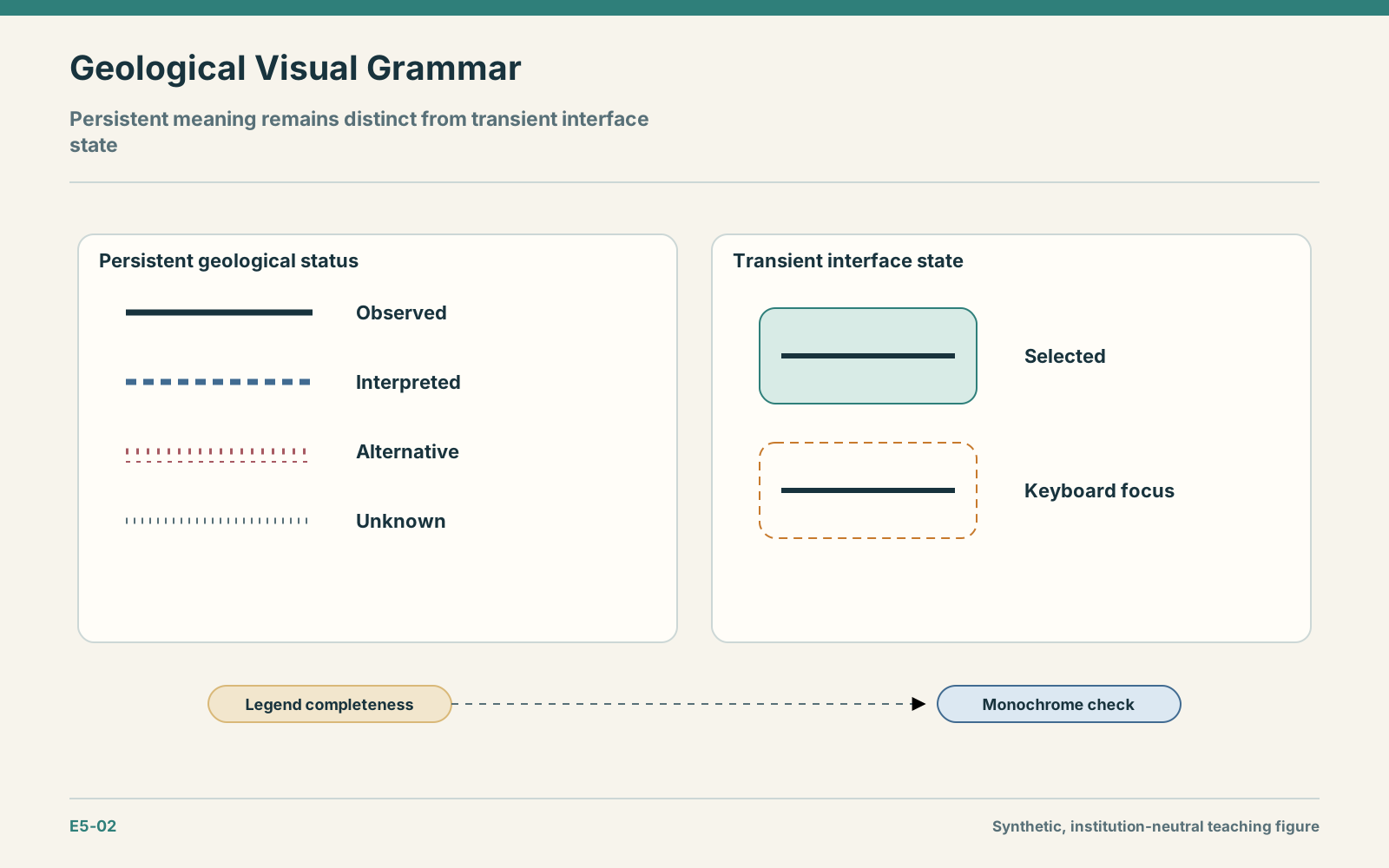
Read the diagram as a reasoning map for observation and interpretation levels, line styles and patterns. Solid relationships are required data or state transitions; checks expose assumptions and failure paths; the evidence card and static path keep the result reviewable outside the interactive scene. No element represents a particular product, company, person or named site.
Integrate a geological visual-grammar registry with observation and interpretation tests into the cumulative SYN-VIS workbench. Re-run earlier task, identity, legend, state and fallback fixtures. Record which assumptions changed, which views consume the new state and whether any previously accepted conclusion must be superseded.
Synthetic worked example
SYN-VIS-02 contains mapped contacts, inferred continuations, alternative fault traces and areas with no exposure. An initial style uses the same solid stroke for all four states and distinguishes them only with similar colours. The revised registry assigns persistent line forms and restrained redundant patterns, while selection uses a separate outline. A monochrome export and a keyboard-focused state preserve every status. The audit records one unresolved overlap rule rather than silently selecting the later rule.
- Preserve the received evidence and state the target decision without choosing a visual form.
- Resolve identity, quantity, support, status, eligible population and uncertainty source.
- Apply the versioned transform, portrayal and state transition while retaining diagnostics.
- Test the answer, cited evidence and fallback; then issue accept, block or unresolved with reasons.
Practice and assessment
Build a geological visual-grammar registry with observation and interpretation tests against SYN-VIS-02. Preserve the received package. Create one ordinary fixture, one boundary fixture, one deliberately misleading portrayal, one accessibility stress case and one unresolved-evidence case. Submit the task model, semantic and visual contracts, serialised state, interactive or inspectable artefact, static fallback, measured results and release decision.
Acceptance criteria:
- The intended geological decision, eligible evidence and consequence of error are explicit.
- Every visible quantity has identity, support, unit, status, transform and version.
- Observation, interpretation, alternative, missing and unknown states remain distinguishable.
- Selection, filters, camera, clipping, scenario and hidden evidence can be inspected and replayed.
- The same core answer and evidence citation are reachable by required input modes and static fallback.
- All blocking failures remain visible and machine-readable; no source evidence is overwritten.
Run a structured review in which a second reviewer receives only the submitted package. The reviewer must reproduce the target state, answer the task, cite the same evidence objects, identify the main limitation and explain any unresolved result. Record discrepancies as findings against the earliest responsible layer and supersede, rather than overwrite, corrected artefacts.
Common failure modes
- Using line colour alone to distinguish observation from interpretation.
- Letting hover or selection overwrite the persistent geological state.
- Publishing a legend that omits unknown and alternative states.
- Allowing symbol rules to depend on file order rather than explicit priority.
- Testing symbols only on a large colour display.
These failures substitute appearance or convenience for evidence. Diagnose the earliest boundary where the unsupported assumption entered, restore the source statement and intended task, make transformation and state explicit, run dependent fixtures and supersede the affected derivative. A warning written after the image is not a repair when the visual claim remains dominant.
Sources and further reading
- OGC Symbology Encoding, defining a vendor-neutral model for symbolisers, rules, scales and graphical portrayal.
- FGDC Digital Cartographic Standard for Geologic Map Symbolization, documenting a systematic geological-map symbol vocabulary and its intended meanings.
- Graphical Perception, DOI 10.1080/01621459.1984.10478080, an experimental foundation for judging how accurately viewers decode graphical quantities.
- The Misuse of Colour in Science Communication, DOI 10.1038/s41467-020-19160-7, explaining perceptual non-uniformity, false gradients and accessibility risks in scientific colour maps.
- Web Content Accessibility Guidelines 2.2, providing testable criteria for perceivable, operable, understandable and robust web content.