B1 · Publication Volume 6
Carbonate and Chemical Sedimentary Systems
carbonate factories, platforms, evaporites and diagenesis
Learning objectives
After this lesson, you should be able to distinguish carbonate production from siliciclastic supply, describe carbonate components and depositional texture, recognise chemical precipitation and evaporite controls, reconstruct a paragenetic sequence, and explain how diagenesis can overprint original environmental evidence.
Start with a field problem
A core contains skeletal limestone, coated grains, laminated dolostone, an evaporite-bearing interval and later calcite veins. Porosity is high in one skeletal bed but absent in another. Which features formed at deposition, which formed during early alteration, and which reflect burial or later fluids?
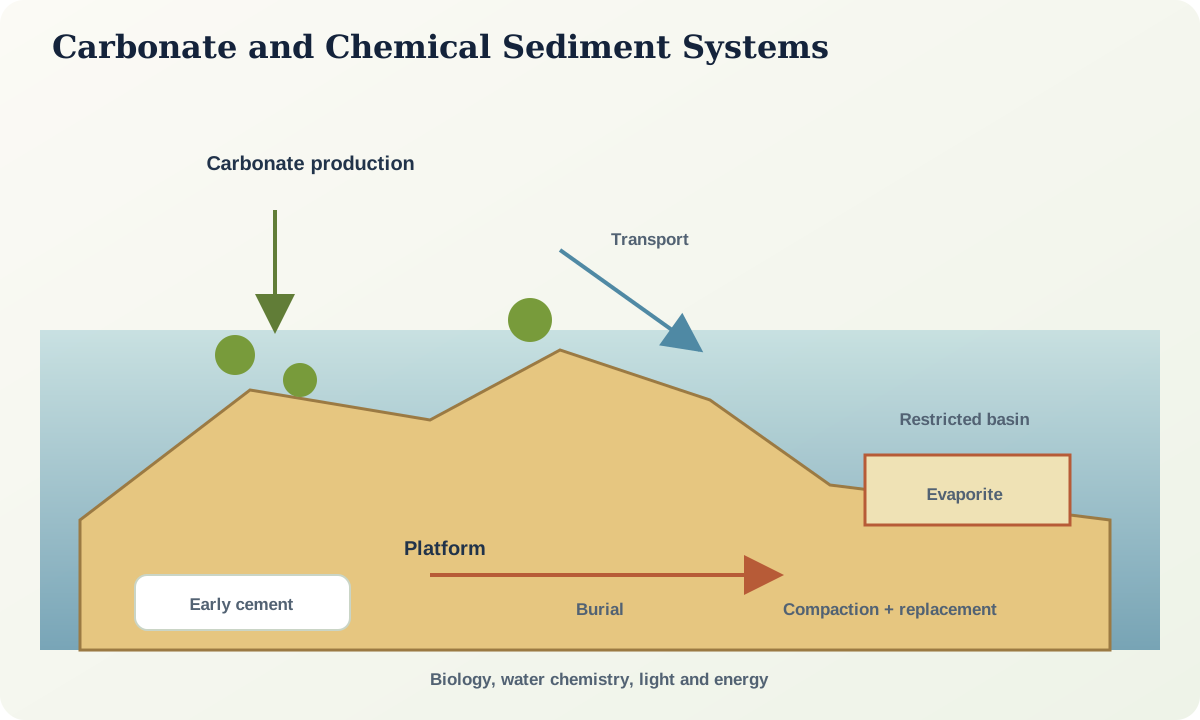
Carbonate sediment is commonly produced within or near the depositional basin by organisms, microbial processes, abrasion and chemical precipitation. Production can therefore increase where detrital input is low, but it depends on water chemistry, temperature, light, nutrients, energy, ecology and accommodation. Later dissolution, cementation, compaction and replacement can transform both texture and composition.
Core process model
Describe components before assigning a platform model. Components may include skeletal grains, peloids, ooids or other coated grains, intraclasts, lime mud, early cements and terrigenous material. State whether the fabric is mud-supported, grain-supported, bound during deposition, crystalline or strongly altered. A rock name should preserve what is observed rather than pretend that recrystallised texture is original.
Carbonate “factories” differ in dominant producers and controls. Shallow photic production, cool-water skeletal production and microbial precipitation can create different facies mosaics. Transport by waves, tides, storms and gravity redistributes locally produced sediment. Platform margins can shed coarse material into deeper water, so basinward fining is not guaranteed.
Chemical sediments form when water becomes supersaturated and precipitation or biological mediation removes solute. Evaporites require concentration and appropriate ion supply, but restricted circulation, repeated replenishment, brine reflux and later dissolution complicate a simple drying-basin story. Silica, iron-rich and phosphate deposits likewise require system-specific chemical and biological evidence.
Evidence and measurement
At hand-sample and thin-section scales, record components, support, matrix, cement generations, pore types, replacement fronts, stylolites, fractures and cross-cutting relationships. Use staining or analytical methods only with documented preparation and detection limits. Fossils may be broken, transported, bioeroded or replaced.
Construct a paragenetic sequence. A cement that lines grain surfaces predates one that fills remaining pores. A replacement that cuts an early cement is later. A vein that crosses compacted beds postdates much compaction. Relative order does not provide numerical age without independent dating.
Mass balance matters. Replacement requires sources and sinks for elements and fluid pathways. Apparent volume preservation may conceal dissolution and precipitation at different scales. Stable isotopes and trace elements can constrain fluids or temperatures, but alteration, mixing and mineral-specific fractionation must be evaluated.
Worked example
A grain-supported limestone has an early rim cement, compacted grain contacts, later blocky pore-filling cement and a fracture lined by a different carbonate. Primary interparticle pores were first partly stabilised, then reduced by compaction and late cement. A nearby porous interval lacks late cement but contains dissolution moulds.
One hypothesis invokes exposure-related dissolution followed by burial cementation. Another invokes burial fluids that dissolved unstable grains and precipitated cement unevenly. Test with cross-cutting relationships, cement chemistry, fluid inclusions, isotopes, exposure surfaces and spatial connection to faults or permeable beds.
For the evaporite-bearing interval, do not infer extreme aridity from mineral presence alone. Determine whether crystals are primary, displacive, replacive or reworked and whether dissolution collapse or pseudomorphs indicate later removal.
Misinterpretations and uncertainty
Limestone is not automatically shallow, warm or reefal. Carbonate mud can be produced by several mechanisms and transported downslope. Dolomite can form in multiple diagenetic settings. An evaporite mineral can be detrital or replacive. High porosity may be secondary and unrelated to depositional energy.
Core recovery can preferentially lose weak evaporites or vuggy intervals. Surface weathering can create porosity and oxidation not present at depth. Thin sections sample a very small area. Integrate scales before generalising.
Practical investigation
Create a component-and-fabric log for a supplied carbonate core. Separate depositional observations from diagenetic features. Draw a paragenetic sequence with at least two competing placements for one uncertain event. Then propose a platform or restricted-basin model and list the facies relation that would most strongly falsify it.
Mastery check
- Why can carbonate supply be local rather than catchment derived?
- What observations distinguish depositional texture from later crystalline fabric?
- Why is an evaporite mineral not sufficient evidence for one climate interpretation?
- How do cross-cutting cements constrain paragenesis?
- Give two ways diagenesis can reverse a simple porosity–energy relationship.
Sources and further reading
- Ocean chemistry and carbonate systems, National Oceanic and Atmospheric Administration.
- Carbonate-rock aquifers and dissolution, U.S. Geological Survey.