B1 · Publication Volume 6
Facies and Facies Associations
facies definition, lateral change, Walther’s Law and environmental interpretation
Learning objectives
After this lesson, you should be able to define facies from explicit observations, group facies into associations, use transitions and geometry to test interpretations, apply the vertical–lateral facies principle only under its conditions, and compare alternative depositional models.
Start with a field problem
An investigator labels beds “channel sandstone,” “levee siltstone” and “floodplain mudstone” during first description. The labels already contain the preferred environment. Later, cross-bedded sandstone is found to extend as a tabular sheet rather than a channel, and the supposed levee contains wave ripples. The initial vocabulary has made revision harder.
Facies should first be defined by observable attributes: lithology, grain size, texture, structures, fossils, colour state, bed geometry, contacts and fabric. “Cross-bedded medium sandstone with erosional base” can be reinterpreted. “River channel facies” hides the evidence inside the conclusion.
Core process model
A facies is a body of sediment or rock distinguished from adjacent bodies by a stated set of characteristics. The definition depends on purpose and scale. A core study may separate laminated and bioturbated mud; a regional map may group both within one mudstone unit. Codes are useful only when their definitions are controlled and changes are tracked.
A facies association is a recurring set of facies whose spatial and stratigraphic relations support a process or environmental model. Co-occurrence alone is insufficient. Contacts, transitions, geometry, palaeoflow and position within larger units provide the causal structure.
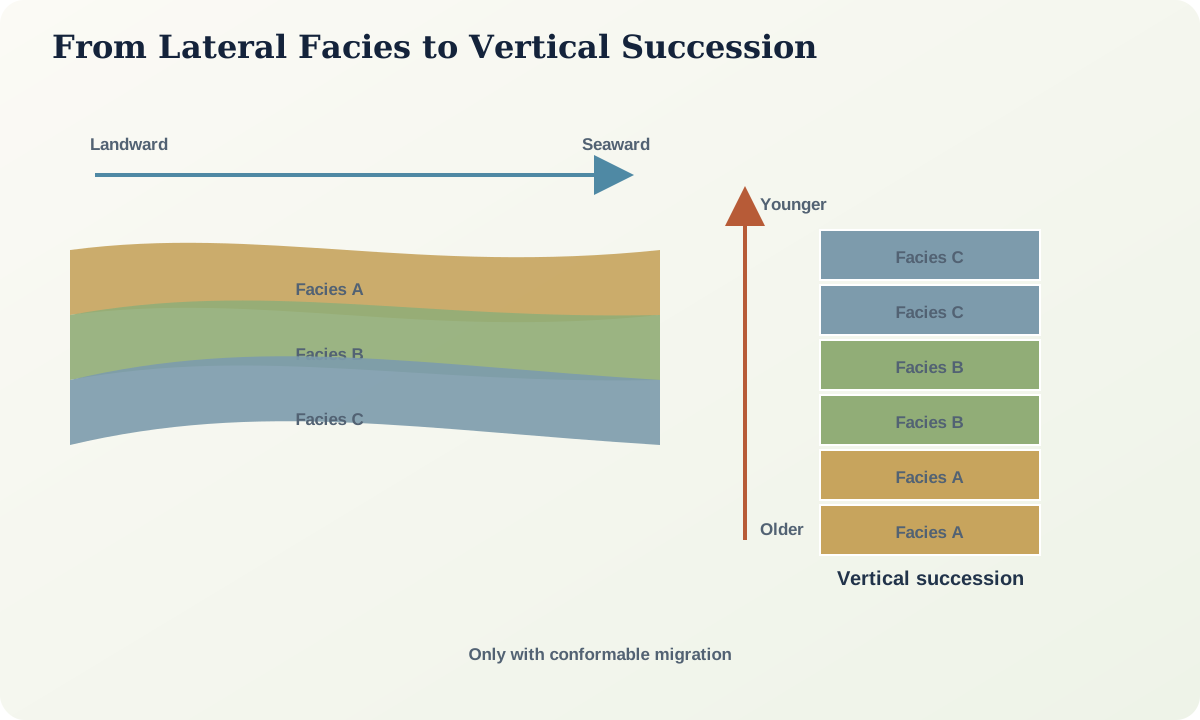
The vertical–lateral facies principle states that, in a conformable succession produced by migrating environments, vertically adjacent facies can reflect environments that were laterally adjacent. Conditions matter. An unconformity, fault, condensed interval, rapid source change or non-depositional gap can place facies together vertically that were not neighbours laterally.
Facies models are structured hypotheses. They compress recurring relations and predict unobserved geometry. They should never become checklists in which one feature forces one environment.
Evidence and measurement
Create a facies scheme iteratively. Begin with observations and enough categories to preserve meaningful differences. Test repeatability between observers. Merge categories only when the distinction does not affect the question; split them when internal variation predicts different processes.
Construct a transition table or graph showing which facies contact one another and through what boundary type. Separate gradational, sharp, erosional and unobserved contacts. Map thickness and geometry. Record whether transitions repeat at one scale or occur across several nested scales.
When using core, distinguish true absence from an interval not recovered. When using outcrop, mark covered sections. A transition frequency calculated without missingness can create a false preferred succession.
Worked example
Define four facies: F1 erosional cross-bedded sandstone, F2 ripple-laminated fine sandstone, F3 rooted massive mudstone and F4 laminated organic mudstone. F1 commonly fines into F2 and F3; F4 occurs laterally and above F2.
Model A interprets a migrating river channel, bar, floodplain and abandoned-channel lake. Model B interprets a distributary channel, mouth-bar fringe, exposed delta plain and interdistributary bay. Both explain fining-upward packages.
Discriminators include salinity-sensitive fossils or traces, bidirectional structures, regional shoreline position, channel-body geometry, palaeoflow dispersion, associated wave-reworked beds and evidence of marine flooding. Until those are available, the facies association supports a channel-to-low-energy transition but not a unique landscape.
Misinterpretations and uncertainty
Facies codes can imply precision that the data do not support. A photograph-based facies may omit hardness, grain-size tails or three-dimensional structures. Colour varies with lighting and weathering. Core and outcrop schemes may not be directly equivalent.
The most common conceptual error is circularity: define a facies by an environment, then use the facies to prove that environment. Another is scale leakage: use a centimetre structure to name a kilometre depositional system without intermediate architectural evidence.
Practical investigation
Given an unlabeled section, define no more than eight descriptive facies. Build a contact graph and identify two recurring associations. Interpret each association twice using different environments. For every interpretation, list one predicted lateral relation and one predicted but currently missing observation.
Mastery check
- Why should an initial facies name avoid environmental terms?
- What turns a facies list into a facies association?
- Under which conditions can lateral facies become a vertical succession?
- How does missing core affect transition analysis?
- Give an example of circular facies reasoning and rewrite it.
Sources and further reading
- International Stratigraphic Guide, International Commission on Stratigraphy.
- Geologic mapping standards and methods, U.S. Geological Survey.