B1 · Publication Volume 6
Stratigraphic Principles
superposition, correlation, hiatuses and unconformities
Learning objectives
After this lesson, you should be able to establish relative order, distinguish rock units from time units, recognise several kinds of stratigraphic gap, select correlation evidence, and express equivalence as a confidence-bearing hypothesis rather than a line drawn by appearance.
Start with a field problem
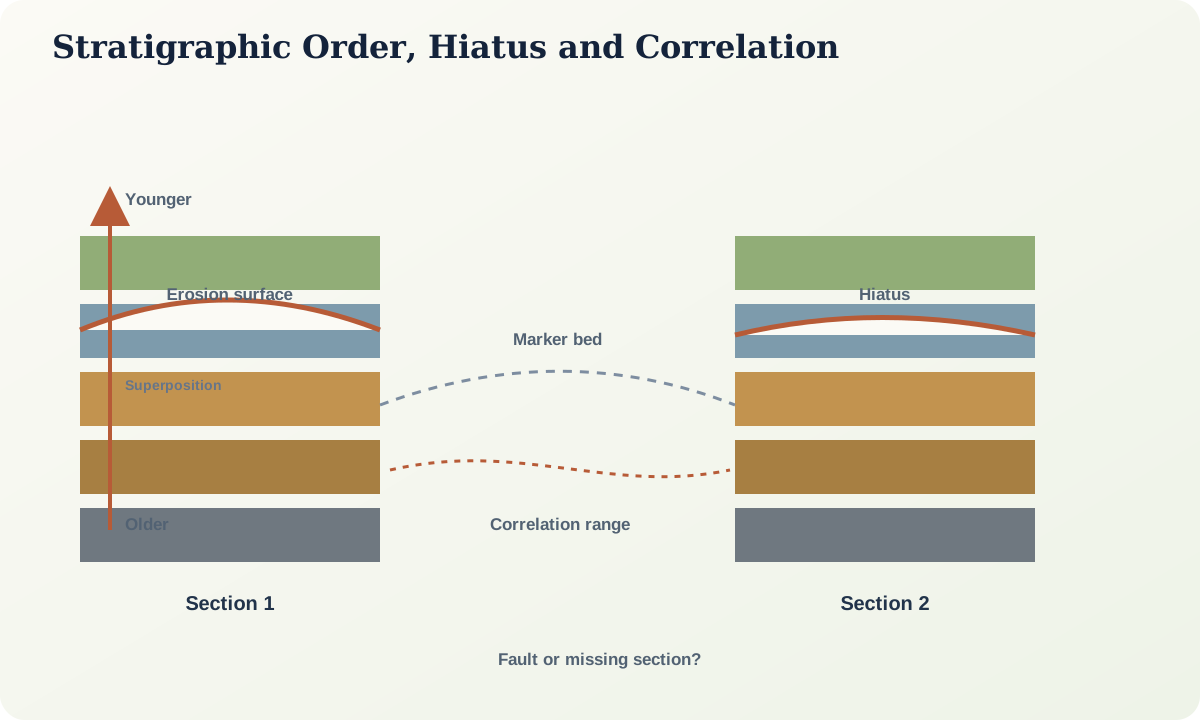
Two sections contain similar sandstone–mudstone packages. A volcanic ash occurs in one section but is covered in the other. An erosional surface truncates beds in the first section; the second contains a thin fossil-rich mud at a comparable level. Are the sandstones the same body, the same age, the same facies in different bodies, or merely similar?
Lithologic similarity is useful but non-unique. Depositional environments recur. A unit can change laterally from sand to mud while remaining approximately coeval, and two similar sandstones can differ greatly in age. Correlation must specify what is being correlated: lithology, a physical surface, fossil zone, polarity interval, chemical excursion or numerical age.
Core process model
In an undeformed sedimentary succession, superposition places younger beds above older beds. Original horizontality and lateral continuity are useful starting models, not absolute rules: dunes, reefs, channel margins and slopes form inclined or discontinuous deposits. Cross-cutting relationships and inclusions constrain relative order. Younging indicators are necessary where strata are overturned.
An unconformity is a surface representing erosion or non-deposition and separating younger from older rocks. Angular discordance is visually strong, but a parallel-bedded disconformity may contain a longer gap. A sedimentary unit deposited on eroded crystalline rock is another distinct relation. A hiatus is the missing time, not the surface itself. Its duration may vary laterally.
Lithostratigraphic units are defined by rock properties and mappability; chronostratigraphic units represent bodies formed during intervals of geological time. Biostratigraphy, magnetostratigraphy, chemostratigraphy and numerical dating add independent correlation dimensions, each with resolution and reworking limits.
Evidence and measurement
Measure section location, datum, bed thickness, contact type, facing, structure, fossil position and sampling support. Distinguish true thickness from apparent thickness. Correct structural dip where appropriate. Record covered intervals rather than interpolating through them.
A marker should be distinctive, laterally traceable and appropriately close to synchronous for the question. A volcanic ash may be an excellent marker, but reworking can move grains upward. A fossil first or last occurrence can be controlled by ecology, preservation or sampling. A chemical excursion can be diagenetically modified. Use independent markers and retain conflict.
Represent a correlation as a graph: section intervals are nodes; proposed equivalences are edges with evidence, uncertainty and alternatives. Do not force every unit to continue across the panel. Pinch-out, erosion, non-deposition and facies change are valid outcomes.
Worked example
Section 1 contains ash A at 42 m with a numerical age and an erosional surface at 55 m. Section 2 lacks visible ash but contains a narrow geochemical anomaly at 38 m and a fossil turnover above it. A sandstone above the surface in Section 1 resembles one at 46 m in Section 2.
Hypothesis 1 correlates the anomaly with altered ash A and the sandstones as one post-surface body. Hypothesis 2 treats the anomaly as unrelated and the sandstone similarity as facies recurrence. Test mineralogy and age of the anomalous interval, trace the surface laterally, compare palaeoflow and provenance, and quantify age-depth constraints.
Until the test is complete, draw the ash correlation as probable and the sandstone correlation as possible. The panel should show uncertainty rather than conceal it behind a solid line.
Misinterpretations and uncertainty
Thickness is not time. A thin condensed interval can represent more time than a thick event deposit. A missing unit can mean erosion, non-deposition, structural omission, poor recovery or an incorrect correlation. “Same elevation” is not “same stratigraphic level” in deformed terrain.
Numerical ages have analytical uncertainty and geological meaning. The dated phase may precede deposition or record later alteration. Rounding ages can reverse apparent order when uncertainties overlap. Use the current time scale version and record revisions.
Practical investigation
Correlate three supplied sections using no more than six surfaces. For each edge, assign observed, probable, possible or rejected status and list the evidence. Create an alternative panel with at least one different pinch-out or unconformity interpretation. State which sample or observation would change the largest number of correlations.
Mastery check
- Why is a hiatus not identical to an unconformity surface?
- Distinguish lithostratigraphic from chronostratigraphic correlation.
- How can similar sandstone units be demonstrably different in age?
- Why might an ash layer fail as an instantaneous marker?
- List five explanations for a unit missing from one section.
Sources and further reading
- International Stratigraphic Guide, International Commission on Stratigraphy.
- International Chronostratigraphic Chart, International Commission on Stratigraphy.