B3 · Publication Volume 8
Stress, Strain and Deformation Mechanisms
stress-tensor intuition, strain, and elastic, brittle and ductile behaviour
Learning objectives
After this lesson, you should be able to distinguish force, traction, stress, displacement and strain; resolve normal and shear traction on a plane; separate mean and deviatoric stress conceptually; compare elastic, brittle, frictional and crystal-plastic responses; and explain why temperature, pressure, fluid pressure, strain rate, grain size and mineralogy can change the mechanism recorded by a rock.
Start with a field problem
A steep fracture zone cuts competent sandstone and continues downward into foliated schist. In the sandstone it contains angular fragments and open veins. In the schist it broadens into a zone of dynamically recrystallised grains and smoothly curved foliation. Is this one structure formed under changing conditions, two structures joined by later reactivation, or a misleading exposure?
“The rock was under compression” is not enough. Compression can be hydrostatic or differential, normal to one plane and oblique to another. The same regional loading can drive extension on one orientation, shear on another and ductile flow in a hot or weak layer. The observed products also integrate a path: fracture, slip, healing, burial, warming and renewed deformation may all occur on the same inherited zone.
Begin by recording contacts, widths, orientations, offsets, clast shapes, veins, grain-size gradients and the relation between fault rock and foliation. Then ask which parts constrain geometry, displacement, deformation mechanism and timing. Stress is inferred through a model; strain and microstructure are observed or measured more directly.
Core process model
Stress is force per unit area in the limit of a small surface. At a point it is represented by a second-order tensor. For a unit normal vector \mathbf{n}, the traction on that plane is
\mathbf{t}(\mathbf{n})=\boldsymbol{\sigma}\mathbf{n}.
The normal component is \sigma_n=\mathbf{n}\cdot\mathbf{t} and the shear vector is \boldsymbol{\tau}=\mathbf{t}-\sigma_n\mathbf{n}. A single stress tensor therefore produces different normal and shear tractions on differently oriented planes. Principal directions are orientations on which shear traction is zero. The mean stress changes volume and pore space; the deviatoric part drives distortion, although natural constitutive behaviour couples them.
Strain describes relative displacement. For small deformation, normal strain measures fractional length change and shear strain measures angular change. Finite deformation needs a deformation gradient and cannot always be reconstructed by adding small strains without regard to order. Rigid translation and rigid rotation change position or orientation but are not strain.
Elastic strain is recoverable when load is removed within the applicable range. Brittle fracture creates or propagates discontinuities. Frictional sliding localises displacement on existing surfaces. Cataclastic flow combines grain fracture, rotation and sliding. Pressure solution transfers material along chemical-potential gradients. Dislocation creep, diffusion creep and grain-boundary sliding accommodate crystal-plastic or viscous deformation. Several mechanisms can operate together, and the preserved microstructure may record the slowest-to-erase stage rather than the stage with greatest displacement.
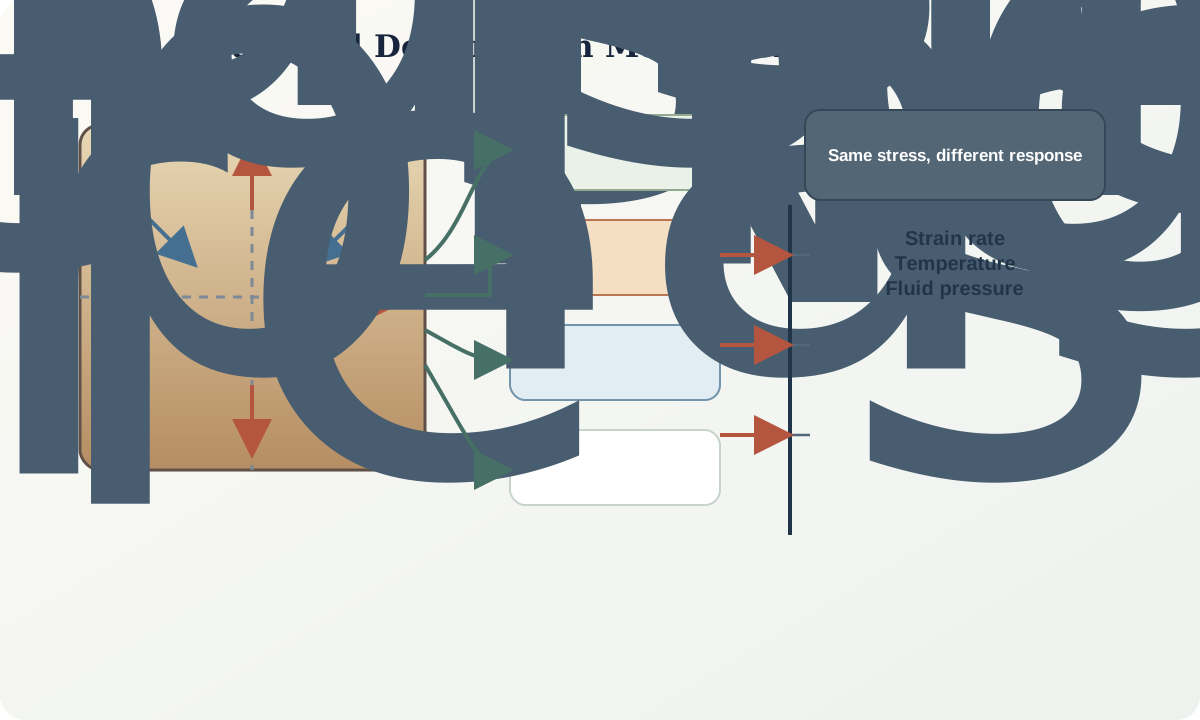
Confining pressure suppresses opening and promotes distributed deformation; temperature generally accelerates thermally activated processes; fluid pressure lowers effective normal stress on connected pores and fractures; strain rate changes the time available for creep and reaction; grain size changes diffusion and boundary contributions; and mineralogy controls strength, anisotropy and reaction. “Brittle–ductile transition” is therefore not one universal depth.
Evidence and measurement
At outcrop scale, measure fracture spacing, fault-zone width, offset markers, vein aperture, fold wavelength, foliation intensity and gradients across the zone. At hand-specimen and thin-section scale, document fractured grains, comminuted matrix, undulose extinction, subgrains, new grains, twins, pressure shadows, dissolved seams, mineral fibres and cross-cutting relations. Report orientation and viewing direction for every kinematic image.
Grain shape alone is ambiguous. Elongate grains may be detrital, igneous, metamorphic or deformed. A fine matrix may reflect cataclasis, reaction, alteration or primary grain size. Dynamic recrystallisation criteria depend on mineral, temperature, water activity and subsequent annealing. Connect microstructures to mapped gradients and mineral chemistry rather than assigning a mechanism from one photomicrograph.
Laboratory strength, friction or flow laws are boundary-condition-specific. Record rock type, porosity, saturation, confining pressure, temperature, loading path, strain rate, sample orientation and scale before comparing them with nature. Extrapolation across orders of magnitude in time or length is a model with uncertainty, not a direct measurement.
Worked example
Consider the two-dimensional compressive stress tensor, in megapascals,
\boldsymbol{\sigma}=
\begin{bmatrix}
100 & 30\\
30 & 60
\end{bmatrix}.
For a plane whose unit normal is \mathbf{n}=(0.707,0.707), the traction is approximately
\mathbf{t}=(91.9,63.6)\ \text{MPa}.
The normal stress is \sigma_n=\mathbf{n}\cdot\mathbf{t}=110 MPa. Subtracting \sigma_n\mathbf{n} leaves a shear vector with magnitude about 20 MPa. This calculation shows why a tensor component is not automatically the stress acting on a mapped fracture.
If connected fluid pressure is 70 MPa, a simple effective-normal-stress approximation gives \sigma'_n=40 MPa. A frictional model with cohesion c=5 MPa and coefficient \mu=0.6 predicts a shear resistance
\tau_f=c+\mu\sigma'_n=5+0.6(40)=29\ \text{MPa}.
The calculated shear traction of 20 MPa is below that threshold for the declared model. Raising fluid pressure, lowering cohesion, rotating the plane or changing the stress tensor may change the result. The calculation does not prove that the plane is inactive: roughness, scale, transient pressure, chemical weakening and dynamic effects have been simplified.
Misinterpretations and uncertainty
Do not draw stress arrows directly from a fold or fault without testing alternative stress histories. Structures can rotate after formation, inherit earlier anisotropy, form during non-coaxial flow or reactivate under a later stress field. Present-day stress measurements need not equal palaeostress during formation.
Do not equate ductile with deep, brittle with shallow, or cataclasite with one slip rate. The response depends on effective pressure, temperature, mineralogy, fluids, grain size and rate. Brittle increments can occur within a broader ductile zone, and ductile creep can occur near fractures. “Competent” and “incompetent” are comparative, scale-dependent descriptions rather than intrinsic constants.
Stress magnitude is usually less constrained than geometry. Inversions from fault-slip or earthquake data depend on assumptions about uniform stress, slip direction and fault interaction. Report which quantities are measured, which are calculated and which are assumed.
Practical investigation
Draw a square stress element and choose three planes with normals at 0°, 30° and 60°. For a symmetric 2D stress tensor, calculate traction, normal stress and shear stress on each plane. Plot the results on a normal-stress versus shear-stress graph and check them against a circle construction. Repeat after subtracting two different pore-fluid pressures from normal stress.
Then examine an outcrop, core image or supplied thin-section set at three scales. Make separate tables for observations, mechanism hypotheses and tests. Require at least two observations before assigning a mechanism, and include one process that could erase or mimic each diagnostic texture.
Mastery check
- Why is stress on a plane not described by one regional arrow?
- Which parts of displacement are removed when calculating strain?
- How does fluid pressure affect a simple frictional failure calculation?
- Why is the brittle–ductile transition not a fixed depth?
- Which observations would distinguish cataclastic grain-size reduction from primary fine grain size?
Sources and further reading
- Theory of rupture and flow in solids, Griffith, 1921.
- Friction of rocks, Byerlee, 1978.
- Fault rocks and fault mechanisms, Sibson, 1977.